
Matthew 26 is the longest chapter in the gospel and the chapter where the cross-narrative actually begins. After the discourses of chapters 23 to 25 are complete, the chapter records the fifth narrative-closing-formula of the gospel (when Jesus had finished all these words) and pivots into the passion. The chapter contains the woman who anoints Jesus at Bethany, Judas’s arrangement with the chief priests, the Last Supper, Gethsemane, the arrest, the trial before Caiaphas, and Peter’s three denials. The chapter is recording, in dense narrative succession, the cross’s historical and theological prelude.
The chapter has four movements. The first (verses 1 to 16) frames the cross’s coming: the chief priests’ plot, the woman’s anointing at Bethany, and Judas’s bargain. The second (verses 17 to 30) is the Last Supper: the Passover preparation, the betrayal-prediction at the table, the institution of the bread and the cup. The third (verses 31 to 56) is Gethsemane and the arrest: the prediction of the disciples’ scattering, the agony in the garden, the arrival of Judas with the armed crowd, the brief sword-incident, and Jesus’s surrender. The fourth (verses 57 to 75) is the trial before the Sanhedrin and Peter’s denials: the night-trial, the I am of Jesus, the verdict of blasphemy, and Peter’s three-fold denial as the rooster crows.
Beneath the chapter’s surface flow is the gospel’s most concentrated single demonstration of the kingdom’s deepest claim: the king reigns through the cross. The anointing at Bethany prefigures the burial; the Last Supper reframes the Passover around Jesus’s body and blood; Gethsemane records the cost in the king’s own voice; the arrest demonstrates the king’s voluntary surrender; the trial reveals the religious establishment’s actual judgment about the kingdom’s representative; Peter’s denial demonstrates that even the closest disciple cannot maintain his confession when the cost arrives. The chapter is recording, with characteristic narrative restraint, the entire architecture of the cross’s coming.
A · Matthew 26:1–16 · The plot, the anointing, and the bargain
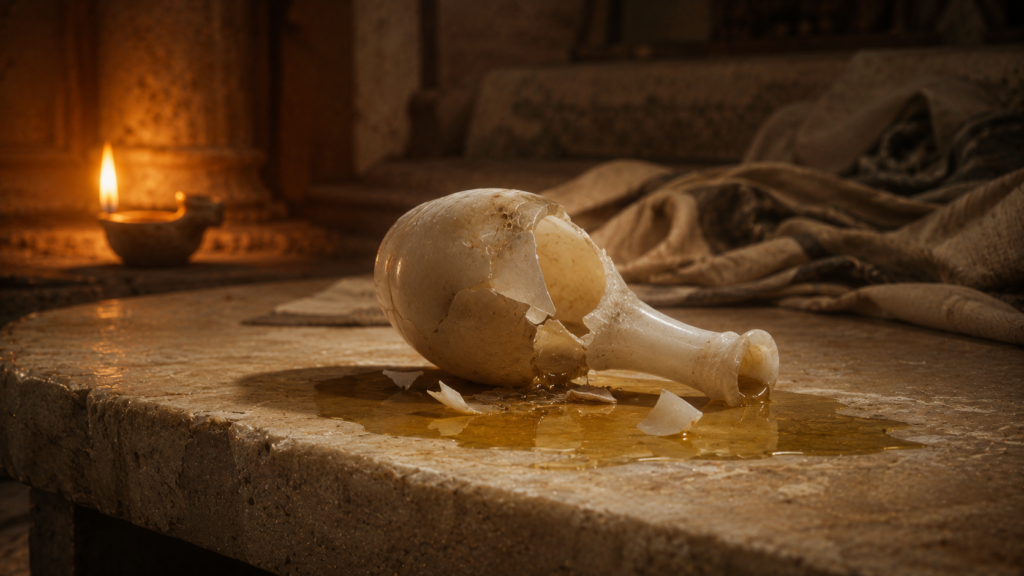
¹ When Jesus had finished all these words, he said to his disciples, ² “You know that after two days the Passover is coming, and the Son of Man will be delivered up to be crucified.” ³ Then the chief priests, the scribes, and the elders of the people were gathered together in the court of the high priest, who was called Caiaphas. ⁴ They took counsel together that they might take Jesus by deceit, and kill him. ⁵ But they said, “Not during the feast, lest a riot occur among the people.” ⁶ Now when Jesus was in Bethany, in the house of Simon the leper, ⁷ a woman came to him having an alabaster jar of very expensive ointment, and she poured it on his head as he sat at the table. ⁸ But when his disciples saw this, they were indignant, saying, “Why this waste? ⁹ For this ointment might have been sold for much, and given to the poor.” ¹⁰ However, knowing this, Jesus said to them, “Why do you trouble the woman? She has done a good work for me. ¹¹ For you always have the poor with you; but you don’t always have me. ¹² For in pouring this ointment on my body, she did it to prepare me for burial. ¹³ Most certainly I tell you, wherever this Good News is preached in the whole world, what this woman has done will also be spoken of as a memorial of her.” ¹⁴ Then one of the twelve, who was called Judas Iscariot, went to the chief priests, ¹⁵ and said, “What are you willing to give me, that I should deliver him to you?” They weighed out for him thirty pieces of silver. ¹⁶ From that time he sought opportunity to betray him. (Matthew 26:1–16, World English Bible)
- When Jesus had finished all these words (verse 1). The Greek hote etelesen pantas tous logous toutous, “when he had finished all these words,” is the fifth and final closing-formula in Matthew (after 7:28; 11:1; 13:53; 19:1). The chapter is recording, with characteristic narrative-structural precision, that the gospel’s five teaching-discourses are complete. The five discourses (Sermon on the Mount, Missionary, Parables, Community, Olivet) form a deliberate five-block structure that has been read by some interpreters as Matthew’s new Pentateuch: five books of teaching from the new Moses, paralleling the five books of the original Pentateuch.
- The Son of Man will be delivered up to be crucified (verse 2). The Greek paradidotai eis to staurothenai, “is delivered up to be crucified,” is the fourth and final passion-prediction of the gospel (after 16:21, 17:22-23, 20:18-19). The chapter is recording, with characteristic narrative-prophetic precision, the most specific prediction yet: after two days, on the Passover, by crucifixion. The disciples have now been told four times.
- They might take Jesus by deceit, and kill him. But they said, “Not during the feast, lest a riot occur among the people” (verses 4 to 5). The Greek records the chief priests’ political calculation. They want to delay until after Passover so that the festival crowds (which would have included many Galileans sympathetic to Jesus) would not riot. The chapter is recording, with characteristic narrative-political precision, the establishment’s own timeline. The chapter is also setting up an irony: the leadership wanted to wait, but Judas’s offer accelerates the timing into the Passover itself, fulfilling Jesus’s prediction in verse 2.
- Now when Jesus was in Bethany, in the house of Simon the leper (verse 6). The Greek Simonos tou leprou, “Simon the leper,” names the host. Simon the leper may be a person Jesus had previously healed (since active leprosy would have rendered the home ritually-unclean and excluded the dinner-party). The chapter is recording, with characteristic narrative-restraint, that Jesus’s last week in Jerusalem is being spent in the home of someone who, by his identifying name, was on the social-religious margin until Jesus’s healing-work brought him back.
- A woman came to him having an alabaster jar of very expensive ointment, and she poured it on his head as he sat at the table (verse 7). The Greek muron polytimon, “very precious ointment,” names a luxury item. (Mark 14:5 specifies the value as roughly three hundred denarii, about a year’s wages for a day-laborer. John 12:3 names the woman as Mary, the sister of Lazarus.) The chapter is recording, with characteristic narrative-cultural precision, the magnitude of the woman’s gesture. She is pouring out, on the rabbi’s head, what would have been a substantial portion of her family’s economic capital.
- Why this waste? For this ointment might have been sold for much, and given to the poor (verses 8 to 9). The Greek eis ti he apoleia haute, “for what this waste,” uses apoleia, the same word the gospel used for the destruction of the wide-gate at 7:13 and that will appear in Judas’s son of perdition designation in John 17:12. The chapter is recording, with characteristic verbal-narrative care, the disciples’ complaint. The chapter does not soften their complaint: their concern for the poor was not unreasonable on its face. The complaint’s problem is its inability to recognize the moment it is missing.
- For in pouring this ointment on my body, she did it to prepare me for burial (verse 12). The Greek eis to entaphiasai me, “for the preparation of my burial,” names the chapter’s most theologically loaded single line. The woman has, perhaps without knowing it, anointed the king for burial. The chapter is recording, with characteristic narrative-theological precision, that she has understood something the twelve have not: the cross is coming, and the woman’s costly gesture is the kingdom’s anointing-of-the-king for the death the king is about to die. The disciples have heard four explicit passion predictions and still want thrones; the woman has anointed the body for burial.
- Most certainly I tell you, wherever this Good News is preached in the whole world, what this woman has done will also be spoken of as a memorial of her (verse 13). The Greek records the chapter’s most extraordinary single promise. Whoever this woman is (Mark and Matthew do not name her; John identifies her as Mary of Bethany), her act has earned permanent gospel-memorial status. The chapter is recording, with characteristic narrative-honest-care, the kingdom’s economy: the woman who recognized the moment is named in the gospel’s own permanent record, while the twelve will scatter within the next twenty-four hours.
- Then one of the twelve, who was called Judas Iscariot, went to the chief priests (verse 14). The Greek heis ton dodeka, “one of the twelve,” is the chapter’s most pointed single identifier. Judas is named not by his geographic origin (Iscariot may mean man from Kerioth) but by his place inside the inner-twelve. The chapter is recording, with characteristic narrative-honest precision, the betrayal’s interior origin. The disciples’ scattering at the arrest is one thing; one of the twelve actively delivering the rabbi to the religious establishment for money is another.
- They weighed out for him thirty pieces of silver (verse 15). The Greek triakonta argyria, “thirty silvers,” echoes Zechariah 11:12 (they weighed for my price thirty pieces of silver) and Exodus 21:32 (the price of a slave gored by an ox). The chapter is recording, with characteristic Hebrew Bible-fulfillment precision, that the bargain itself is the prophetic fulfillment: the price of the king is the price of a slave.
B · Matthew 26:17–30 · The Last Supper
¹⁷ Now on the first day of unleavened bread, the disciples came to Jesus, saying to him, “Where do you want us to prepare for you to eat the Passover?” ¹⁸ He said, “Go into the city to a certain person, and tell him, ‘The Teacher says, “My time is at hand. I will keep the Passover at your house with my disciples.”‘” ¹⁹ The disciples did as Jesus commanded them, and they prepared the Passover. ²⁰ Now when evening had come, he was reclining at the table with the twelve disciples. ²¹ As they were eating, he said, “Most certainly I tell you that one of you will betray me.” ²² They were exceedingly sorrowful, and each began to ask him, “It isn’t me, is it, Lord?” ²³ He answered, “He who dipped his hand with me in the dish, the same will betray me. ²⁴ The Son of Man goes, even as it is written of him, but woe to that man through whom the Son of Man is betrayed! It would be better for that man if he had not been born.” ²⁵ Judas, who betrayed him, answered, “It isn’t me, is it, Rabbi?” He said to him, “You said it.” ²⁶ As they were eating, Jesus took bread, gave thanks for it, and broke it. He gave to the disciples, and said, “Take, eat; this is my body.” ²⁷ He took the cup, gave thanks, and gave to them, saying, “All of you drink it, ²⁸ for this is my blood of the new covenant, which is poured out for many for the remission of sins. ²⁹ But I tell you that I will not drink of this fruit of the vine from now on, until that day when I drink it anew with you in my Father’s Kingdom.” ³⁰ When they had sung a hymn, they went out to the Mount of Olives. (Matthew 26:17–30, World English Bible)
- Now on the first day of unleavened bread, the disciples came to Jesus (verse 17). The Greek te de prote ton azymon, “the first of the unleavened-breads,” names the start of the Passover-week feast (Exodus 12). The Passover meal itself was eaten on the evening of the first day; the festival of unleavened bread continued for seven additional days. The chapter is recording, with characteristic narrative-cultural precision, that this meal is being kept in the actual Passover-context. Whatever Jesus is about to do with the bread and the cup is being done inside the Passover-frame, not as a replacement for it.
- Where do you want us to prepare for you to eat the Passover? (verse 17b). The Greek records the disciples’ practical question. The Passover meal had specific preparation requirements: an appropriate room, a sacrificed lamb (slain at the temple and brought home), unleavened bread, bitter herbs, wine. The chapter is recording, with characteristic narrative-cultural precision, the disciples’ practical role.
- Now when evening had come, he was reclining at the table with the twelve disciples (verse 20). The Greek anekeito, “was reclining,” names the standard first-century Greco-Roman dining posture (which had become the standard Passover posture, even in Pharisaic practice, as a marker of freedom: slaves stood and ate, free people reclined). The chapter is recording, with characteristic narrative-cultural specificity, the meal’s posture: the disciples are eating as free people of the kingdom-of-the-exodus.
- Most certainly I tell you that one of you will betray me (verse 21). The Greek records the betrayal-prediction at the table. The chapter is recording, with characteristic narrative honesty, the chapter’s most pastorally-loaded single moment. The intimacy of the Passover meal makes the betrayal’s coming particularly searing. The chapter is also recording the disciples’ response: each of them asks it isn’t me, is it, Lord? The chapter is recording, with characteristic narrative-honest precision, that the disciples have enough self-knowledge to wonder.
- Judas, who betrayed him, answered, “It isn’t me, is it, Rabbi?” (verse 25). The Greek records Judas’s question. The chapter is recording, with characteristic narrative-honest precision, that Judas addresses Jesus as Rabbi (teacher) while every other disciple at the table addresses him as Kyrie (Lord). The vocabulary distinction is the chapter’s quietest single signal of the difference Judas is making.
- Jesus took bread, gave thanves for it, and broke it. He gave to the disciples, and said, “Take, eat; this is my body” (verse 26). The Greek labon, eulogesas, eklasen, edidou, “having taken, having blessed, having broken, gave,” uses the four-verb sequence the gospel has used at both feeding-miracles (14:19, 15:36). The chapter is recording, with characteristic narrative-verbal continuity, that the feeding-miracles were prefiguring this meal. The bread that fed the five thousand and the four thousand is, on this reading, the same bread that is now being identified with Jesus’s own body. The kingdom’s table-fellowship has reached its definitive form.
- This is my blood of the new covenant, which is poured out for many for the remission of sins (verse 28). The Greek to haima mou tes diathekes to peri pollon ekchynnomenon eis aphesin hamartion, “my blood of the covenant poured out for many for the forgiveness of sins,” uses the diatheke (covenant) vocabulary. The phrase blood of the covenant echoes Exodus 24:8 (Moses sprinkling the people with the blood of the Sinai covenant). The phrase poured out for many echoes Isaiah 53:12 (the suffering servant poured out unto death… bare the sin of many). The chapter is recording, with characteristic Hebrew Bible-double-citation precision, that the cup is being interpreted by both the Sinai-covenant-blood and the Isaiah-53-suffering-servant patterns. The new covenant Jeremiah 31:31-34 promised is being inaugurated in the cup the disciples are about to drink.
Influence callout: Scot McKnight (the Last Supper as the gospel’s eucharistic foundation)
McKnight’s reading of the Last Supper names this scene as the gospel’s deepest single foundation for Christian eucharistic-practice. The early church (1 Corinthians 11:23-26 records the same words within twenty years of the event) immediately recognized the meal as the church’s foundational liturgy. McKnight argues that the Last Supper does not break with the Passover; it intensifies it. The Passover commemorated Israel’s deliverance from Egyptian slavery; the Last Supper commemorates the deeper deliverance from sin’s-and-death’s slavery that is happening through Jesus’s own body and blood. The bread is broken; the body will be broken on the cross. The cup is poured out; the blood will be poured out on the cross. The disciples are participating now in what is about to happen historically. McKnight argues that this is why the early church kept practicing the meal: not as nostalgic memorial but as ongoing participation in the new-covenant-blood that is the kingdom’s foundation. Every later eucharistic-practice (Catholic, Orthodox, Reformed, Lutheran, Anabaptist, modern evangelical) traces back to this scene. The chapter is recording, in five short verses, the church’s whole sacramental life. McKnight pairs this with the for many phrase (verse 28): the blood is poured out for many, language that echoes the Isaiah-53 servant’s bearing the sin of many. The cup is the chapter’s most direct single statement of what the cross is going to accomplish: a new covenant, in Jesus’s blood, for the forgiveness of sins, for many.
- I will not drink of this fruit of the vine from now on, until that day when I drink it anew with you in my Father’s Kingdom (verse 29). The Greek records the chapter’s most loaded eschatological-promise single line. The cup the disciples are drinking now is paired with a future cup Jesus will drink with them in the Father’s kingdom. The chapter is recording, with characteristic narrative-eschatological care, that the meal is not just a final-supper looking back at the body-and-blood; the meal is also a first-supper looking forward to the messianic-banquet of the kingdom-fully-come.
C · Matthew 26:31–56 · Gethsemane and the arrest
³¹ Then Jesus said to them, “All of you will be made to stumble because of me tonight, for it is written, ‘I will strike the shepherd, and the sheep of the flock will be scattered.’ ³² But after I am raised up, I will go before you into Galilee.” ³³ But Peter answered him, “Even if all will be made to stumble because of you, I will never be made to stumble.” ³⁴ Jesus said to him, “Most certainly I tell you that tonight, before the rooster crows, you will deny me three times.” ³⁵ Peter said to him, “Even if I must die with you, I will not deny you.” All of the disciples also said likewise. ³⁶ Then Jesus came with them to a place called Gethsemane, and said to his disciples, “Sit here, while I go there and pray.” ³⁷ He took with him Peter and the two sons of Zebedee, and began to be sorrowful and severely troubled. ³⁸ Then he said to them, “My soul is exceedingly sorrowful, even to death. Stay here, and watch with me.” ³⁹ He went forward a little, fell on his face, and prayed, saying, “My Father, if it is possible, let this cup pass away from me; nevertheless, not what I desire, but what you desire.” ⁴⁰ He came to the disciples, and found them sleeping, and said to Peter, “What, couldn’t you watch with me for one hour? ⁴¹ Watch and pray, that you don’t enter into temptation. The spirit indeed is willing, but the flesh is weak.” ⁴² Again, a second time he went away, and prayed, saying, “My Father, if this cup can’t pass away from me unless I drink it, your desire be done.” ⁴³ He came again and found them sleeping, for their eyes were heavy. ⁴⁴ He left them again, went away, and prayed a third time, saying the same words. ⁴⁵ Then he came to his disciples, and said to them, “Sleep on now, and take your rest. Behold, the hour is at hand, and the Son of Man is betrayed into the hands of sinners. ⁴⁶ Arise, let’s be going. Behold, he who betrays me is at hand.” ⁴⁷ While he was still speaking, behold, Judas, one of the twelve, came, and with him a great multitude with swords and clubs, from the chief priests and elders of the people. ⁴⁸ Now he who betrayed him gave them a sign, saying, “Whoever I kiss, he is the one. Seize him.” ⁴⁹ Immediately he came to Jesus, and said, “Hail, Rabbi!” and kissed him. ⁵⁰ Jesus said to him, “Friend, why are you here?” Then they came and laid hands on Jesus, and took him. ⁵¹ Behold, one of those who were with Jesus stretched out his hand, and drew his sword, and struck the servant of the high priest, and struck off his ear. ⁵² Then Jesus said to him, “Put your sword back into its place, for all those who take the sword will die by the sword. ⁵³ Or do you think that I couldn’t ask my Father, and he would even now send me more than twelve legions of angels? ⁵⁴ How then would the Scriptures be fulfilled that it must be so?” ⁵⁵ In that hour Jesus said to the multitudes, “Have you come out as against a robber with swords and clubs to seize me? I sat daily in the temple teaching, and you didn’t arrest me. ⁵⁶ But all this has happened that the Scriptures of the prophets might be fulfilled.” Then all the disciples left him and fled. (Matthew 26:31–56, World English Bible)
- I will strike the shepherd, and the sheep of the flock will be scattered (verse 31). The Greek cites Zechariah 13:7. The chapter is recording, with characteristic Hebrew Bible-prophetic citation precision, that the disciples’ coming scattering is itself prophetically scripted. Zechariah’s strike the shepherd prophecy was, in its original context, about the shepherd-king’s wounding; Jesus is now applying it to himself.
- Even if all will be made to stumble because of you, I will never be made to stumble… Even if I must die with you, I will not deny you (verses 33, 35). The Greek records Peter’s two-fold protest. The chapter is recording, with characteristic narrative-honest precision, the gap between Peter’s confidence and Peter’s actual capacity. The chapter has been preparing the reader for this gap since chapter 16 (where Peter’s confession was followed by Peter’s get behind me, Satan rebuke). The chapter is recording the human disciple’s perpetual self-overconfidence.
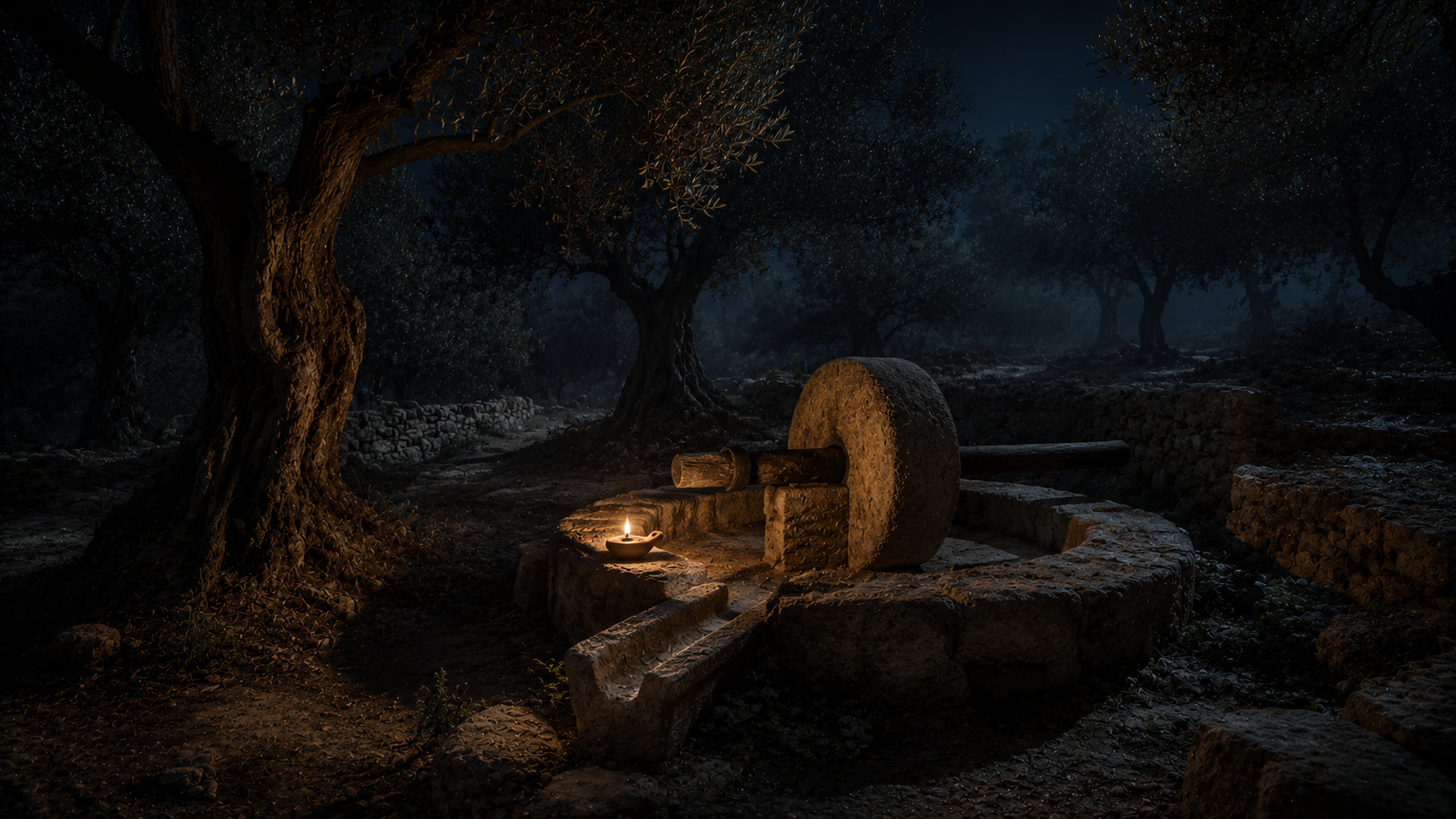
- Then Jesus came with them to a place called Gethsemane (verse 36). The Greek Gethsemane transliterates the Hebrew gat-shemanim, “olive press.” The location was a garden at the western foot of the Mount of Olives, where olive presses processed the harvest. The chapter is recording, with characteristic narrative-cultural specificity, the location where the olives were crushed under stone. The image is theologically loaded: the place where the olives are pressed is the place where the king’s prayers will be pressed out of him in the night.
- My soul is exceedingly sorrowful, even to death (verse 38). The Greek perilypos estin he psyche mou heos thanatou, “my soul is exceedingly sorrowful unto death,” echoes Psalm 42:5, 11 and Psalm 43:5 (why are you cast down, O my soul?). The chapter is recording, with characteristic Hebrew Bible-vocabulary precision, the king’s grief in the language of the Psalter’s most-grieving psalms. The chapter is being honest about the cost in Jesus’s own voice.
- My Father, if it is possible, let this cup pass away from me; nevertheless, not what I desire, but what you desire (verse 39). The Greek records the chapter’s most theologically dense single prayer. The cup image picks up the same cup-vocabulary the gospel has been using (20:22-23, the cup the sons of Zebedee will drink; 26:27, the cup of the new covenant). The chapter is recording, with characteristic narrative-theological care, that the king’s prayer is genuinely a request for the cup to pass, and a willing acceptance of the Father’s will if it does not. The kingdom’s prayer-pattern, on the chapter’s reading, is not stoic resignation; it is honest request, paired with submission. The Lord’s Prayer’s let your will be done on earth as it is in heaven is being prayed in the king’s own voice, in the actual moment of his own cup.
- Couldn’t you watch with me for one hour? (verse 40). The Greek records the disciples’ inability. The chapter is recording, with characteristic narrative-honest precision, that the disciples (who said I will never deny a few hours earlier) cannot stay awake for the king’s most painful hour. The chapter is being honest about the gap between commitment and capacity.
- Hail, Rabbi! and kissed him (verse 49). The Greek kateephilesen auton, “kissed him fervently” (the prefix kata- intensifies the verb), describes Judas’s kiss as more than a casual greeting. A Greek kataphileo is the kiss of intimate affection. The chapter is recording, with characteristic narrative-honest care, the kiss’s particular cruelty. Judas is using the affection-gesture as the betrayal-signal.
- Friend, why are you here? (verse 50). The Greek Hetaire, eph’ ho parei, “Comrade, for what are you here,” uses hetairos (comrade, fellow), a notably less-warm word than philos (friend, the more intimate term). The chapter is recording, with characteristic narrative-precision, the address. Jesus is meeting Judas at the level Judas has chosen.
- Put your sword back into its place, for all those who take the sword will die by the sword (verse 52). The Greek records the chapter’s most direct single application of the Sermon on the Mount’s teaching to the actual moment of crisis. The disciple who drew the sword (John 18:10 names him as Peter) is being told, by name, to put the sword back. The chapter is recording, with characteristic narrative-theological precision, that the kingdom’s non-violence-teaching is being lived out in the moment of the king’s actual arrest. The Sermon on the Mount’s do not resist the evil one (5:39) is being practiced at the only moment that mattered: the moment when the master himself was being seized.
- Have you come out as against a robber with swords and clubs to seize me? (verse 55). The Greek hos epi lesten, “as against a brigand,” uses the same word the gospel has used for those who were crucified beside Jesus (27:38, two robbers). The chapter is recording, with characteristic narrative-political precision, that Jesus is being arrested as if he were an armed insurrectionist, the kind of revolutionary leader the establishment had reason to fear. The arrest is staged as a security operation, not as a rabbinic dispute.
- Then all the disciples left him and fled (verse 56). The Greek aphentes auton ephygon, “leaving him they fled,” names the disciples’ fulfillment of Zechariah 13:7. The chapter is recording, with characteristic narrative-prophetic precision, the scattering of the sheep. The disciples have, within minutes of the arrest, abandoned the rabbi they swore they would die with.
D · Matthew 26:57–75 · The trial before Caiaphas and Peter’s denial
⁵⁷ Those who had taken Jesus led him away to Caiaphas the high priest, where the scribes and the elders were gathered together. ⁵⁸ But Peter followed him from a distance, to the court of the high priest, and entered in and sat with the officers, to see the end. ⁵⁹ Now the chief priests, the elders, and the whole council sought false testimony against Jesus, that they might put him to death; ⁶⁰ and they found none. Even though many false witnesses came forward, they found none. But at last two false witnesses came forward, ⁶¹ and said, “This man said, ‘I am able to destroy the temple of God, and to build it in three days.’” ⁶² The high priest stood up, and said to him, “Have you no answer? What is this that these testify against you?” ⁶³ But Jesus held his peace. The high priest answered him, “I adjure you by the living God, that you tell us whether you are the Christ, the Son of God.” ⁶⁴ Jesus said to him, “You have said it. Nevertheless, I tell you, after this you will see the Son of Man sitting at the right hand of Power, and coming on the clouds of the sky.” ⁶⁵ Then the high priest tore his clothing, saying, “He has spoken blasphemy! Why do we need any more witnesses? Behold, now you have heard his blasphemy. ⁶⁶ What do you think?” They answered, “He is worthy of death!” ⁶⁷ Then they spit in his face and beat him with their fists, and some slapped him, ⁶⁸ saying, “Prophesy to us, you Christ! Who hit you?” ⁶⁹ Now Peter was sitting outside in the court, and a maid came to him, saying, “You were also with Jesus, the Galilean!” ⁷⁰ But he denied it before them all, saying, “I don’t know what you are talking about.” ⁷¹ When he had gone out onto the porch, someone else saw him, and said to those who were there, “This man also was with Jesus of Nazareth.” ⁷² Again he denied it with an oath, “I don’t know the man.” ⁷³ After a little while those who stood by came and said to Peter, “Surely you are also one of them, for your speech makes you known.” ⁷⁴ Then he began to curse and to swear, “I don’t know the man!” Immediately the rooster crowed. ⁷⁵ Peter remembered the word which Jesus had said to him, “Before the rooster crows, you will deny me three times.” He went out and wept bitterly. (Matthew 26:57–75, World English Bible)
- Those who had taken Jesus led him away to Caiaphas the high priest (verse 57). The Greek records the location: the residence of the high priest, where a hastily-convened Sanhedrin trial is taking place. Standard rabbinic-legal procedure (Mishnah, Sanhedrin 4:1) prohibited capital trials at night and required them to convene in the temple precincts; this trial violates both rules. The chapter is recording, with characteristic narrative-political precision, that the trial is procedurally irregular from the start.
- They found none. Even though many false witnesses came forward, they found none (verse 60). The Greek records the trial’s first phase. Mosaic law (Deuteronomy 19:15) required two-or-three corroborating witnesses for a capital case; the prosecution cannot find consistent testimony. The chapter is recording, with characteristic narrative-legal honesty, that the religious establishment’s trial cannot produce even procedurally-valid witnesses.
- I am able to destroy the temple of God, and to build it in three days (verse 61). The Greek records the testimony eventually used. The chapter is recording, with characteristic narrative-honest precision, that this is the closest the prosecution can come to grounds for execution. (John 2:19 records Jesus saying destroy this temple, and in three days I will raise it up, referring, John specifies, to his own body. The witnesses are mis-quoting Jesus, but they have at least approached an actual statement.)
- I adjure you by the living God, that you tell us whether you are the Christ, the Son of God (verse 63). The Greek exorkizo se kata tou theou tou zontos, “I adjure you by the living God,” uses the formal oath-imposition vocabulary. The high priest is putting Jesus under oath. The chapter is recording, with characteristic narrative-legal precision, the moment of the trial’s actual question.
- You have said it. Nevertheless, I tell you, after this you will see the Son of Man sitting at the right hand of Power, and coming on the clouds of the sky (verse 64). The Greek sy eipas, “you said it,” is an affirmative answer in oblique form. Jesus’s reply sitting at the right hand of Power, and coming on the clouds combines Psalm 110:1 (sit at my right hand) and Daniel 7:13 (one like a son of man… came with the clouds of heaven). The chapter is recording, with characteristic Hebrew Bible-double-citation precision, that Jesus is identifying himself with both the Davidic-king of Psalm 110 and the Daniel-7 son-of-man. The two messianic-tradition strands are converging in the figure now standing on trial.
- He has spoken blasphemy! (verse 65). The Greek eblasphemesen, “he blasphemed,” names the high priest’s verdict. The chapter is recording, with characteristic narrative-theological precision, the religious establishment’s actual judgment. They have heard Jesus’s claim, they have understood it correctly (the establishment is not, on the chapter’s reading, missing the point), and they have judged it blasphemy. The chapter is being honest about the establishment’s position. They are not confused; they are, on their own reading of the Hebrew Bible, condemning the claim Jesus has just made.
- Now Peter was sitting outside in the court, and a maid came to him (verse 69). The Greek records the chapter’s most pastorally-painful single juxtaposition. While Jesus is being tried inside, Peter is being tried outside. The chapter is recording, with characteristic narrative-paralleling care, the simultaneous trials. Both are being asked the same question (are you the Christ? / were you with him?); Jesus is answering with truth, and Peter is answering with denial.
- Then he began to curse and to swear, “I don’t know the man!” (verse 74). The Greek anathematizein, “to anathematize / to call down a curse,” names Peter’s third-and-strongest denial. He is invoking a curse on himself if his words are not true. The chapter is recording, with characteristic narrative-honest precision, the depth of Peter’s collapse. The disciple who said even if I must die with you, I will not deny you is now publicly cursing his association with the rabbi.
- Immediately the rooster crowed. Peter remembered the word which Jesus had said to him… he went out and wept bitterly (verses 74b to 75). The Greek closes the chapter with Peter’s tears. The chapter is recording, with characteristic narrative-honest care, that the chapter ends not with judgment of Peter but with Peter’s grief at his own failure. The chapter is leaving open what the next chapters will eventually do with Peter (chapter 28’s resurrection-meeting will not exclude him; John 21’s restoration will receive him back). The chapter ends, with characteristic narrative restraint, on the disciple’s tears.
Reflection prompts
- The woman at Bethany pours out a year’s wages of perfume on Jesus’s head, and the disciples call it waste. The chapter records her gesture as the chapter’s most clear-sighted recognition of the moment: she has, perhaps without knowing it, anointed the king for burial. Where in your life are you currently calculating the use of resources in ways the chapter would call waste, and what would it mean to recognize the kingdom’s actual moment with the woman’s costly precision?
- My Father, if it is possible, let this cup pass away from me; nevertheless, not what I desire, but what you desire. The chapter records the kingdom’s prayer-pattern in Jesus’s own voice: honest request, paired with submission. Where in your life are you currently praying as if honest request and submission were opposed, and what would it mean to take the chapter’s pattern as your own: ask the Father for the cup to pass, and at the same time pray that the Father’s will be done?
- The chapter records two simultaneous trials: Jesus inside, answering with truth; Peter outside, answering with denial. The disciple who said I will never deny you is the one whose denial gets the chapter’s longest narrative. The chapter is honest about the gap between commitment and capacity. Where in your life is your own commitment to the king currently outpacing your actual capacity, and what would it mean to take the chapter’s quiet mercy seriously: even Peter, who denied three times, is in the gospel that gets preached for the next two thousand years?