
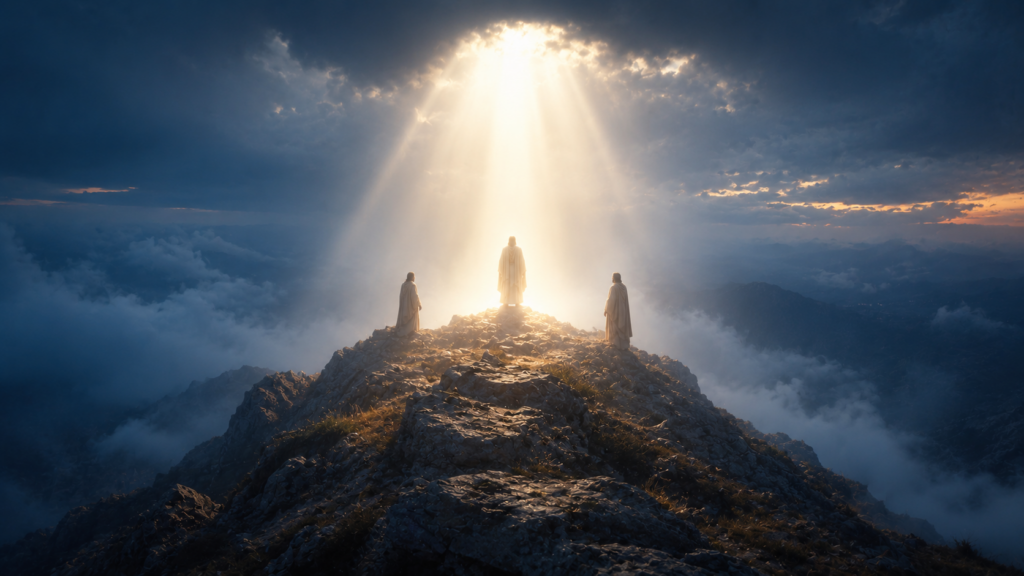
Matthew 17 is the gospel’s most direct single staging of the Mosaic typology that has been running through the gospel since chapter 1. Six days after Peter’s confession at Caesarea Philippi (16:13-20), Jesus takes Peter, James, and John up a high mountain and is transfigured before them: his face shines like the sun, his clothes become as white as light, and Moses and Elijah appear to talk with him. A voice from a bright cloud names him as the beloved Son and commands the disciples to listen to him. The chapter then descends from the mountain into a scene of disciple-failure (a boy the other disciples could not heal), the second passion prediction, and a brief unique scene about the temple-tax found in a fish’s mouth.
The chapter has three movements. The first (verses 1 to 13) is the Transfiguration: the ascent of the mountain, the glorification of Jesus, the appearance of Moses and Elijah, Peter’s proposal of three booths, the divine voice from the cloud, the descent. The second (verses 14 to 21) is the failed exorcism: a man brings his demon-possessed son, the disciples could not heal him, Jesus does, and the disciples ask why they could not. The third (verses 22 to 27) is the second passion prediction (briefer than the first) and the temple-tax-in-the-fish’s-mouth scene at Capernaum.
Beneath the chapter’s surface flow is the gospel’s most concentrated single Christological revelation. The Transfiguration discloses, to three of the disciples, what Jesus actually is: the Sinai-glory of God now present in the body of the Galilean rabbi. The chapter is recording, in narrative form, what Peter’s confession at 16:16 had reached for: Jesus is not just the Christ; he is the Son of the living God in a sense the Hebrew Bible’s Sinai-theophany prepared the disciples to recognize.
A · Matthew 17:1–13 · The Transfiguration
¹ After six days, Jesus took with him Peter, James, and John his brother, and brought them up into a high mountain by themselves. ² He was changed before them. His face shone like the sun, and his garments became as white as the light. ³ Behold, Moses and Elijah appeared to them talking with him. ⁴ Peter answered, and said to Jesus, “Lord, it is good for us to be here. If you want, let’s make three tents here: one for you, one for Moses, and one for Elijah.” ⁵ While he was still speaking, behold, a bright cloud overshadowed them. Behold, a voice came out of the cloud, saying, “This is my beloved Son, in whom I am well pleased. Listen to him.” ⁶ When the disciples heard it, they fell on their faces, and were very afraid. ⁷ Jesus came and touched them and said, “Get up, and don’t be afraid.” ⁸ Lifting up their eyes, they saw no one, except Jesus alone. ⁹ As they were coming down from the mountain, Jesus commanded them, saying, “Don’t tell anyone what you saw, until the Son of Man has risen from the dead.” ¹⁰ His disciples asked him, saying, “Then why do the scribes say that Elijah must come first?” ¹¹ Jesus answered them, “Elijah indeed comes first, and will restore all things, ¹² but I tell you that Elijah has come already, and they didn’t recognize him, but did to him whatever they wanted to. Even so the Son of Man will also suffer by them.” ¹³ Then the disciples understood that he spoke to them of John the Baptizer. (Matthew 17:1–13, World English Bible)
- After six days, Jesus took with him Peter, James, and John his brother, and brought them up into a high mountain by themselves (verse 1). The Greek meth’ hemeras hex paralambanei, “after six days he took along,” names a deliberate temporal-narrative seam to chapter 16. The reference to six days echoes Exodus 24:16, where Moses ascended Sinai after six days of waiting before the cloud descended on the seventh. The chapter is recording, with characteristic Hebrew Bible literacy, that the Transfiguration is being staged on the temporal pattern of the Sinai theophany. The three disciples (Peter, James, John) become the privileged witnesses, parallel to Moses-and-his-three-companions (Aaron, Nadab, Abihu) on Sinai (Exodus 24:1, 9).
- He was changed before them. His face shone like the sun, and his garments became as white as the light (verse 2). The Greek metemorphothe, “he was transfigured,” uses metamorphoo, the verb for changing from one form to another. The face shining is a deliberate echo of Moses’s Sinai descent (Exodus 34:29-35, the skin of his face shone because he had been talking with God). The garments white as the light picks up Daniel 7:9’s description of the Ancient of Days (his clothing was white as snow) and 12:3’s description of the resurrected righteous (those who are wise shall shine like the brightness of the firmament). The chapter is recording, with characteristic Hebrew Bible-fulfilling specificity, that the Sinai-shining-face has been intensified: where Moses reflected God’s glory after speaking with him, Jesus is the source of the glory.
Influence callout: Tim Mackie (the Transfiguration as Sinai 2.0)
Mackie’s reading of the Transfiguration in Matthew 17 names it as the gospel’s most concentrated single Mosaic-typology scene. The structural parallels are dense: six days (Exodus 24:16); high mountain (Sinai); the radiant face (Exodus 34:29); the bright cloud overshadowing (Exodus 24:15-18, 40:34-35); the divine voice from the cloud (Exodus 19:9, 24:16); Moses himself is present, in conversation with Jesus (the Mosaic-typology becomes self-conscious: the new Moses is talking with the old Moses, and the divine voice is naming the new Moses as the beloved Son whom Israel must listen to, a direct citation of Deuteronomy 18:15, the LORD your God will raise up for you a prophet like me from among you, from your brethren; to him you shall listen). Mackie argues that Matthew is recording, in this chapter, the gospel’s most explicit single confirmation of the Mosaic-typology framework that has been running since chapter 2 (the flight from a murderous king and the return), chapter 4 (the wilderness testing recapitulating Israel’s forty years), chapter 5-7 (the Sinai-Sermon delivering the new Torah from a mountain), and chapter 14 (the new manna in the wilderness). The Transfiguration is the chapter where the typology becomes Christologically loaded: the new Moses is not just doing what Moses did; the new Moses is the beloved Son in whom the Father is well pleased, the Son to whom the Father commands the disciples to listen. The whole gospel’s Mosaic-typology arc reaches its eight-chapter climax here.
- Behold, Moses and Elijah appeared to them talking with him (verse 3). The Greek Moyses kai Elias, “Moses and Elijah,” names the two figures who together represent the Hebrew Bible’s two great covenantal-prophetic streams: Moses (the Torah) and Elijah (the Prophets). Both also have unusual departure-from-this-world stories (Moses’s burial by Yahweh in Deuteronomy 34:6; Elijah’s chariot-of-fire ascension in 2 Kings 2). Both are associated with mountain-theophanies (Moses on Sinai; Elijah at Horeb in 1 Kings 19). The chapter is recording, with characteristic Hebrew Bible-symbolic precision, that the Transfiguration is staging Jesus in conversation with the two great Hebrew Bible witnesses to God’s covenantal speech.
- Lord, it is good for us to be here. If you want, let’s make three tents here: one for you, one for Moses, and one for Elijah (verse 4). The Greek poieso hode treis skenas, “I will make here three tents,” uses skene, the Septuagint’s word for the tabernacle (and the Festival of Sukkot, Tabernacles, the booth-festival commemorating Israel’s wilderness wandering). Peter’s instinct is festal-theological: build three booths, one for each, settle into the moment. The chapter is recording, with characteristic narrative honesty, Peter’s reaching for a Hebrew Bible category that almost works. Tabernacles is the festival of God-dwelling-with-his-people-in-tents; what Peter is suggesting is not wrong as instinct (the Mosaic-Sinai connection is real); it is wrong as conclusion (the moment is not for settling but for descending toward Jerusalem).
- While he was still speaking, behold, a bright cloud overshadowed them. Behold, a voice came out of the cloud, saying, “This is my beloved Son, in whom I am well pleased. Listen to him” (verse 5). The Greek outos estin ho huios mou ho agapetos, en ho eudokesa, “this is my beloved Son in whom I am well pleased,” is identical to the heavenly voice at Jesus’s baptism (3:17), with one addition: akouete autou, “listen to him.” The added phrase is a direct citation of Deuteronomy 18:15, the prophet-like-Moses promise. The chapter is recording, with characteristic narrative-theological precision, the Father’s self-disclosure: the figure standing on the mountain is the long-promised prophet-like-Moses, and the disciples are commanded to listen to him. Worth noting that the three clauses of the divine voice draw, in compact form, on all three of the canonical sections of the Hebrew Bible. This is my Son echoes Psalm 2:7, from the Ketuvim (the Writings). In whom I am well pleased echoes Isaiah 42:1 (the first servant song), from the Nevi’im (the Prophets). Listen to him echoes Deuteronomy 18:15, from the Torah. There is a Jewish midrashic tradition that taught the Messiah’s identity would be confirmed by all three sections of the Tanakh testifying about him; the divine voice from the cloud delivers exactly that triple confirmation in a single sentence. The chapter is recording, with characteristic Hebrew-Bible literacy, that the Father’s announcement is gathering the whole canonical witness onto the figure standing on the mountain. There is also a striking distinction between Moses’s mountain-radiance and Jesus’s. After Sinai, Moses’s face shone because he had been speaking with God (Exodus 34:29-35), the borrowed light of one who had stood in the divine presence. Jesus’s face shines like the sun, not as a reflection of light shining onto him from elsewhere but as a source. The patristic interpretive tradition (especially Ephraim the Syrian) read the contrast as the chapter’s quietest theological claim: Moses was lunar; the Son is solar. The disciples are not seeing borrowed glory; they are seeing what has always been Christ’s, briefly opened to their senses.
Influence callout: Maximus the Confessor (Ambigua and the Christological reading of the Transfiguration)
Maximus the Confessor (c. 580 to 662 AD), the great seventh-century Byzantine theologian, is one of the most important pre-modern interpreters of the Transfiguration. His Ambigua (a long collection of theological reflections on difficult passages from Gregory of Nazianzus and pseudo-Dionysius) returns repeatedly to Matthew 17 as the most direct single Christological revelation in the gospels. Maximus argues that the Transfiguration is the moment when the divine Logos, who has been hidden in the human nature throughout the gospel narrative, becomes visible to the disciples in the uncreated light of his eternal divinity. The light shining from Jesus’s face is not, on Maximus’s reading, a created phenomenon (a temporary divine effect); it is the eternal divine glory that has always been Christ’s, now made perceptible to the three disciples by a temporary opening of their senses. The Transfiguration, in this reading, does not change Jesus; it changes the disciples’ capacity to see what Jesus has always been. Maximus’s reading became foundational for the entire Eastern Orthodox tradition’s understanding of the uncreated light, which would later become a core element in the fourteenth-century Hesychast controversy (Gregory Palamas defending the same Maximian reading against Western objections). The Eastern Orthodox icon of the Transfiguration, painted in every parish across the Eastern church, is the Maximian-Palamite reading rendered in image form. The site does not adopt every move of Maximus’s metaphysics, but the instinct that the Transfiguration is the gospel’s most direct disclosure of who Jesus actually is, and that the disclosure is given to the disciples to form them for what is coming, is the church’s most enduring single contribution to interpreting Matthew 17. The chapter is the Eastern church’s most-loved gospel scene, and Maximus is the theological voice that has shaped its reception since the seventh century.
- Don’t tell anyone what you saw, until the Son of Man has risen from the dead (verse 9). The Greek eos hou ho huios tou anthropou ek nekron egerthe, “until the Son of Man has been raised from the dead,” names the silence-instruction. The chapter is recording, with characteristic narrative care, that the Transfiguration is being kept private until after the resurrection. The disciples are not yet equipped to interpret the experience without the cross-and-resurrection framework that the next eleven chapters will establish.
- Then why do the scribes say that Elijah must come first? (verse 10). The disciples ask a natural question: if you are the Messiah and the Transfiguration confirms it, why has Elijah’s promised pre-Messianic ministry (Malachi 4:5) not happened? Jesus’s answer (verse 11-13) names John the Baptist as the Elijah-fulfillment. The chapter is recording, with characteristic narrative-theological care, the gospel’s continuing claim that John was the prophesied Elijah-figure, and that the Hebrew Bible’s expectations are being fulfilled in unexpected forms.
B · Matthew 17:14–21 · The boy with the spirit and the disciples’ lack of faith
¹⁴ When they came to the multitude, a man came to him, kneeling down to him and saying, ¹⁵ “Lord, have mercy on my son, for he is epileptic, and suffers grievously; for he often falls into the fire, and often into the water. ¹⁶ So I brought him to your disciples, and they could not cure him.” ¹⁷ Jesus answered, “Faithless and perverse generation! How long will I be with you? How long will I bear with you? Bring him here to me.” ¹⁸ Jesus rebuked the demon, and it went out of him, and the boy was cured from that hour. ¹⁹ Then the disciples came to Jesus privately, and said, “Why weren’t we able to cast it out?” ²⁰ He said to them, “Because of your unbelief. For most certainly I tell you, if you have faith as a grain of mustard seed, you will tell this mountain, ‘Move from here to there,’ and it will move; and nothing will be impossible for you. ²¹ But this kind doesn’t go out except by prayer and fasting.” (Matthew 17:14–21, World English Bible)
- When they came to the multitude, a man came to him, kneeling down to him (verse 14). The Greek pivots from the mountain-top to the crowd-at-the-foot in one verse. The chapter is recording, with characteristic narrative-spatial care, the standard Hebrew Bible pattern: the prophet ascends the mountain, the prophet descends to the crisis. Moses came down Sinai to find the golden calf; Jesus comes down the Transfiguration-mountain to find a boy his disciples could not heal.
- Lord, have mercy on my son, for he is epileptic, and suffers grievously (verse 15). The Greek seleniazetai, “he is moonstruck” (the etymological source of the English “lunatic”), is the standard first-century Greek term for what we would now call epilepsy. The chapter is recording, with characteristic narrative-cultural specificity, the diagnosis as the man’s culture would have framed it. The text does not require a modern reader to share the etymology to understand what is happening: a child has a serious chronic condition, and his father is bringing him to the rabbi.
- I brought him to your disciples, and they could not cure him (verse 16). The Greek ouk edynethesan auton therapeusai, “they were not able to heal him,” names the disciples’ failure. The disciples have authority over disease and the demonic (chapter 10:1, 8); they had used it during the missionary discourse. Here they cannot. The chapter is recording, with characteristic narrative honesty, that the disciples’ authority is not autonomous; it depends on the connection to the source.
- Faithless and perverse generation! How long will I be with you? How long will I bear with you? (verse 17). The Greek o genea apistos kai diestrammene, “O faithless and perverted generation,” echoes Deuteronomy 32:5 (the same crooked and twisted generation the Sermon on the Mount applied to the contemporary world at 16:4). The chapter is recording, with characteristic narrative-Hebrew-Bible echo, that Jesus’s frustration is in the prophetic register. He is using Mosaic vocabulary to name the disciple-community’s faithlessness.
- If you have faith as a grain of mustard seed, you will tell this mountain, “Move from here to there,” and it will move (verse 20). The Greek hos kokkon sinapeos, “as a mustard seed,” uses the same image the parable of the kingdom used at 13:31-32. The chapter is recording, with characteristic narrative-pedagogical care, the kingdom’s smallest-faith principle. The disciples do not need more faith; they need real faith, even at mustard-seed-scale. The mountain-moving image is hyperbolic-rhetorical (Jesus is not commanding literal mountain-relocation); it is naming faith’s actual capacity in the kingdom.
C · Matthew 17:22–27 · The second passion prediction and the temple-tax
²² While they were staying in Galilee, Jesus said to them, “The Son of Man is about to be delivered up into the hands of men, ²³ and they will kill him, and the third day he will be raised up.” They were exceedingly sorry. ²⁴ When they had come to Capernaum, those who collected the didrachma coins came to Peter, and said, “Doesn’t your teacher pay the didrachma?” ²⁵ He said, “Yes.” When he came into the house, Jesus anticipated him, saying, “What do you think, Simon? From whom do the kings of the earth receive toll or tribute? From their children, or from strangers?” ²⁶ Peter said to him, “From strangers.” Jesus said to him, “Therefore the children are exempt. ²⁷ But, lest we cause them to stumble, go to the sea, cast a hook, and take up the first fish that comes up. When you have opened its mouth, you will find a stater coin. Take that, and give it to them for me and you.” (Matthew 17:22–27, World English Bible)

- While they were staying in Galilee, Jesus said to them, “The Son of Man is about to be delivered up into the hands of men, and they will kill him, and the third day he will be raised up” (verses 22 to 23). The Greek paradidosthai, “to be delivered up,” is the same word the gospel uses for Judas’s coming betrayal (10:4, 26:21-25). The chapter is recording, with characteristic verbal-narrative continuity, the gospel’s second passion prediction (after 16:21). The journey toward Jerusalem is intensifying.
- They were exceedingly sorry (verse 23b). The Greek elypethesan sphodra, “they were grieved exceedingly,” names the disciples’ response. They have absorbed the prediction better than Peter did at 16:22 (where he rebuked Jesus); now the dominant response is grief. The chapter is recording, with characteristic narrative honesty, the disciples’ deepening but still incomplete reception of the cross-shape.
- When they had come to Capernaum, those who collected the didrachma coins came to Peter, and said, “Doesn’t your teacher pay the didrachma?” (verse 24). The Greek ta didrachma, “the two-drachma coins,” refers to the temple-tax (Exodus 30:13’s half-shekel for the sanctuary, by the first century paid annually as the didrachma, roughly two days’ wages). The chapter is recording, with characteristic narrative-cultural specificity, that the question is whether Jesus pays the temple-tax. The collectors are at Capernaum during the annual tax-collection season. The original Exodus context of the half-shekel is worth a careful read because it gives the dialogue with Peter its theological edge. Exodus 30:11-16 calls the half-shekel a ransom for each Israelite’s life, given so that there will be no plague among them when you number them, and explicitly names it as atonement money: the rich shall not give more, and the poor shall not give less, than the half shekel, when you give the LORD’s offering to make atonement for your lives. The two-drachma temple-tax is, in its origin, atonement money. Peter has just confessed at Caesarea Philippi that Jesus is the Christ, the Son of the living God. The conversation in this scene applies that confession to the temple-tax question with quiet logic: the Son of the Living God does not need to bring atonement money to the Father’s house, because he is the Son of the very God for whom the atonement is made; he is the One in whom the atonement will eventually be accomplished, not one of the strangers the kings tax. Jesus’s the children are exempt (verse 26) is therefore not a casual quip about kings and family. It is a quiet but precise theological claim about who he is in relation to the temple’s whole sacrificial system.
- From whom do the kings of the earth receive toll or tribute? From their children, or from strangers? (verse 25). The Greek apo ton allotrion, “from strangers/foreigners,” names the standard ancient practice: kings collected taxes from non-family-members, not from their own children. The chapter is recording, with characteristic narrative-pedagogical care, Jesus’s argument: the temple-tax is for the temple, the temple is the Father’s house, and the Son and his disciples are the household. The tax does not, in principle, apply to them.
- But, lest we cause them to stumble, go to the sea, cast a hook, and take up the first fish that comes up. When you have opened its mouth, you will find a stater coin. Take that, and give it to them for me and you (verse 27). The Greek hina de me skandalisomen autous, “but lest we cause them to stumble,” names the chapter’s most pastorally-loaded principle. The Son is not, in principle, obligated to pay; the Son will pay anyway, to avoid the offense. The stater (Greek silver coin worth four drachma, exactly the right amount for two temple-taxes) is found in the fish’s mouth, a strange one-off miracle that Matthew alone records. The chapter is closing with characteristic narrative restraint on a scene that is part theological argument, part free-the-fishermen gentle comedy, and part practical instruction: the kingdom’s freedom does not require the kingdom’s representatives to be aggressively-confrontational about every legitimate cultural-religious obligation. Sometimes the pastoral move is to pay the tax, miraculously or not.
Reflection prompts
- The Transfiguration shows three disciples what Jesus actually is. The face shines like the sun; the garments are white as the light; the divine voice names him as the beloved Son. Six days later, the same Jesus is walking down a mountain toward a boy his disciples could not heal. The glory and the descent are the same Jesus. Where in your life are you currently dividing what you have been told about Jesus into a glory-Christ and a suffering-Christ, and what would it mean to recognize that the chapter is showing them as the same person on the same six-day journey?
- Listen to him. The Father’s voice from the cloud commands the disciples to listen to the Son. The instruction is structurally Mosaic (Deuteronomy 18:15: to him you shall listen). Where in your life are you currently listening to other voices (cultural-religious, family-of-origin, professional, ideological) more carefully than you are listening to Jesus, and what does it mean to take the chapter’s instruction as the disciple’s primary obligation: listen to him?
- If you have faith as a grain of mustard seed. The disciples want more faith; Jesus offers a different diagnosis. The mountain-moving issue is not the size of the faith; it is the connection-to-the-source the faith is rooted in. Where in your life are you currently asking for more faith when the actual problem is that the faith you have is not connected to the source, and what would it mean to attend to the connection rather than to the quantity?