

Genesis 30 is one of the most uncomfortable chapters in the patriarchal narrative. Leah has had four sons in the closing scene of chapter 29; Rachel is barren. The chapter opens with Rachel’s despairing cry to Jacob and Jacob’s angry refusal, then moves through the slow, painful production of the rest of the twelve sons of Israel through four mothers (Leah, Rachel, and their two slaves Bilhah and Zilpah). The chapter records the rivalry without softening it. Each child is named in pain or competition; the matriarchs barter their husband’s nights with mandrakes; the household is the inverse of partnership.
By the end of the chapter, eleven of the twelve sons of Israel have been born (Benjamin will arrive in chapter 35). Jacob then turns to Laban with a request to leave. Laban, recognizing that his prosperity has been built on Jacob’s labor, asks him to stay. Jacob proposes a wage arrangement: he will keep the speckled, spotted, and dark-colored animals from Laban’s flocks; the rest stay with Laban. The chapter then records Jacob’s selective-breeding scheme involving peeled rods, watering troughs, and a strategic preference for the stronger animals. Jacob becomes enormously wealthy. Laban does not.
The chapter is doing several things at once. It is finishing the family-of-Israel composition: the eleven sons here, plus Benjamin in chapter 35, will become the twelve tribes. It is giving us the etymology of each tribal name in Hebrew. It is recording the slow, broken process by which the covenant family was actually built (not romantic, not tidy, riddled with rivalry, jealousy, and competition for the patriarch’s attention). And it is setting up the final separation between Jacob and Laban that chapter 31 will narrate, with Jacob now wealthy, Laban resentful, and the long road back to Canaan beginning to come into view.
A · Genesis 30:1–24 · The rivalry of the sisters and the names of the tribes
¹ When Rachel saw that she bore Jacob no children, Rachel envied her sister. She said to Jacob, “Give me children, or else I will die.” ² Jacob’s anger burned against Rachel, and he said, “Am I in God’s place, who has withheld from you the fruit of the womb?” ³ She said, “Behold, my maid Bilhah. Go in to her, that she may bear on my knees, and I also may obtain children by her.” ⁴ She gave him Bilhah her servant as wife, and Jacob went in to her. ⁵ Bilhah conceived, and bore Jacob a son. ⁶ Rachel said, “God has judged me, and has also heard my voice, and has given me a son.” Therefore she called his name Dan. ⁷ Bilhah, Rachel’s servant, conceived again, and bore Jacob a second son. ⁸ Rachel said, “With mighty wrestlings have I wrestled with my sister, and have prevailed.” She named him Naphtali. ⁹ When Leah saw that she had stopped bearing, she took Zilpah, her servant, and gave her to Jacob as a wife. ¹⁰ Zilpah, Leah’s servant, bore Jacob a son. ¹¹ Leah said, “How fortunate!” She named him Gad. ¹² Zilpah, Leah’s servant, bore Jacob a second son. ¹³ Leah said, “Happy am I, for the daughters will call me happy.” She named him Asher. ¹⁴ Reuben went in the days of wheat harvest, and found mandrakes in the field, and brought them to his mother, Leah. Then Rachel said to Leah, “Please give me some of your son’s mandrakes.” ¹⁵ She said to her, “Is it a small matter that you have taken away my husband? Would you take away my son’s mandrakes, also?” Rachel said, “Therefore he will lie with you tonight for your son’s mandrakes.” ¹⁶ Jacob came from the field in the evening, and Leah went out to meet him, and said, “You must come in to me; for I have surely hired you with my son’s mandrakes.” He lay with her that night. ¹⁷ God listened to Leah, and she conceived, and bore Jacob a fifth son. ¹⁸ Leah said, “God has given me my hire, because I gave my servant to my husband.” She named him Issachar. ¹⁹ Leah conceived again, and bore a sixth son to Jacob. ²⁰ Leah said, “God has endowed me with a good dowry. Now my husband will live with me, because I have borne him six sons.” She named him Zebulun. ²¹ Afterwards, she bore a daughter, and named her Dinah. ²² God remembered Rachel, and God listened to her, and opened her womb. ²³ She conceived, bore a son, and said, “God has taken away my reproach.” ²⁴ She named him Joseph, saying, “May the LORD add another son to me.” (Genesis 30:1–24, World English Bible)
- The chapter opens with Rachel’s despairing cry. Give me children, or else I will die. The Hebrew is havah-li banim, ve-im-ayin metah anokhi. The construction is dramatic. Rachel sees her sister bearing son after son; she sees her own womb closed; she names her grief in the most extreme terms available. The matriarch’s pain is real, and the chapter does not soften it.
Pushback note
Some readings have framed Rachel’s cry as petulance or melodrama. The text supports a different reading. ANE women’s social standing was tied tightly to their childbearing; barrenness in this period was experienced as a near-total loss of place in the household. Rachel, who is also competing with a fertile sister-wife in the same household, is naming a real grief. Her cry is not flattering, but it is not unwarranted. The chapter is recording a matriarch in genuine distress.
- Jacob’s response (verse 2) is bracing. Jacob’s anger burned against Rachel, and he said, “Am I in God’s place, who has withheld from you the fruit of the womb?” The patriarchal grandson is, in this moment, refusing to be made the answer to a problem only Yahweh can solve. The response is theologically correct and pastorally cold. He is right that he is not God; he is not warm in the way he names it. The chapter is honest about Jacob’s edges.
- Rachel’s solution (verses 3 to 5) is the same solution Sarah used in chapter 16: give the slave woman to the husband as a secondary wife and consider her child the matriarch’s. That she may bear on my knees, and I also may obtain children by her. The phrase bear on my knees is the ANE adoption gesture; Rachel will, in effect, claim Bilhah’s child as her own. The chapter records the move without softening it. The patriarchal narrative is doing what it has done before with Hagar: the matriarch’s strategy is recorded, and the consequences will run through the rest of the text.
Influence callout: Tim Mackie
Mackie’s reading of this scene foregrounds the deliberate echo of Genesis 16. Sarah gave Hagar to Abraham; Rachel gives Bilhah to Jacob; Leah will give Zilpah to Jacob in verse 9. The patriarchal narrative’s matriarch-and-slave-woman pattern repeats across generations. Mackie reads this as part of the chapter’s honest theology: the covenant family, in its actual production, has been built on choices that the rest of Scripture (the Mosaic law, the prophets, and certainly the New Testament) will eventually critique. The Hebrew Bible is recording how Israel actually came to be, which includes the moral compromises of its matriarchs. The chapter does not pretend the family was built on consent and equality. It records what was done.
Influence callout: Nijay Gupta
The kind of attentive reading on women in biblical narrative that Gupta and others have done is especially important here. Bilhah and Zilpah are the chapter’s most silenced figures. They do not speak. They do not name their children; the matriarchs name them. They are given to the patriarch by the women they belong to. Their bodies bear children whom they will not be permitted to claim as their own. The patriarchal narrative is recording, in their silence, a moral cost the chapter does not foreground. We can read the chapter forward (the twelve tribes are forming) without forgetting that two of the four mothers of those tribes were enslaved women whose voices the text never gives us.
- The naming of the eleven sons in this chapter is one of Genesis’s most intricate Hebrew passages. Each name carries an etymological meaning, and the matriarch’s stated reason for the name traces what was happening in her life at each birth. Here is the catalogue:
Word studies on the seven new sons’ names (Dan through Joseph)
Dan (Dan) is from din (to judge). Rachel’s stated meaning: “God has judged me, and has also heard my voice.” Rachel reads Bilhah’s first son as Yahweh’s vindication of her cause.
Naphtali (Naftali) is from patal (to wrestle, twist). Rachel’s stated meaning: “With mighty wrestlings have I wrestled with my sister, and have prevailed.” The name explicitly invokes the rivalry. Rachel is reading the second son through Bilhah as her victory in the contest against Leah.
Gad (Gad) means “fortune” or “good luck.” Leah’s stated exclamation: “How fortunate!” The first child by Zilpah arrives with Leah’s relieved cry.
Asher (Asher) is from ashar (happy, blessed). Leah’s stated meaning: “Happy am I, for the daughters will call me happy.” Leah is reading the second son by Zilpah as her expanded standing.
Issachar (Yissakhar) is connected to sakhar (hire, wages). Leah’s stated meaning: “God has given me my hire, because I gave my servant to my husband.” Leah’s fifth son by her own body is named for the transactional logic of how he came to be.
Zebulun (Zevulun) is from zaval (to dwell, to honor). Leah’s stated meaning: “God has endowed me with a good dowry. Now my husband will live with me.” Leah is, again, naming a child for the love she still hopes will land on her.
Joseph (Yosef) is from yasaf (to add). Rachel’s stated meaning, given in two separate Hebrew explanations: “God has taken away my reproach… May the LORD add another son to me.” The name carries both the relief of the present and the hope for the future.
- The mandrakes episode (verses 14 to 16) is the chapter’s most strange and most often misunderstood scene. Reuben, Leah’s eldest son, finds mandrake plants in the field at wheat harvest and brings them to his mother. Mandrakes (Hebrew dudaim, related to the word for love) were considered, in ANE folklore, to be fertility-enhancing. Rachel asks for some. Leah’s response (verse 15) is sharp: is it a small matter that you have taken away my husband? Would you take away my son’s mandrakes, also? The two sisters then strike a deal: Rachel will give Leah the night with Jacob in exchange for the mandrakes. Jacob comes home from the field; Leah meets him and announces she has bought him for the night.
Pushback note
The mandrakes episode has often been preached as a comic interlude or a quaint piece of folklore. The chapter is doing something more serious. Both sisters are, by this point, transacting their husband’s body in exchange for symbols of fertility. Jacob does not get a vote in verse 16; Leah informs him of the arrangement his sisters have made. The chapter is recording, with characteristic restraint, the deep dysfunction of a household in which the patriarch has been reduced to an instrumentalized figure in his wives’ rivalry. Reading this scene as charming misses what the narrator is showing us: the family that the covenant runs through is, by this chapter, a household whose intimacy has been thoroughly transactional.
- The mandrakes turn out to be ironic. Rachel, who acquired them, does not conceive from them; the chapter records that God listened to Leah (verse 17), and Leah conceives from the night Rachel sold her. The mandrakes were, in the chapter’s framing, ineffective; the children come from God’s listening, not from herbal magic. The chapter is making a quiet theological point: fertility is in Yahweh’s hand, not in the supposed efficacy of the dudaim.
- Joseph’s birth (verses 22 to 24) is the chapter’s quiet pivot. God remembered Rachel, and God listened to her, and opened her womb. The Hebrew construction is the same construction the chapter has used for Yahweh “remembering” earlier in Genesis (8:1, when God remembered Noah; 19:29, when God remembered Abraham). The verb zakar is not informational (“God recalled who Rachel was”); it is covenantal (“God acted on her behalf in line with his commitment to her”). Rachel’s barrenness has, after years, ended.
Influence callout: Walter Brueggemann
Brueggemann’s reading of the chapter’s matriarchal pattern names the recurring barrenness-and-fertility cycle as one of the patriarchal narrative’s structural arguments. Sarah was barren until Yahweh opened her womb. Rebekah was barren until Isaac entreated Yahweh. Rachel is barren until Elohim zakar. The pattern is not coincidence. The covenant family is repeatedly produced through bodies that should not have been able to produce. Brueggemann argues that the chapter is making a sustained theological case: the people of God are not a people of natural fertility but a people of remembered-by-God fertility. The wombs do not open by their own logic. They open because Yahweh has remembered.
- Verse 24 closes the section with a small forward-look. Rachel names the boy Yosef and says, “may the LORD add another son to me.” The wordplay (Yosef / yasaf, “may he add”) is not just descriptive; it is hopeful. The next son will come (Benjamin, in chapter 35), and Rachel will die in giving birth to him. The chapter does not yet know this; the narrator is preparing the reader for what comes.
B · Genesis 30:25–43 · The bargain and the speckled flocks
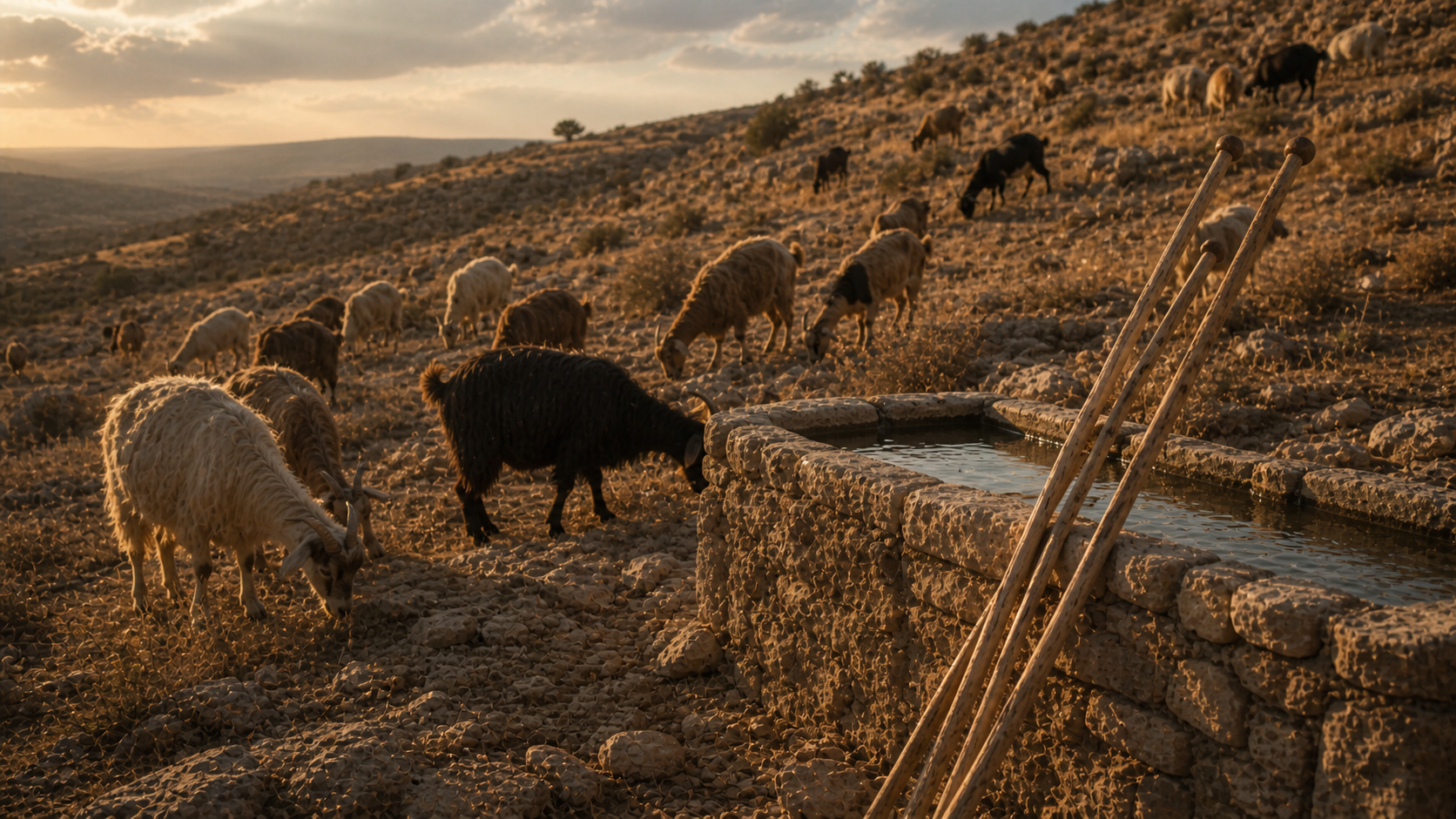
²⁵ When Rachel had borne Joseph, Jacob said to Laban, “Send me away, that I may go to my own place, and to my country. ²⁶ Give me my wives and my children for whom I have served you, and let me go; for you know my service with which I have served you.” ²⁷ Laban said to him, “If now I have found favor in your eyes, stay here, for I have divined that the LORD has blessed me for your sake.” ²⁸ He said, “Appoint me your wages, and I will give it.” ²⁹ Jacob said to him, “You know how I have served you, and how your livestock have fared with me. ³⁰ For it was little which you had before I came, and it has increased to a multitude. The LORD has blessed you wherever I turned. Now when will I provide for my own house also?” ³¹ He said, “What shall I give you?” Jacob said, “You shall not give me anything. If you will do this thing for me, I will again feed your flock and keep it. ³² I will pass through all your flock today, removing from there every speckled and spotted one, and every black one among the sheep, and the spotted and speckled among the goats. This will be my hire. ³³ So my righteousness will answer for me hereafter, when you come concerning my hire that is before you. Every one that is not speckled and spotted among the goats, and black among the sheep, that might be with me, will be considered stolen.” ³⁴ Laban said, “Behold, let it be according to your word.” ³⁵ That day, he removed the male goats that were streaked and spotted, and all the female goats that were speckled and spotted, every one that had white in it, and all the black ones among the sheep, and gave them into the hand of his sons. ³⁶ He set three days’ journey between himself and Jacob, and Jacob fed the rest of Laban’s flocks. ³⁷ Jacob took to himself rods of fresh poplar, almond, and plane tree, peeled white streaks in them, and made the white appear which was in the rods. ³⁸ He set the rods which he had peeled opposite the flocks in the watering troughs where the flocks came to drink. They conceived when they came to drink. ³⁹ The flocks conceived before the rods, and the flocks produced streaked, speckled, and spotted. ⁴⁰ Jacob separated the lambs, and set the faces of the flocks toward the streaked and all the black in the flock of Laban: and he put his own droves apart, and didn’t put them into Laban’s flock. ⁴¹ Whenever the stronger of the flock conceived, Jacob laid the rods before the eyes of the flock in the watering troughs, that they might conceive among the rods; ⁴² but when the flock were feeble, he didn’t put them in. So the feebler were Laban’s, and the stronger Jacob’s. ⁴³ The man increased exceedingly, and had large flocks, female servants and male servants, and camels and donkeys. (Genesis 30:25–43, World English Bible)
- Jacob’s request to leave (verse 25) is timed with Joseph’s birth. The chapter has been building to this. The patriarchal grandson has now served fourteen years; he has eleven sons; the youngest by his beloved Rachel is named “may the LORD add another.” Jacob is ready to go home.
- Laban’s response (verse 27) is both a compliment and a refusal. I have divined that the LORD has blessed me for your sake. The Hebrew word nichashti, “I have divined,” is the standard word for ANE divinatory practice (animal entrails, lots, omens). Laban is, in his own framing, reading his prosperity through pagan religious categories and concluding that Yahweh’s presence with Jacob is the source of his good fortune. The chapter records this without commentary; Laban is the chapter’s most consistently transactional figure, and the language he uses for Yahweh is the language of his own religious world.
- The negotiation (verses 28 to 34) is one of the chapter’s most carefully worded passages. Jacob proposes that he take the speckled, spotted, and dark-colored animals from Laban’s flock as his wages, with all the white and uniformly-colored animals remaining Laban’s. By ANE breeding norms, the speckled and spotted were a small minority of the flock; Laban accepts the proposal because it appears to favor him substantially.
- Laban’s first move (verse 35) is itself a small deception. He removes the existing speckled, spotted, and dark-colored animals from his flock himself and gives them to his sons, three days’ journey away. Jacob is left with the unmarked flock, which by normal breeding would produce mostly unmarked offspring. Laban has, in effect, structured the deal to ensure Jacob’s wages would be minimal.
- The peeled-rod scheme (verses 37 to 42) is the chapter’s most strange and most contested passage. Jacob takes rods from poplar, almond, and plane trees; he peels white stripes into them; he places them in the watering troughs where the flocks drink. The animals conceive in the troughs and produce striped, speckled, and spotted offspring. The narrator is recording, at face value, a kind of sympathetic-magic breeding theory: what the animals see while conceiving affects the offspring.
Pushback note
Modern readers often find the peeled-rod scheme either embarrassing or confusing. Modern genetics, of course, does not work this way. Some readings have tried to reframe the scheme as Yahweh’s blessing operating through Jacob’s effort regardless of the actual mechanism; others have argued the scheme is real ANE folklore that the narrator is recording without endorsing as scientifically accurate. The simplest reading is that the chapter is recording what Jacob believed and what the result was. The chapter’s theological argument is not in the rods; it is in verse 30 (the LORD has blessed you wherever I turned) and the narrator’s repeated note that Jacob’s prosperity comes from Yahweh’s presence with him, not from the rods. The rods are how Jacob thought it worked. The narrator is honest about the patriarchal grandson’s folk-religious imagination.
- Verse 41 reveals an additional layer: Jacob preferentially uses the rods for the stronger animals and not for the feebler ones. The chapter is recording, alongside the folk-magic scheme, a real selective-breeding strategy: Jacob is keeping the stronger genetic lines for his own flock and leaving the weaker animals with Laban. Whether the rods worked as Jacob believed or whether the genetic selection was the actual mechanism, the chapter’s outcome is clear.
- Verse 43 closes the chapter with a precise summary: The man increased exceedingly, and had large flocks, female servants and male servants, and camels and donkeys. The patriarchal grandson, who arrived in chapter 28 with a staff in his hand, has by the end of this chapter become a man of large flocks, servants, and pack animals. The chapter is preparing the reader for chapter 31, where Jacob’s wealth will be the catalyst for his break with Laban and the long road back to Canaan.
Influence callout: Tim Mackie
Mackie’s reading of the chapter’s economic dynamics names this transition as one of the patriarchal narrative’s quiet inversions. Jacob arrived at Laban’s house with nothing and was treated as a worker who would generate wealth for the patriarch’s father-in-law. By the end of fourteen years (the labor for the wives) plus an undisclosed but substantial period (the labor for the flocks), Jacob has become wealthier than Laban. The narrator is, again, performing the deceiver-becomes-the-deceived structure that marked chapter 29. Laban’s strategic deception of Jacob at the wedding has been answered, by the chapter’s end, with Jacob’s strategic out-thinking of Laban at the breeding troughs. The patriarchal narrative is honest about this kind of moral parallelism: each wrong tends to find its own form of return, and the chapter does not pretend either party is clean.
Influence callout: Walter Brueggemann
Brueggemann’s reading of the long Jacob-and-Laban arc names it as the Hebrew Bible’s quiet critique of pure-transactional religion. Laban is the chapter’s most consistently transactional figure: he calculates his blessing in animals; he reads his fortune by divination; he treats Jacob as a worker to be retained at the lowest possible wage. The patriarchal grandson, despite his own deceptions, is being slowly shaped by this household into someone who recognizes that Laban’s transactional view of life is not the same as the covenant view. Brueggemann argues that Genesis 30 to 31 is the patriarchal narrative’s preparation of Jacob to leave Laban’s worldview behind. The man who will wrestle with God at Jabbok in chapter 32 is being made, slowly, by twenty years of contest with a father-in-law who calculates everything.
Reflection prompts
- The names of the eleven sons in this chapter trace, in their etymologies, what was happening in the matriarchs’ lives at each birth. The covenant family was named in pain, in rivalry, in barter, in praise. Where in your life have you named something (a child, a project, a season) for what you were feeling in the moment, and what does it mean to look at the name now and see what was actually happening?
- The chapter records, alongside its rivalry, that God listened to Leah and God remembered Rachel. Both matriarchs were heard by Yahweh, even in their conflict with each other. Where in your life have you assumed that God could only be on one side of a contested relationship, and what does it mean to discover that the divine listening reaches both parties?
- Jacob’s wealth grows through a combination of what he believed (the rods) and what was actually happening (the selective breeding). The chapter does not separate the two cleanly. Where in your life are you mixing real-action with folk-belief, and what would it look like to be honest about which is doing the actual work?