
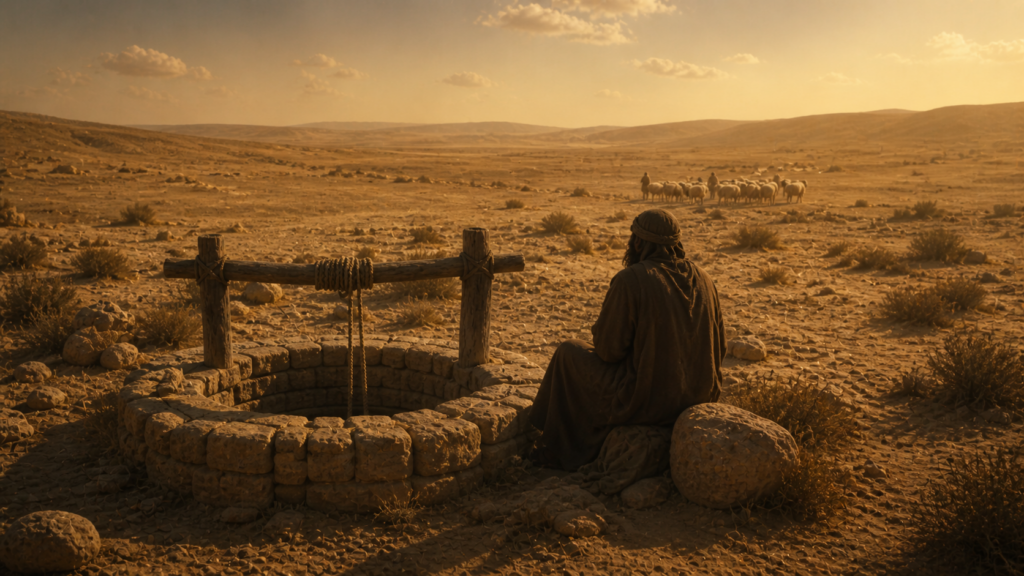
Genesis 29 picks up from Bethel and walks Jacob the rest of the way to Haran. The chapter records his arrival at the well outside Laban’s town, his meeting with Rachel, his welcome into Laban’s household, his agreement to serve seven years for her, the seven years served, and the wedding night that turns out to be the chapter’s most stunning scene: Laban gives Leah instead of Rachel. The morning reveals the substitution. Jacob is now on the receiving end of a deception. Laban’s defense is itself a quiet rebuke: it is not done in our country to give the younger before the firstborn.
The patriarchal narrative is doing something deliberate. The man who deceived his father in chapter 27 by exploiting his blindness has, in chapter 29, been deceived in the dark by exploiting his assumption. The chapter does not editorialize. It just records the inversion. Jacob agrees to serve another seven years; he marries Rachel after the bridal week with Leah; the household has two sister-wives, one beloved and one unloved.
The chapter then records the beginning of the twelve sons of Israel. Leah, unloved, conceives, and Yahweh “opens her womb” while Rachel remains barren. Four sons are born to Leah in this chapter: Reuben, Simeon, Levi, and Judah. Each son is named in pain. The names trace, in their etymologies, the matriarch’s slow grief and small hopes. The fourth son’s name, Judah, will be the one whose tribe carries the line to David and to Christ, and the chapter closes with Leah’s praise. The covenant family is being built through the body of the wife the patriarch did not want.
The chapter is about substitution and inversion. The deceiver receives the deception. The unloved becomes the matriarch of the line that matters. The Hebrew Bible’s pattern of God working through unexpected paths is operating in full.
A · Genesis 29:1–14 · The well, Rachel, and the welcome
¹ Then Jacob went on his journey, and came to the land of the children of the east. ² He looked, and behold, a well in the field, and, behold, three flocks of sheep lying there by it. For out of that well they watered the flocks. The stone on the well’s mouth was large. ³ There all the flocks were gathered. They rolled the stone from the well’s mouth, and watered the sheep, and put the stone again on the well’s mouth in its place. ⁴ Jacob said to them, “My relatives, where are you from?” They said, “We are from Haran.” ⁵ He said to them, “Do you know Laban, the son of Nahor?” They said, “We know him.” ⁶ He said to them, “Is it well with him?” They said, “It is well. See, Rachel, his daughter, is coming with the sheep.” ⁷ He said, “Behold, it is still the middle of the day, not time to gather the livestock together. Water the sheep, and go and feed them.” ⁸ They said, “We can’t, until all the flocks are gathered together, and they roll the stone from the well’s mouth. Then we water the sheep.” ⁹ While he was yet speaking with them, Rachel came with her father’s sheep, for she kept them. ¹⁰ When Jacob saw Rachel the daughter of Laban, his mother’s brother, and the sheep of Laban, his mother’s brother, Jacob went near, and rolled the stone from the well’s mouth, and watered the flock of Laban his mother’s brother. ¹¹ Jacob kissed Rachel, and lifted up his voice, and wept. ¹² Jacob told Rachel that he was her father’s relative, and that he was Rebekah’s son. She ran and told her father. ¹³ When Laban heard the news of Jacob, his sister’s son, he ran to meet Jacob, and embraced him, and kissed him, and brought him to his house. Jacob told Laban all these things. ¹⁴ Laban said to him, “Surely you are my bone and my flesh.” He lived with him for a month. (Genesis 29:1–14, World English Bible)
- The chapter opens with one of the patriarchal narrative’s most beloved type-scenes: the meeting at the well. We have seen this before. The servant met Rebekah at the well in chapter 24. We will see it again in Exodus 2 (Moses meeting Zipporah). The Gospel of John 4 will play with the same form (Jesus meeting the Samaritan woman). The well-meeting is its own genre. The reader who knows the form recognizes immediately what kind of scene this is.
- The setup, however, is different from chapter 24. The servant of Abraham came with ten camels, gifts, and a specific prayer. Jacob comes with nothing. He is alone, on foot, with no household behind him. The contrast with the earlier well-scene is part of the chapter’s argument. The deceiver who fled Beersheba arrives at the well in Haran with nothing but the staff in his hand.
- The stone on the well’s mouth (verse 2) is the chapter’s first detail. It is large; it requires the gathered flocks to be rolled away; it functions as a community lock on the water. The narrator gives us the detail because it is going to matter in verse 10.
- Jacob’s conversation with the local shepherds (verses 4 to 8) sets up the encounter. They are from Haran. They know Laban. They report he is well. Rachel his daughter is coming with the sheep. The narrator gives us Rachel’s arrival before Jacob sees her.
- Verse 10 is the chapter’s first physical action by Jacob. When Jacob saw Rachel… Jacob went near, and rolled the stone from the well’s mouth, and watered the flock of Laban his mother’s brother. The stone that required multiple flocks to roll, that required the standard cultural protocol of waiting until everyone was present, Jacob rolls alone. The patriarchal grandson is, in this moment, demonstrating the strength and energy that will mark his life. The man who would later wrestle a divine being at Jabbok is, in this scene, rolling a stone that should have taken several men. The narrator does not editorialize, but the strength is the chapter’s first signal that Jacob is no ordinary fugitive.
Influence callout: Tim Mackie
Mackie’s reading of the well-meeting type-scenes notes that each one carries forward elements of the previous instances while adding new dimensions. Rebekah at the well drew water for ten camels (a chesed feat). Jacob at the well rolls the stone alone (a strength feat). Moses at the well in Exodus 2 will defend the daughters of Reuel from the shepherds (a justice feat). Each well-meeting introduces a partner in a way that previews who the patriarch will become. Mackie argues that the type-scenes are doing literary character-introduction work: the wife-scene tells you something about the husband. Rebekah’s chesed will travel through Isaac. Jacob’s stone-rolling strength will travel through his entire long contest with Laban and with God.
- Verse 11 is striking. Jacob kissed Rachel, and lifted up his voice, and wept. The kiss is the cultural greeting of family kinship. The weeping is something else. The narrator does not explain. The man who has fled his family, walked alone for many days, and arrived among strangers has just discovered he is not alone in the world. His mother’s brother’s daughter is in front of him. The relief is its own emotion. The chapter records the body’s response.
- Laban’s welcome (verses 13 to 14) is generous, embracing, kin-affirming. Surely you are my bone and my flesh. The Hebrew construction echoes Genesis 2:23 (Adam’s recognition speech to Eve) but is applied here to extended family kinship. The patriarchal grandson is, in this moment, fully welcomed. The next twenty years are going to complicate that welcome. But the opening is warm.
B · Genesis 29:15–30 · The bargain and the deception
¹⁵ Laban said to Jacob, “Because you are my relative, should you therefore serve me for nothing? Tell me, what will your wages be?” ¹⁶ Laban had two daughters. The name of the elder was Leah, and the name of the younger was Rachel. ¹⁷ Leah’s eyes were weak, but Rachel was beautiful in form and attractive. ¹⁸ Jacob loved Rachel. He said, “I will serve you seven years for Rachel, your younger daughter.” ¹⁹ Laban said, “It is better that I give her to you, than that I should give her to another man. Stay with me.” ²⁰ Jacob served seven years for Rachel. They seemed to him but a few days, for the love he had for her. ²¹ Jacob said to Laban, “Give me my wife, for my days are fulfilled, that I may go in to her.” ²² Laban gathered together all the men of the place, and made a feast. ²³ In the evening, he took Leah his daughter, and brought her to him. He went in to her. ²⁴ Laban gave Zilpah his servant to his daughter Leah for a servant. ²⁵ In the morning, behold, it was Leah! He said to Laban, “What is this you have done to me? Didn’t I serve with you for Rachel? Why then have you deceived me?” ²⁶ Laban said, “It is not done so in our place, to give the younger before the firstborn. ²⁷ Fulfill the week of this one, and we will give you the other also for the service which you will serve with me for seven more years.” ²⁸ Jacob did so, and fulfilled her week. He gave him Rachel his daughter as wife. ²⁹ Laban gave Bilhah, his servant, to his daughter Rachel to be her servant. ³⁰ He went in also to Rachel, and he loved Rachel more than Leah, and served with him seven more years. (Genesis 29:15–30, World English Bible)
- Laban’s question (verse 15) is the chapter’s first hint that the welcome has business dimensions. What will your wages be? The patriarchal grandson is no longer just a kinsman; he has become a worker. The transition from kinship to employment is being negotiated.
- The introduction of the two daughters (verses 16 to 17) is one of the chapter’s most quietly devastating sentences. Leah’s eyes were weak, but Rachel was beautiful in form and attractive. The Hebrew word for “weak” (rakkot) is debated. Some translations render it “tender” or “soft” (a positive trait); others “weak” or “pale” (a negative). What the Hebrew construction is clearly doing is contrasting the sisters. Leah has eyes of one kind; Rachel is beautiful overall. The narrator’s description is not flattering to Leah, and the rest of the chapter will make clear that Jacob’s preference falls overwhelmingly on Rachel.
Pushback note
Some readings have tried to soften this verse by making Leah’s eyes a kind of beauty; some Jewish midrashim, for instance, read rakkot as meaning “tender” in the sense of devotional. The Hebrew text resists the rescue. The narrator is contrasting the sisters and naming, in the contrast, that Rachel is the more beautiful of the two. Leah’s pain across the rest of the chapter (and the rest of the patriarchal narrative) is grounded in this asymmetry. The chapter is honest about it; we should be too.
- Jacob’s offer (verse 18) is striking. I will serve you seven years for Rachel, your younger daughter. Seven years was, by ANE standards, a substantial bride-price equivalent. The patriarch is offering a long labor commitment in lieu of the wealth he does not have. He arrived with nothing; he is offering his back.
- Verse 20 is one of the chapter’s most romantic sentences. Jacob served seven years for Rachel. They seemed to him but a few days, for the love he had for her. The Hebrew is vayehi-be’einav ke-yamim achadim be-ahavato otah, “and they were in his eyes as a few days because of his love for her.” The narrator is, for one verse, unguardedly inside the patriarch’s emotional life. The seven years passed quickly because love compressed them.
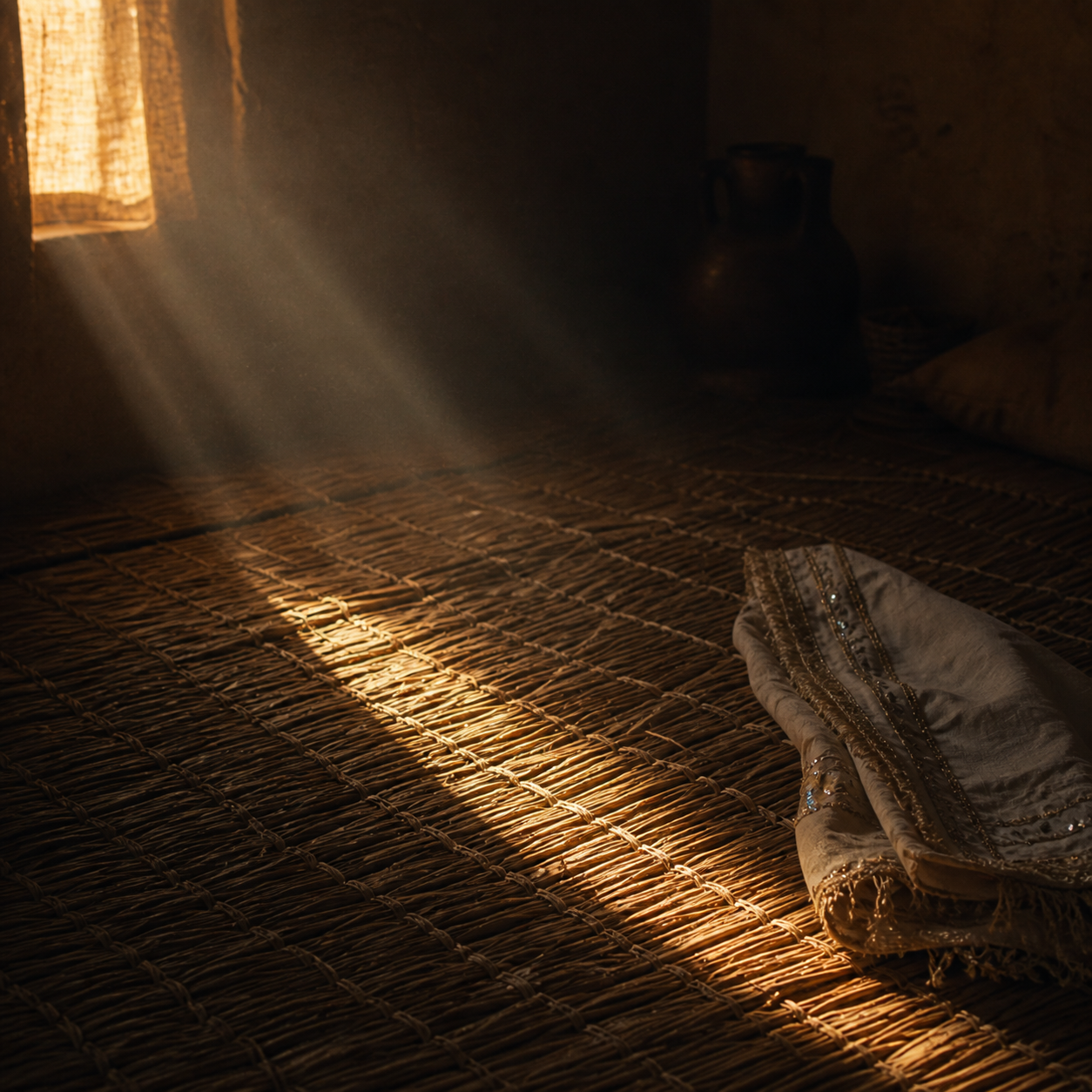
- The wedding night (verses 22 to 25) is the chapter’s most stunning scene. The feast is held; the men of the place are gathered; the wine flows; the bride is brought in the evening. The text says, with characteristic restraint, He went in to her. The morning light reveals what the dark concealed: it was Leah.
Word study: vehineh-hi Leah (וְהִנֵּה־הִיא לֵאָה), “and behold, it was Leah!”
The Hebrew of verse 25 is one of the great narrative reveals in the patriarchal cycle. The construction hineh-hi (behold-she) is the storyteller’s gesture: look, here is the surprise. The reader, having been told in verse 23 that Leah was brought, has been waiting for this realization to dawn on Jacob. The chapter has held the suspense for two verses. The morning brings the recognition. Hebrew narrative loves these reveal-moments; this is among the most charged in Genesis.
Influence callout: Tim Mackie
Mackie’s reading of this scene foregrounds the deliberate inversion. Genesis 27 had the deceiver Jacob exploiting his father’s blindness in the daytime to take what was meant for the elder; Genesis 29 has Laban exploiting Jacob’s blindness (the dark of the wedding night, the wine of the feast, the assumption that the right woman has been brought) to give the elder where Jacob expected the younger. Laban’s defense in verse 26 (it is not done so in our place, to give the younger before the firstborn) is itself a quiet rebuke. The man who reversed birth-order to take the blessing has been corrected by a culture that does not, by its own statement, reverse birth-order. The deceiver has been deceived. The chapter is naming the inversion without rubbing it in.
- Jacob’s confrontation (verse 25) echoes Abimelech’s confrontation of Abraham in chapter 20 (what is this you have done to me?). The patriarchal grandson is now in the position the patriarch’s pagan victim once was. The chapter is making the parallel sharp without italicizing it.
- Laban’s solution (verses 27 to 28) is to require another seven years’ service for Rachel, with the bridal week of Leah completed first. Jacob agrees. The patriarchal grandson is now contracted for fourteen years of labor for the right to marry the woman he loves. The chapter records the transaction without protest.
Pushback note
Some readings have tried to make Leah complicit in the deception, framing her as a willing partner in Laban’s scheme. The text does not support this. Leah does not speak in this section. She is given to Jacob by her father; she is brought to the wedding chamber; she is named only by her father’s actions and by Jacob’s morning recognition. The deception is Laban’s. Leah is, in this scene, an object of her father’s manipulation, not a co-conspirator. The chapter’s pain about Leah’s life unfolds in the next section because of how she has been treated, not because of what she has done.
C · Genesis 29:31–35 · Leah’s children, named in pain
³¹ The LORD saw that Leah was hated, and he opened her womb, but Rachel was barren. ³² Leah conceived, and bore a son, and she named him Reuben. For she said, “Because the LORD has looked at my affliction; for now my husband will love me.” ³³ She conceived again, and bore a son, and said, “Because the LORD has heard that I am hated, he has therefore given me this son also.” She named him Simeon. ³⁴ She conceived again, and bore a son. She said, “Now this time will my husband be joined to me, because I have borne him three sons.” Therefore his name was called Levi. ³⁵ She conceived again, and bore a son. She said, “This time I will praise the LORD.” Therefore she named him Judah. Then she stopped bearing. (Genesis 29:31–35, World English Bible)
- Verse 31 is the chapter’s pivot. The LORD saw that Leah was hated, and he opened her womb, but Rachel was barren. The Hebrew word translated “hated” is senuah, which is the strong word; some translations soften it to “unloved.” Either way, the chapter is naming what Jacob’s love for Rachel has produced for Leah. Leah is the wife he did not want. Yahweh sees this. The verb vayar Yahweh, “and Yahweh saw,” is the chapter’s quiet theological move: the unwanted wife is seen.
Influence callout: Walter Brueggemann
Brueggemann’s reading of Leah’s chapter names it as one of the patriarchal narrative’s deepest pastoral moves. The family that the covenant runs through has, at its heart, a wife whom the patriarch does not love. The narrator does not euphemize this. Yahweh’s response is to see Leah and open her womb. The opened womb is not consolation; it is action. The chapter is recording, in the matriarchal infertility-and-fertility pattern that has shaped the patriarchal narrative since Sarah, that Yahweh’s attention often falls on the rejected. Leah is the Hagar of the second generation, the matriarch’s matriarch, the woman whose children will become the spine of the covenant family. Brueggemann argues that the chapter is doing pastoral work for every reader who has ever felt unwanted: the LORD saw that Leah was hated, and he opened her womb.
- The naming of the four sons is the chapter’s most intricate Hebrew passage. Each name carries a meaning, and Leah’s stated reason for the name shows what she was hoping for at each birth.
Word studies on the four sons’ names
Reuben (Re’uven) is built on ra’ah (to see) plus ben (son). Leah’s stated meaning: “the LORD has looked at my affliction.” The name records that Yahweh has seen what her husband has not.
Simeon (Shim’on) is built on shama (to hear). Leah’s stated meaning: “the LORD has heard that I am hated.” The name records that Yahweh has heard what her husband has not noticed.
Levi (Levi) is related to the verb lavah (to join). Leah’s stated meaning: “now this time will my husband be joined to me, because I have borne him three sons.” The name records her hope that her husband’s affection might finally land on her.
Judah (Yehudah) is built on yadah (to praise). Leah’s stated meaning: “this time I will praise the LORD.” The name records the matriarch’s fourth-son shift: she stops naming the children for what she hopes from her husband and starts naming for what she will give to Yahweh.
- The sequence of the four names traces Leah’s emotional arc with precision. He has seen me. He has heard me. Maybe my husband will join me. I will praise the LORD. The matriarch is moving from longing-for-her-husband to direct-relationship-with-Yahweh. By the fourth son, she has reframed her own theological center. The husband has not changed; her place has.
Influence callout: Nijay Gupta
The kind of attentive reading Gupta and others have done on women in biblical narrative pays particular attention to Leah’s arc. The matriarch has been treated as the “wrong” wife by her husband; she has borne three sons hoping for love that has not come. By the fourth son, her speech has changed. She no longer mentions the husband. She names the child for praise. Gupta and others have read this as one of the Hebrew Bible’s quiet recoveries: the unloved wife discovers, by the fourth child, that her relationship with Yahweh does not depend on her relationship with her husband. The chapter is honoring that recovery in the etymology itself. Judah, the son who will give his name to a tribe and ultimately to David’s line and to Christ, is named not in hope of love but in praise of God. The covenant line emerges from a moment of theological reorientation, not from a moment of marital repair.
- Then she stopped bearing (verse 35). The chapter closes the section abruptly. Leah’s first round of childbearing is over. The narrative will turn, in chapter 30, to Rachel’s pain and the long competition between the sisters and their slaves. But the four sons are in place: Reuben, Simeon, Levi, Judah. The covenant line that will lead to David and to Christ runs through the fourth, named in praise.
Reflection prompts
- The chapter’s central inversion is that the deceiver becomes the deceived. Jacob, who exploited his father’s blindness in chapter 27, is now exploited by Laban’s manipulation of the dark. The Hebrew Bible is honest about this kind of justice: what we have done to others sometimes returns to us in unexpected forms. Where in your life are you currently experiencing the back-end of an earlier choice? What does it look like to recognize the inversion without becoming defensive?
- Leah’s naming of her four sons traces an arc from longing-for-her-husband to praise-of-Yahweh. By the fourth son, she has reframed her own center. Where in your life are you still naming things in hope of someone’s love that you may need to start naming in praise to God? What would change if your theological orientation no longer depended on someone else’s emotional response?
- The chapter records that the LORD saw that Leah was hated, and he opened her womb. Yahweh’s attention falls on the rejected. The covenant family’s spine, the line that runs to Christ, comes through the wife the patriarch did not love. Where in your life have you been the Leah of the story, the one who was not chosen, and what does it mean to know that the canonical record names your seeing without softening it?