
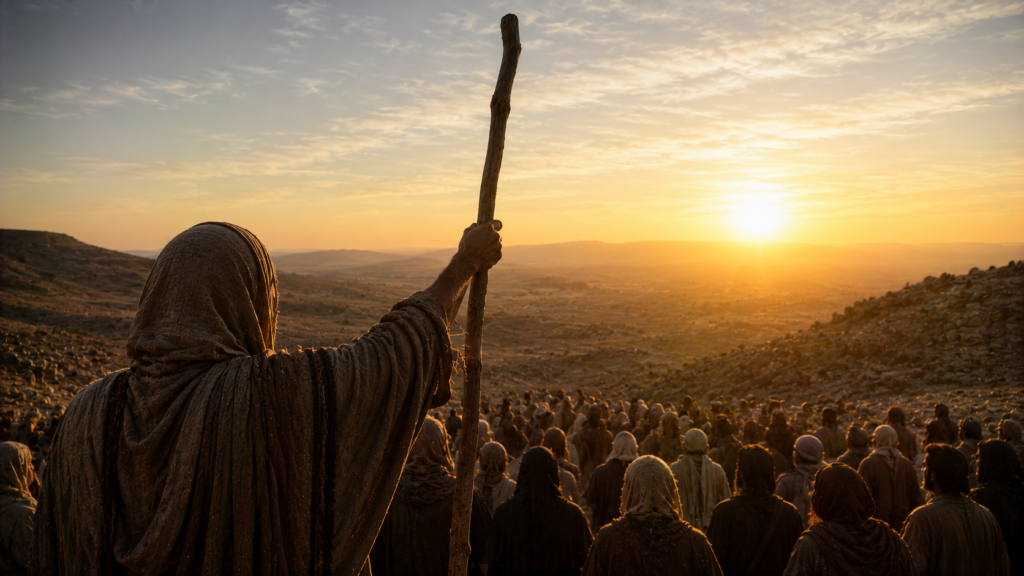
Chapter 18 is about how Israel relates to the unseen world and the unknown future, and how that sets it apart from every nation around it. The Canaanite cultures grasped at hidden power through divination, sorcery, mediums, omen-reading, and, at the horrifying extreme, child sacrifice. Israel is forbidden all of it. But Deuteronomy does not leave a vacuum. Instead of manipulating the spirit-world to wring out secrets, Israel will be spoken to, God will raise up prophets who carry his word.
The chapter climbs to one of the Hebrew Bible’s great promises: Yahweh your God will raise up to you a prophet from among you, of your brothers, like me. You shall listen to him (18:15). It inaugurates the whole line of Israel’s prophets, and it plants an expectation that grows across the centuries into the hope of a coming Prophet (see the new Moses). The New Testament seizes on it: Peter and Stephen both name Jesus as this prophet (Acts 3:22-23; 7:37), and at the Transfiguration the Father’s own voice echoes the verse word for word, “listen to him” (Mark 9:7).
A · Deuteronomy 18:1-8 · The Levites, whose inheritance is the Lord
¹ The priests and the Levites—all the tribe of Levi—shall have no portion nor inheritance with Israel. They shall eat the offerings of Yahweh made by fire and his portion. ² They shall have no inheritance among their brothers. Yahweh is their inheritance, as he has spoken to them. ³ This shall be the priests’ due from the people, from those who offer a sacrifice, whether it be ox or sheep, that they shall give to the priest: the shoulder, the two cheeks, and the inner parts. ⁴ You shall give him the first fruits of your grain, of your new wine, and of your oil, and the first of the fleece of your sheep. ⁵ For Yahweh your God has chosen him out of all your tribes to stand to minister in Yahweh’s name, him and his sons forever. ⁶ If a Levite comes from any of your gates out of all Israel where he lives, and comes with all the desire of his soul to the place which Yahweh shall choose, ⁷ then he shall minister in the name of Yahweh his God, as all his brothers the Levites do, who stand there before Yahweh. ⁸ They shall have like portions to eat, in addition to that which comes from the sale of his family possessions. (Deuteronomy 18:1–8, World English Bible)
- Yahweh is their inheritance (verses 1-5). The tribe of Levi receives no land. They live instead from the offerings, supported by the people they serve. And the reason given is not deprivation but privilege: Yahweh is their inheritance (verse 2, echoing 10:9). The tribe with no acreage has the best portion of all, God himself. It is a quiet anticipation of a whole people who will one day learn that their true inheritance is not real estate but the Lord (Ps 16:5; 73:26).
- Any Levite… may come… and minister (verses 6-8). The law protects the rural Levite’s right to serve, and share equally, at the central sanctuary if he wishes to come. No Levite is to be shut out of his calling by geography or local politics.
B · Deuteronomy 18:9-14 · No traffic with the occult
⁹ When you have come into the land which Yahweh your God gives you, you shall not learn to imitate the abominations of those nations. ¹⁰ There shall not be found with you anyone who makes his son or his daughter to pass through the fire, one who uses divination, one who tells fortunes, or an enchanter, or a sorcerer, ¹¹ or a charmer, or someone who consults with a familiar spirit, or a wizard, or a necromancer. ¹² For whoever does these things is an abomination to Yahweh. Because of these abominations, Yahweh your God drives them out from before you. ¹³ You shall be blameless with Yahweh your God. ¹⁴ For these nations that you shall dispossess listen to those who practice sorcery and to diviners; but as for you, Yahweh your God has not allowed you so to do. (Deuteronomy 18:9–14, World English Bible)
- Anyone who makes his son or daughter pass through the fire… divination… necromancy (verses 9-12). The list catalogs the whole Canaanite toolkit for accessing hidden power: child sacrifice (the same horror named in 12:31), divination, fortune-telling, enchantment, sorcery, spells, mediums, and consulting the dead. All of it is abomination. The thread that unites these very different practices is the impulse to manipulate the unseen, to bend gods, spirits, or the future to one’s own ends by technique.
- But as for you, Yahweh your God has not allowed you (verses 13-14). Israel’s alternative is not to deny the unseen world (the Hebrew Bible takes the spirit-realm entirely seriously; see the divine council), but to relate to it differently. The nations grab at hidden knowledge through ritual technique; Israel receives what God chooses to reveal, and otherwise rests content not to know (“the secret things belong to Yahweh,” 29:29). The difference is the difference between magic and faith: magic manipulates, faith listens and trusts. To “be blameless” (verse 13) is to refuse to seize control of the future and to leave it in God’s hands, which is exactly what the next section makes possible.
Influence callout: Daniel Block on the prophet and the diviner
Block’s reading of Deut 18’s two-sided law, no traffic with the occult (18:9-14), a prophet like Moses will come (18:15-22), argues that the two halves are deliberately set in opposition. The diviner and the prophet both deal in the future. They are not different in topic; they are different in direction. The diviner is in the business of controlling the future: reading omens, manipulating spirits, casting lots in a way that lets you see and steer what is coming. The prophet is the opposite: not a future-reader for hire but a messenger given by God to confront the present with a word the speaker did not generate. Block: “Israel does not need diviners, because Israel has prophets.” The forbidden practices in 18:10-12, the medium, the necromancer, the soothsayer, are not banned because they don’t work but because they are the wrong posture. They reach for control. The prophet is given and confronts you. This is why the New Testament, when it warns the early church against false prophets (Matt 7:15-23; 2 Pet 2; 1 John 4:1), keeps the same test Deut 18 keeps: what does the word do to the listener? Does it ask for surrender, or does it offer a service of mastery? The diviner-prophet line did not vanish after the canon closed; it runs straight through the modern marketplace of “prophetic words,” and Deut 18 still names which side of it a faithful word will be on.
C · Deuteronomy 18:15-22 · A prophet like Moses
¹⁵ Yahweh your God will raise up to you a prophet from among you, of your brothers, like me. You shall listen to him. ¹⁶ This is according to all that you desired of Yahweh your God in Horeb in the day of the assembly, saying, “Let me not hear again Yahweh my God’s voice, neither let me see this great fire any more, that I not die.” ¹⁷ Yahweh said to me, “They have well said that which they have spoken. ¹⁸ I will raise them up a prophet from among their brothers, like you. I will put my words in his mouth, and he shall speak to them all that I shall command him. ¹⁹ It shall happen, that whoever will not listen to my words which he shall speak in my name, I will require it of him. ²⁰ But the prophet who speaks a word presumptuously in my name, which I have not commanded him to speak, or who speaks in the name of other gods, that same prophet shall die.” ²¹ You may say in your heart, “How shall we know the word which Yahweh has not spoken?” ²² When a prophet speaks in Yahweh’s name, if the thing doesn’t follow, nor happen, that is the thing which Yahweh has not spoken. The prophet has spoken it presumptuously. You shall not be afraid of him. (Deuteronomy 18:15–22, World English Bible)
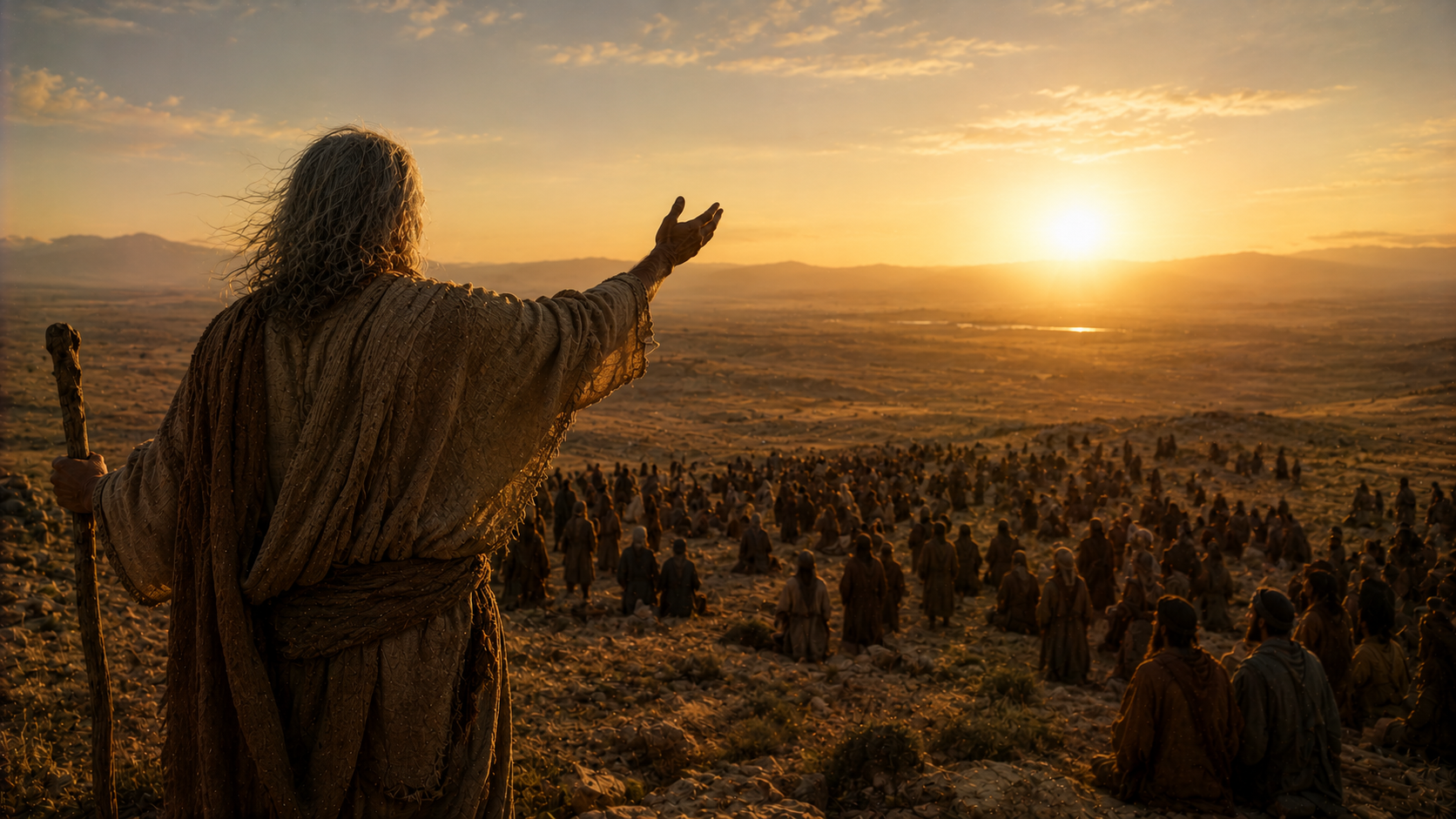
- A prophet… like me. You shall listen to him (verses 15-19). Here is God’s answer to the occult: not a technique for seizing the future, but a person who carries his word. The promise is rooted in the people’s terror at Horeb (verse 16; see 5:23-27), where they begged not to hear God’s voice directly and asked for a mediator. God grants the request permanently, I will put my words in his mouth.
Influence callout: “a prophet like me” (Moses and the Prophet to come)
Deuteronomy 18:15-18 works on two levels at once (see the new Moses). At the first level it institutes the office of prophet: a continuing line of authorized voices (Samuel, Elijah, Isaiah, Jeremiah, and the rest) who, unlike the nations’ diviners, do not manipulate but speak God’s words. The translations keep the call clear, you must listen to him (CSB, NIV). But the singular language, “a prophet like me,” and the book’s own closing verdict that “there has not arisen a prophet since in Israel like Moses” (34:10), opened a deeper expectation: that one day a prophet of Moses’ own stature would come. By the first century this was a live messianic hope (“are you the Prophet?” they ask John, John 1:21). The New Testament answers it directly: Peter (Acts 3:22-23) and Stephen (Acts 7:37) both quote this passage of Jesus, and at the Transfiguration the Father’s voice deliberately echoes verse 15, “This is my beloved Son. Listen to him” (Mark 9:7), as Moses himself stands beside Jesus and then withdraws. Moses pointed past himself to one who would not merely carry God’s words but be the Word (John 1:1). The chapter that forbids grasping at hidden knowledge ends by promising the fullest revelation of all.
- How shall we know the word which Yahweh has not spoken? (verses 20-22). Deuteronomy is realistic: prophets can be frauds, speaking “presumptuously” in God’s name. So it gives a test, the long-range one of fulfillment (does the word come true?) alongside the test of chapter 13 (does it lead you toward YHWH or away?). Together the two tests guard the community: a true prophet’s word both comes to pass and points to the true God. False prophecy is treated with deadly seriousness because a counterfeit word in God’s name can destroy a people, but the believer is told, reassuringly, you shall not be afraid of him. Truth outlasts the fraud.
Reflection prompts
- The occult arts in this chapter are all forms of manipulating the unseen to control the future. Where are you tempted, maybe in subtle, modern forms, to grasp for control of what’s hidden or to come, instead of trusting God with it and listening for his word?
- The Levites’ inheritance was the Lord himself, not land. Where might God be inviting you to find your security in him rather than in the “portion” (property, savings, status) you’d normally count on?
- The Father’s word about Jesus echoes Deuteronomy 18: “listen to him.” Of all the voices competing for your attention and loyalty, how do you actually practice listening to the Prophet God told you to heed?
Frameworks at play in this chapter: the new Moses, the place YHWH will choose, the divine council.