
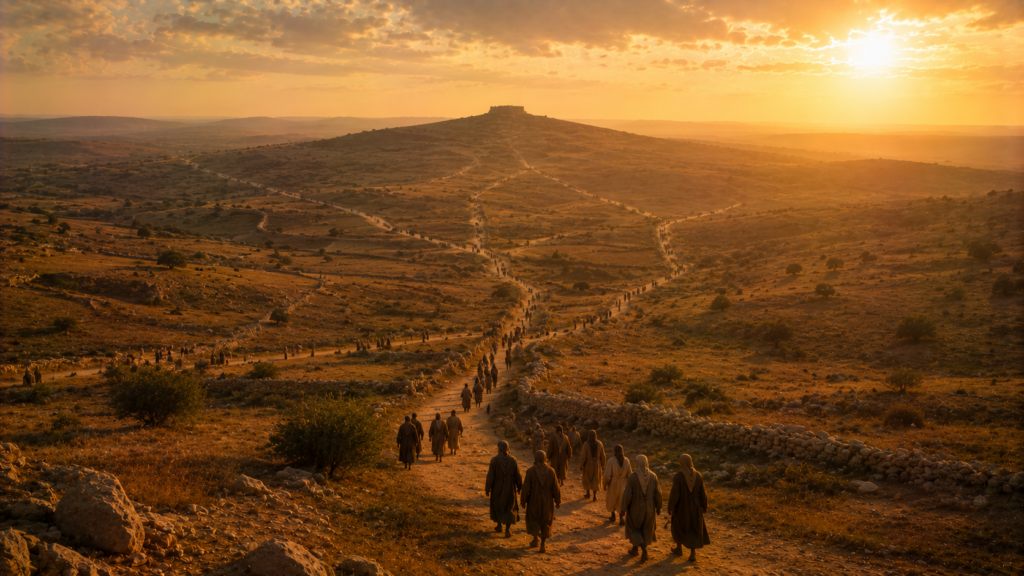
Chapter 16 sets two things side by side that the modern mind files in separate folders: worship and justice. The first two-thirds lays out Israel’s three annual pilgrim feasts, Passover and Unleavened Bread, Weeks, and Booths, all to be kept at the one chosen place (see the festival calendar, the place YHWH will choose). The last third turns to courts and judges and lands on one of the most famous commands in the Hebrew Bible: you shall follow that which is altogether just (16:20), the doubled cry “justice, justice you shall pursue.”
The two halves belong together. The feasts are not private piety; they are communal acts of memory and joy that deliberately fold in the people most easily excluded, your son and daughter, your male and female servant, the Levite, the foreigner, the fatherless, and the widow. A people re-formed three times a year by remembering its own slavery and feasting with the vulnerable is a people that must then do justice in its gates. Worship that remembers Egypt produces courts that protect the weak. Deuteronomy will not let the festival and the courtroom be strangers.
A · Deuteronomy 16:1-8 · Passover and the bread of affliction
¹ Observe the month of Abib, and keep the Passover to Yahweh your God; for in the month of Abib Yahweh your God brought you out of Egypt by night. ² You shall sacrifice the Passover to Yahweh your God, of the flock and the herd, in the place which Yahweh shall choose to cause his name to dwell there. ³ You shall eat no leavened bread with it. You shall eat unleavened bread with it seven days, even the bread of affliction (for you came out of the land of Egypt in haste) that you may remember the day when you came out of the land of Egypt all the days of your life. ⁴ No yeast shall be seen with you in all your borders seven days; neither shall any of the meat, which you sacrifice the first day at evening, remain all night until the morning. ⁵ You may not sacrifice the Passover within any of your gates which Yahweh your God gives you; ⁶ but at the place which Yahweh your God shall choose to cause his name to dwell in, there you shall sacrifice the Passover at evening, at the going down of the sun, at the season that you came out of Egypt. ⁷ You shall roast and eat it in the place which Yahweh your God chooses. In the morning you shall return to your tents. ⁸ Six days you shall eat unleavened bread. On the seventh day shall be a solemn assembly to Yahweh your God. You shall do no work. (Deuteronomy 16:1–8, World English Bible)
- Keep the Passover… for in the month of Abib Yahweh brought you out of Egypt by night (verses 1-2). The feast year opens with the festival of rescue. Passover is memory made edible: the lamb, the date, the very darkness (“by night”) all rehearse the exodus, so that each generation tastes the deliverance rather than merely hearing about it.
- Unleavened bread… even the bread of affliction (verses 3-8). The seven days of flat bread carry a double meaning Deuteronomy holds together. It is the bread of haste (no time for dough to rise on the night of escape) and the bread of affliction (lechem oni), the plain, poor bread of slaves. Eating it yearly keeps the memory of bondage in the body. A people that never forgets it was poor and enslaved is being formed for the justice the chapter will demand. (The New Testament hears this feast fulfilled at the cross, “Christ our Passover has been sacrificed,” 1 Cor 5:7, and Jesus’ Last Supper is a Passover meal.)
B · Deuteronomy 16:9-17 · Weeks and Booths: the pilgrim feasts of joy
⁹ You shall count for yourselves seven weeks. From the time you begin to put the sickle to the standing grain you shall begin to count seven weeks. ¹⁰ You shall keep the feast of weeks to Yahweh your God with a tribute of a free will offering of your hand, which you shall give according to how Yahweh your God blesses you. ¹¹ You shall rejoice before Yahweh your God: you, your son, your daughter, your male servant, your female servant, the Levite who is within your gates, the foreigner, the fatherless, and the widow who are among you, in the place which Yahweh your God shall choose to cause his name to dwell there. ¹² You shall remember that you were a slave in Egypt. You shall observe and do these statutes. ¹³ You shall keep the feast of booths seven days, after you have gathered in from your threshing floor and from your wine press. ¹⁴ You shall rejoice in your feast, you, your son, your daughter, your male servant, your female servant, the Levite, the foreigner, the fatherless, and the widow who are within your gates. ¹⁵ You shall keep a feast to Yahweh your God seven days in the place which Yahweh chooses, because Yahweh your God will bless you in all your increase and in all the work of your hands, and you shall be altogether joyful. ¹⁶ Three times in a year all of your males shall appear before Yahweh your God in the place which he chooses: in the feast of unleavened bread, in the feast of weeks, and in the feast of booths. They shall not appear before Yahweh empty. ¹⁷ Every man shall give as he is able, according to Yahweh your God’s blessing which he has given you. (Deuteronomy 16:9–17, World English Bible)
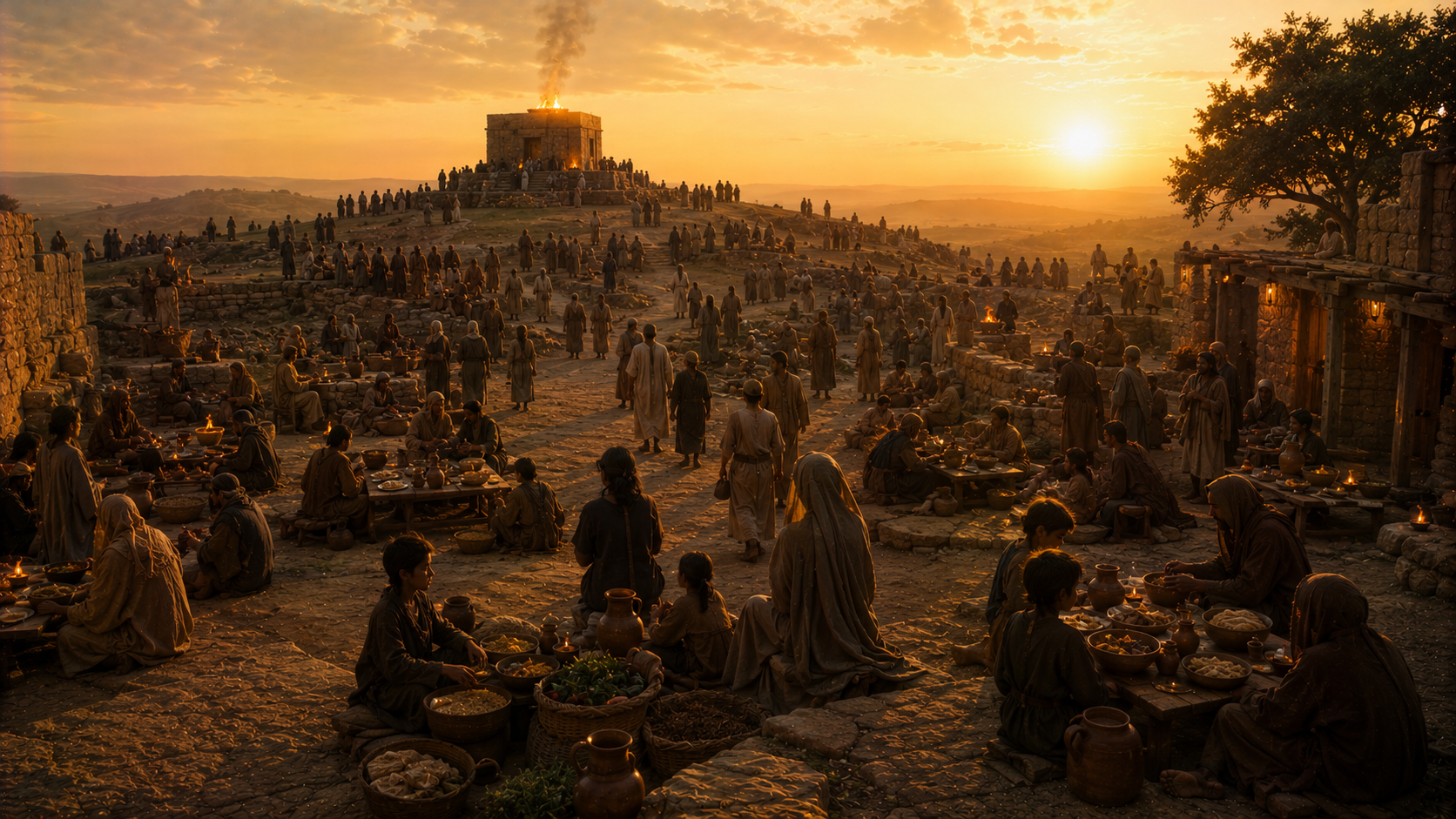
- The feast of weeks… the feast of booths… you shall rejoice (verses 9-15). The other two pilgrim feasts are harvest feasts. Weeks (Shavuot/Pentecost) celebrates the grain harvest seven weeks after Passover; Booths (Sukkot/Tabernacles) celebrates the full autumn ingathering. The dominant verb is rejoice, and verse 15 caps it: you shall be altogether joyful. Israelite worship at its center is not anxious appeasement but a harvest party before God.
Influence callout: the three feasts, and the joy that includes the outsider
Deuteronomy 16 gives the calendar of Israel’s three pilgrimage festivals (see the festival calendar): Passover/Unleavened Bread (spring, rescue from Egypt), Weeks/Pentecost (early summer, the grain harvest), and Booths/Tabernacles (autumn, the great ingathering). Two things stand out in Deuteronomy’s version. First, the guest list: twice (verses 11, 14) the command to rejoice names the same vulnerable people, the servant, the Levite, the foreigner, the orphan, the widow, and folds them into the celebration. Covenant joy is not exclusive; the people with no land and no protector are seated at the feast. Second, the memory clause: “you shall remember that you were a slave in Egypt” (verse 12). The reason to include the powerless is that Israel was once powerless and was rescued. The New Testament finds these feasts fulfilled in the gospel’s own rhythm, Christ the Passover lamb (1 Cor 5:7), the Spirit poured out at Pentecost (Acts 2), and the final ingathering of all peoples that Booths anticipated (Zech 14:16; Rev 7). The feasts were always pointing beyond themselves to a joy that gathers in the outsider.
- They shall not appear before Yahweh empty (verses 16-17). Pilgrims come with a gift “as he is able,” proportioned to blessing received. Worship in Deuteronomy is responsive generosity: you bring back a measure of what you’ve been given, and the size of the gift tracks the size of the grace.
Influence callout: Patrick Miller on the feasts as covenant joy made plural
Patrick Miller’s Deuteronomy commentary in the Interpretation series reads the festival calendar of chapter 16 as one of the book’s quiet revolutions. The three pilgrim feasts of Israel’s neighbors were normally elite occasions: kings, priests, landowners. Deuteronomy refuses that. The guest list at Israel’s feasts, explicitly named three times in 16:11 and 16:14, is son, daughter, male servant, female servant, the Levite, the foreigner, the fatherless, and the widow. Joy in Deuteronomy is plural by design. The chapter does not just permit the outsider to attend; it commands that the celebration is not complete without them. Miller argues this is the Deuteronomic move at full volume: religion that does not gather in the people without standing in it is failing its own grammar. The harvest is real; the table is real; the rejoicing is real. But who is at the table is the test of whether the rejoicing belongs to the LORD whose feast it is. Centuries later Jesus’ parable of the great banquet (Luke 14:15-24) is preached straight out of Deut 16’s guest list.
C · Deuteronomy 16:18-22 · Justice, and only justice
¹⁸ You shall make judges and officers in all your gates, which Yahweh your God gives you, according to your tribes; and they shall judge the people with righteous judgment. ¹⁹ You shall not pervert justice. You shall not show partiality. You shall not take a bribe, for a bribe blinds the eyes of the wise and perverts the words of the righteous. ²⁰ You shall follow that which is altogether just, that you may live and inherit the land which Yahweh your God gives you. ²¹ You shall not plant for yourselves an Asherah of any kind of tree beside Yahweh your God’s altar, which you shall make for yourselves. ²² Neither shall you set yourself up a sacred stone which Yahweh your God hates. (Deuteronomy 16:18–22, World English Bible)
- Judges and officers in all your gates… you shall not take a bribe (verses 18-19). The festival section flows straight into a charge to establish courts. The standards are stringent: no perverting justice, no partiality, no bribes, “for a bribe blinds the eyes of the wise.” The “gate” was the ancient town’s courtroom; justice is to be local, accessible, and incorruptible.
- You shall not plant an Asherah… nor set up a sacred stone (verses 21-22). The chapter closes by guarding worship from contamination, no fertility-pole or pagan pillar beside YHWH’s altar. The placement is pointed: right after the call for pure justice comes the call for pure worship. Corrupt courts and corrupt altars are the same disease; a people is only as just as its God is true.
Word study: tzedeq tzedeq tirdof, “justice, justice you shall pursue”
The doubled noun in 16:20 is one of the most quoted half-verses in the Hebrew Bible, and the repetition is doing real work. Hebrew already has ways to intensify a noun (the construct phrase “holy of holies”; the adverb me’od); the bare doubling of tzedeq is rarer and more emphatic. The rabbinic tradition has several beautiful readings of why the word repeats. Some sages: one tzedeq for the verdict, one for the manner of arriving at it, a just outcome reached unjustly is no longer justice. Others: pursue justice with just means. Others still: one tzedeq for friends, the other for enemies, the same standard must apply on both sides of the dispute. The verb tirdof (“pursue”) is the language of hunting; you don’t fall into justice, you chase it. And the imperative is plural, addressed to the community, not just to the judge. The verse names the lifelong, communal, active chase that a covenant people are committed to: not just do justice, hunt it, with means that match what you are hunting. Modern Christian appeals to this verse often quote only the second word and skip the doubling; the doubling is the whole instruction.
Reflection prompts
- Deuteronomy’s feasts were memory made edible, tasting the rescue and the affliction so the body would not forget. What practices keep your own deliverance vivid, not just believed but re-lived?
- The command to rejoice deliberately named the servant, the foreigner, the orphan, and the widow at the table. Whose absence would be conspicuous at your celebrations, and what would it take to widen the guest list the way Deuteronomy does?
- Justice, justice you shall pursue, doubled, relentless, and by just means. Where are you content to merely not commit injustice, when Scripture calls you to actively hunt for justice on behalf of someone who can’t secure it themselves?
Frameworks at play in this chapter: the festival calendar, the place YHWH will choose, the cry of the oppressed.