
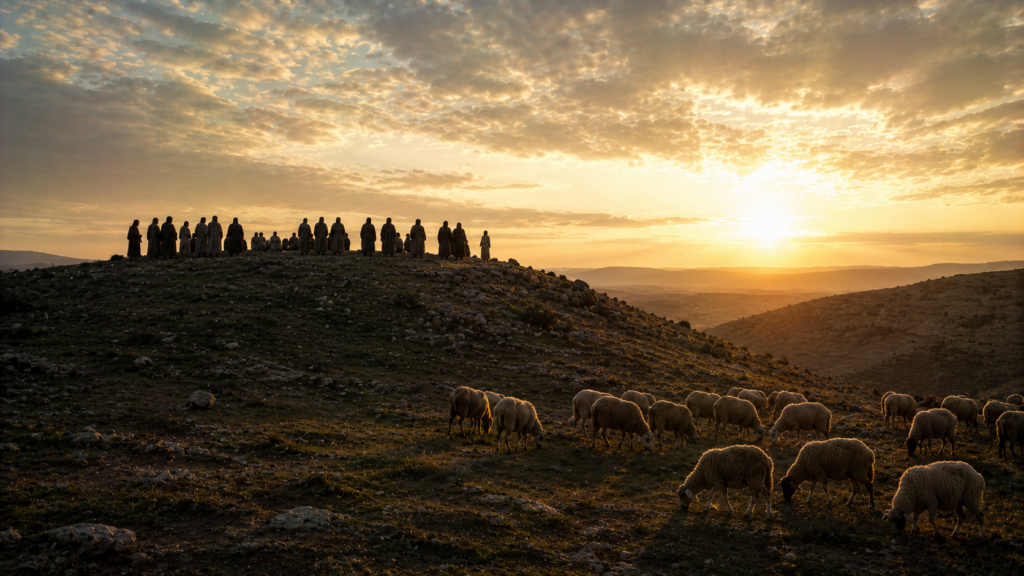
Chapter 14 works out covenant identity in the most ordinary materials of life: how you grieve, what you eat, and what you do with your harvest. It opens by naming Israel children of Yahweh your God and a holy people, and then traces that identity through the body (no pagan mourning rites), the table (clean and unclean food), and the barn (the tithe). Holiness in Deuteronomy is never abstract; it shows up at the graveside, at dinner, and in the granary.
The food laws mark Israel as set apart, a quiet, daily, three-meals-a-day reminder of belonging to a particular God (see clean and unclean). But the chapter’s most striking note comes at the end. Every third year, the tithe is stored up not for the altar but to feed the people with no land of their own, the Levite, the foreigner, the orphan, and the widow, “that they may eat and be satisfied.” The set-apart people is meant to be the open-handed people. Distinctiveness and generosity are two sides of the same holiness.
A · Deuteronomy 14:1-2 · Children of YHWH: don’t grieve like the nations
¹ You are the children of Yahweh your God. You shall not cut yourselves, nor make any baldness between your eyes for the dead. ² For you are a holy people to Yahweh your God, and Yahweh has chosen you to be a people for his own possession, above all peoples who are on the face of the earth. (Deuteronomy 14:1–2, World English Bible)
- You are the children of Yahweh… you shall not cut yourselves… for the dead (verses 1-2). The food laws are introduced by an identity and a grief. Israelites are children of God and a holy people (am qadosh), his segullah, treasured possession (the same words as 7:6). And that identity reshapes even how they mourn: no gashing the skin or shaving the forehead, the self-mutilating mourning rites of the surrounding cultures (associated with frenzied appeals to the dead and to fertility gods, cf. the prophets of Baal in 1 Kings 18:28). The reasoning is striking, our identity reaches all the way into our grief. A people who belong to the living God, and who have hope, do not mourn with the despairing violence of those who don’t (a logic Paul echoes: do not grieve “as the rest, who have no hope,” 1 Thess 4:13). How you handle death reveals what you believe about God.
B · Deuteronomy 14:3-21 · Clean and unclean: a diet that remembers who you are
³ You shall not eat any abominable thing. ⁴ These are the animals which you may eat: the ox, the sheep, the goat, ⁵ the deer, the gazelle, the roebuck, the wild goat, the ibex, the antelope, and the chamois. ⁶ Every animal that parts the hoof, and has the hoof split in two and chews the cud, among the animals, you may eat. ⁷ Nevertheless these you shall not eat of them that chew the cud, or of those who have the hoof split: the camel, the hare, and the rabbit. Because they chew the cud but don’t part the hoof, they are unclean to you. ⁸ The pig, because it has a split hoof but doesn’t chew the cud, is unclean to you. You shall not eat their meat. You shall not touch their carcasses. ⁹ These you may eat of all that are in the waters: you may eat whatever has fins and scales. ¹⁰ You shall not eat whatever doesn’t have fins and scales. It is unclean to you. ¹¹ Of all clean birds you may eat. ¹² But these are they of which you shall not eat: the eagle, the vulture, the osprey, ¹³ the red kite, the falcon, the kite of any kind, ¹⁴ every raven of any kind, ¹⁵ the ostrich, the owl, the seagull, the hawk of any kind, ¹⁶ the little owl, the great owl, the horned owl, ¹⁷ the pelican, the vulture, the cormorant, ¹⁸ the stork, the heron after its kind, the hoopoe, and the bat. ¹⁹ All winged creeping things are unclean to you. They shall not be eaten. ²⁰ Of all clean birds you may eat. ²¹ You shall not eat of anything that dies of itself. You may give it to the foreigner living among you who is within your gates, that he may eat it; or you may sell it to a foreigner; for you are a holy people to Yahweh your God. You shall not boil a young goat in its mother’s milk. (Deuteronomy 14:3–21, World English Bible)
- These are the animals which you may eat (verses 3-20). Deuteronomy gives a shorter form of the food laws set out fully in Leviticus 11: cud-chewing, split-hoofed land animals; finned and scaled fish; a list of forbidden birds (mostly raptors and scavengers). The criteria are not primarily about hygiene (the text never says the pig carries disease); they are about order and belonging.
Influence callout: clean and unclean as the table of a holy people
The dietary laws make most sense as identity markers, not health code (see clean and unclean). The chapter brackets the whole list with the same refrain, you are a holy people to Yahweh your God (verses 2, 21), framing the menu as a function of belonging. Three meals a day, an Israelite was reminded by the very food on the plate that this people lives differently because it belongs to a particular God. Mary Douglas argued the categories track wholeness and order (creatures that fit their domain cleanly versus those that blur it); whatever the precise logic, the effect is a daily, embodied discipline of distinctiveness. This is also why the New Testament can later relativize the food laws without contradicting Deuteronomy: when Jesus “declared all foods clean” (Mark 7:19) and Peter’s sheet-vision reframed the clean/unclean line (Acts 10), the point was that the boundary marking Israel off from the nations had done its work, the gospel was now going to those nations, and the table was being opened (see Paul Within Judaism). The laws were never arbitrary fussiness; they were a centuries-long lesson in being set apart, fulfilled when the set-apart people became the sent people.
- You shall not boil a young goat in its mother’s milk (verse 21). The chapter’s odd final line (repeated three times in the Torah) became the basis of the later Jewish separation of meat and dairy. Its original sense is debated, possibly a rejection of a specific Canaanite fertility ritual, possibly a broader instinct against mixing the source of life (a mother’s milk) with the death of her young. Either way it fits the chapter’s grammar: even in the kitchen, Israel is to refuse the casual cruelties and confusions of the surrounding cults. Note too the humane aside in the same verse, an animal that died on its own may be given to the resident foreigner or sold, not simply wasted, care extending to the outsider even inside the purity laws.
Influence callout: Jeffrey Tigay on the food laws as markers of belonging
Tigay’s JPS commentary on the dietary laws of Deuteronomy 14 (and Lev 11) sets aside two unsatisfying modern explanations: that the rules were hygienic (a public-health code dressed in religious language) or arbitrary (a divine test of obedience with no internal logic). What Tigay foregrounds, drawing on the Jewish exegetical tradition and ANE comparative work, is that the food laws function as symbols of belonging. Israel’s table mirrors Israel’s God. The animals permitted are land-walking ruminants that share traits with the domesticated flocks and herds Israel’s life depends on; the carnivores, scavengers, and sea creatures excluded are creatures of disorder, predation, or boundary-crossing. Eating is identity-shaping: every meal quietly rehearses who we are and whose we are. The third-year tithe in 14:28-29 then turns the same set-apartness outward: the produce that marks Israel as holy is the produce that feeds the Levite, the foreigner, the fatherless, the widow. Belonging is not a moat; it is a table with reserved seats for those without land. The New Testament will later abolish the specific food regulations (Mark 7:19; Acts 10), but it does not abolish the underlying logic: the people of God still eat in a way that says who they are, and they still eat in a way that feeds those who could not have been at the table on their own.
C · Deuteronomy 14:22-29 · The tithe, and the third-year tithe for the vulnerable
²² You shall surely tithe all the increase of your seed, that which comes out of the field year by year. ²³ You shall eat before Yahweh your God, in the place which he chooses to cause his name to dwell, the tithe of your grain, of your new wine, and of your oil, and the firstborn of your herd and of your flock; that you may learn to fear Yahweh your God always. ²⁴ If the way is too long for you, so that you are not able to carry it because the place which Yahweh your God shall choose to set his name there is too far from you, when Yahweh your God blesses you, ²⁵ then you shall turn it into money, bind up the money in your hand, and shall go to the place which Yahweh your God shall choose. ²⁶ You shall trade the money for whatever your soul desires: for cattle, or for sheep, or for wine, or for strong drink, or for whatever your soul asks of you. You shall eat there before Yahweh your God, and you shall rejoice, you and your household. ²⁷ You shall not forsake the Levite who is within your gates, for he has no portion nor inheritance with you. ²⁸ At the end of every three years you shall bring all the tithe of your increase in the same year, and shall store it within your gates. ²⁹ The Levite, because he has no portion nor inheritance with you, as well as the foreigner living among you, the fatherless, and the widow who are within your gates shall come, and shall eat and be satisfied; that Yahweh your God may bless you in all the work of your hand which you do. (Deuteronomy 14:22–29, World English Bible)
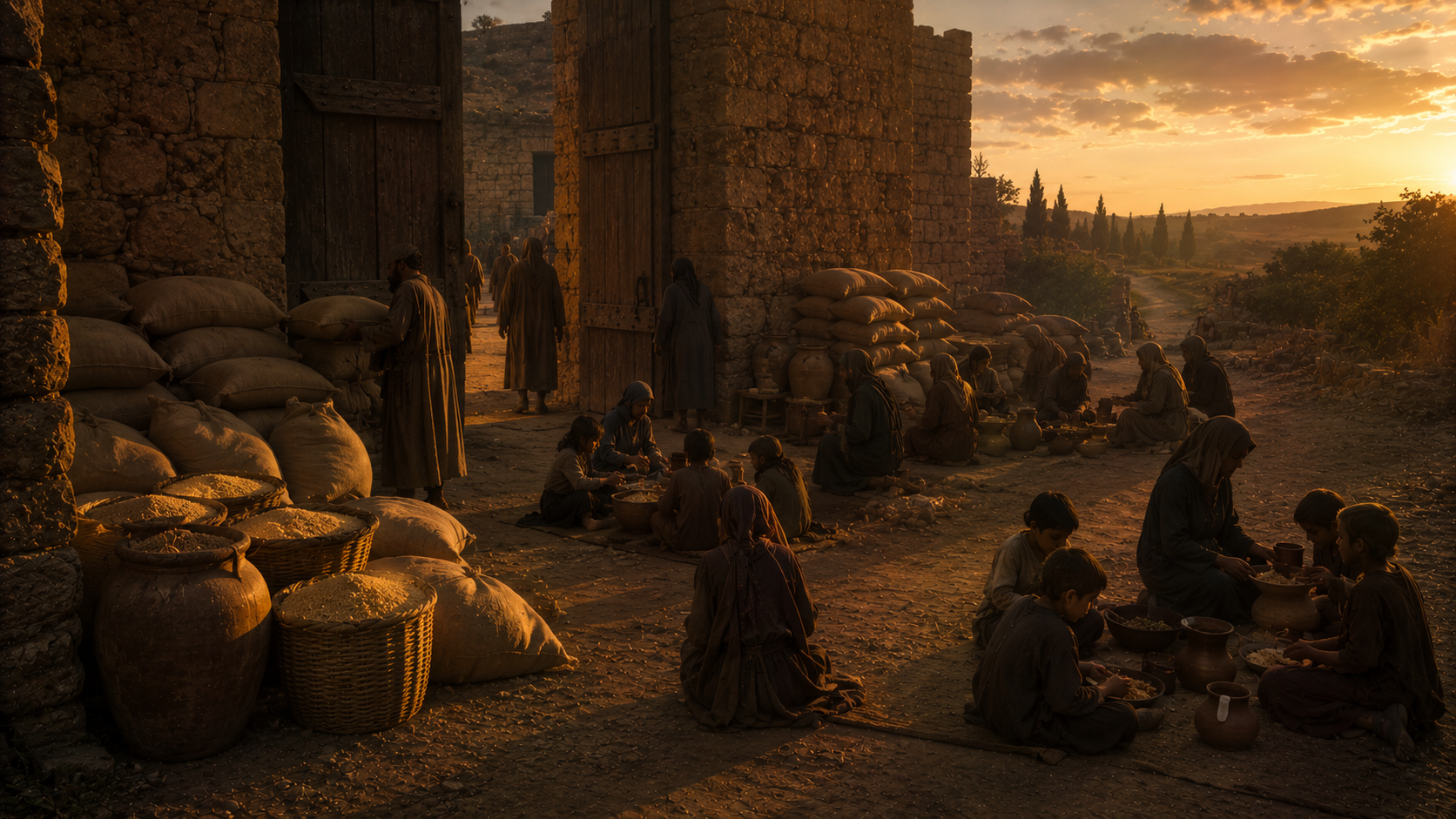
- You shall eat before Yahweh… and you shall rejoice (verses 22-27). The festival tithe is, surprisingly, mostly something you eat. The tithe of grain, wine, oil, and firstborn animals is brought to the chosen place and consumed in a joyful feast before God (see the place YHWH will choose). If the journey is too far, convert it to silver and buy “whatever your soul desires” once you arrive, cattle, sheep, wine, strong drink, and celebrate. The purpose, verse 23, is “that you may learn to fear Yahweh your God always”: gratitude and feasting teach reverence in a way that mere rule-keeping cannot. And the landless Levite is explicitly not to be forgotten in the party.
- The third-year tithe: the Levite, the foreigner, the fatherless, and the widow… shall eat and be satisfied (verses 28-29). Here is one of Deuteronomy’s most beautiful laws. Every third year the tithe is not carried to the sanctuary at all but stored in your own town as a local welfare fund for those with no land to live on, the same four figures the God of gods himself defends (10:18): the Levite, the immigrant, the orphan, the widow. The goal is not bare survival but that they eat and be satisfied, full, as God’s own people are meant to be (8:10). The set-apart diet of the holy people and the open hand to the vulnerable belong to one identity: Israel eats differently and feeds the hungry, because both flow from belonging to the God who fed them in the wilderness and loves the stranger.
Where this lands: when holiness becomes food for the hungry
The most quietly radical sentence in Deuteronomy 14 is verse 29: the third-year tithe, the same produce that marks Israel as set apart for God, feeds “the Levite, the foreigner, the fatherless, and the widow,” so they “may come and eat and be satisfied.” That is what holiness looks like in Deuteronomy. It does not stay on its shelf. The set-apart food moves, in a defined rhythm, to the people who could not have grown it. When the markers of our identity in Christ become the means by which someone outside our tribe is fed and seen, that is the Deuteronomic shape of holiness. When they only become the means by which we know who is in and who is out, we have kept the form and lost the function. The third-year tithe is not the part of the law that died with the cross. It is the part of the law the church has often quietly forgotten.
Reflection prompts
- Deuteronomy says even your grief should look different because you are God’s child with hope. Does the way you handle loss, disappointment, and death quietly reveal what you actually believe about God?
- The food laws made Israel remember who they were three times a day, an embodied, ordinary discipline of distinctiveness. What ordinary, repeated practices mark your life as belonging to God, not in dramatic moments but at the level of daily habit?
- The third-year tithe turned a tenth of the harvest into food for the landless, “that they may eat and be satisfied.” Holiness and generosity were the same identity. Where might your set-apartness have become mere distinctiveness without the open hand that’s supposed to come with it?
Frameworks at play in this chapter: clean and unclean, the place YHWH will choose, bearing God’s name.