
Genesis 21 is the chapter the patriarchal narrative has been waiting for. Twenty-five years after the call of Abram in chapter 12, twenty-four years after the first promise of countless descendants in chapter 13, eleven years after Hagar bore Ishmael in chapter 16, one year after Yahweh’s promise that Sarah would bear a son “at this set time next year” in chapter 17 and 18: Isaac is born. The covenant has, finally, produced a body.
But the chapter does not stop at the birth. It moves immediately into the second Hagar crisis. Sarah, watching Isaac and Ishmael at the weaning feast, demands that Hagar and her son be sent away. Abraham is distressed; God tells him to do as Sarah asks. Hagar and Ishmael walk into the wilderness with bread and a skin of water. The water runs out. The boy is dying. Hagar lifts up her voice and weeps. The angel of God meets her again, opens her eyes to a well she had not seen, and pronounces that God has heard the voice of the boy.
The chapter ends with a treaty scene at Beer-sheba between Abraham and the same Abimelech who appeared in chapter 20. The pagan king, having seen what Yahweh has done in Abraham’s life, comes seeking a covenant of peace. Abraham plants a tamarisk tree and calls on a divine name we have not heard before: El Olam, the Everlasting God.
The chapter is doing several things at once. It is delivering the covenant heir whose birth has been promised since chapter 12. It is recording the second and final exile of Hagar from the Abrahamic household, with all the moral discomfort that entails. It is showing that God’s care for Hagar and Ishmael has not been withdrawn, even as the covenant line narrows toward Isaac. And it is establishing Beer-sheba as a covenantal landmark for the rest of the patriarchal narratives.
A note on Hagar. The Hagar of chapter 21 is not the same character as the Hagar of chapter 16. Sixteen years have passed. Her son is now a teenager. Her social standing has been displaced by Sarah’s son. The chapter records her second wilderness encounter without softening the trauma of how she got there. The Womanist tradition has done particularly important work on this chapter (Delores Williams’ Sisters in the Wilderness is again the canonical reference). We will not match the depth of that work, but we will try to read with it.
A · Genesis 21:1–8 · The promise kept and the laughter named
¹ The LORD dealt with Sarah as he had said, and the LORD did for Sarah as he had promised. ² Sarah conceived and bore Abraham a son in his old age, at the set time of which God had spoken to him. ³ Abraham gave the name Isaac to the son whom Sarah bore him. ⁴ And Abraham circumcised his son Isaac when he was eight days old, as God had commanded him. ⁵ Abraham was a hundred years old when his son Isaac was born to him. ⁶ Now Sarah said, “God has brought laughter for me; everyone who hears will laugh with me.” ⁷ And she said, “Who would ever have said to Abraham that Sarah would nurse children? Yet I have borne him a son in his old age.” ⁸ The child grew, and was weaned; and Abraham made a great feast on the day that Isaac was weaned. (Genesis 21:1–8, NRSVue)
- The chapter opens with three verbal repetitions in two verses. The LORD dealt with Sarah as he had said. The LORD did for Sarah as he had promised. Sarah conceived and bore Abraham a son… at the set time of which God had spoken. The narrator is hammering. Yahweh said it. Yahweh promised it. Yahweh spoke it. And now Yahweh has done it. The covenant heir is not a surprise; he is the fulfillment of words spoken across multiple chapters. The reader has been waiting since 12:2; the narrator wants the reader to feel the keeping of the promise as a deliberate act of divine faithfulness.
Influence callout: Tim Mackie
Mackie’s literary reading of this opening notes the contrast with chapter 20. Genesis 20 ended with Abraham’s deception in Gerar producing closed wombs in Abimelech’s household; Genesis 21 opens with Sarah’s womb being opened. The narrator placed the two chapters in deliberate sequence. The God who closes wombs because of patriarchal failure is the same God who opens a womb because of patriarchal promise. The chapter’s first three verses are the narrator’s quiet announcement: God’s promise, despite everything, has held.
- The boy is named Yitzchaq, “he laughs.” The name carries the entire arc we have been tracking. Abraham laughed at the announcement (17:17). Sarah laughed at the visitor’s repetition (18:12). Sarah denied the laugh and was gently corrected (18:15). Now the boy named for the laughter is born, and the matriarch finally claims her own laughter out loud: “God has brought laughter for me; everyone who hears will laugh with me” (verse 6).
Word study: tzachaq (צָחַק) revisited
The verb that has run through the entire birth-of-Isaac arc finally lands here in its joy-form. Sarah’s laughter in 18:12 was internal, skeptical, partly afraid. Sarah’s laughter in 21:6 is announced, public, communal. The same Hebrew root has carried the family’s whole posture: from disbelief through denial to the publicly named gift. Tzachaq in Genesis 21:6 is the laughter the chapter has been waiting twenty-five years for.
- Sarah’s second statement (verse 7) is wonderful: “Who would ever have said to Abraham that Sarah would nurse children? Yet I have borne him a son in his old age.” She is, in effect, narrating her own life backward in disbelief. The body that should not have nursed is nursing. The age that should not have borne is bearing. The chapter is not embarrassed about the body. The promise has come through bodies that should not have been able to do this, and the matriarch is the one naming the wonder.
- Verse 4 is small but important: “Abraham circumcised his son Isaac when he was eight days old, as God had commanded him.” The eighth-day circumcision instituted in Genesis 17 is now performed on the first child of the covenant. The covenant sign in the body is no longer just on the patriarch and his household; it is now on the heir. The covenant has produced a body, and the body has been marked.
- The weaning feast (verse 8) was the cultural marker, in this period, that a child had survived early infancy. Weaning happened around two to three years of age, and the feast was a public celebration of the child’s continued life. The narrator places the next scene at the celebration meal. The pivot from joy to crisis happens at the boy’s first major public moment.
B · Genesis 21:9–21 · The casting out and the desert well
⁹ But Sarah saw the son of Hagar the Egyptian, whom she had borne to Abraham, playing with her son Isaac. ¹⁰ So she said to Abraham, “Cast out this slave woman with her son; for the son of this slave woman shall not inherit along with my son Isaac.” ¹¹ The matter was very distressing to Abraham on account of his son. ¹² But God said to Abraham, “Do not be distressed because of the boy and because of your slave woman; whatever Sarah says to you, do as she tells you, for it is through Isaac that offspring shall be named for you. ¹³ As for the son of the slave woman, I will make a nation of him also, because he is your offspring.” ¹⁴ So Abraham rose early in the morning, and took bread and a skin of water, and gave it to Hagar, putting it on her shoulder, along with the child, and sent her away. And she departed, and wandered about in the wilderness of Beer-sheba. ¹⁵ When the water in the skin was gone, she cast the child under one of the bushes. ¹⁶ Then she went and sat down opposite him a good way off, about the distance of a bowshot; for she said, “Do not let me look on the death of the child.” And as she sat opposite him, she lifted up her voice and wept. ¹⁷ And God heard the voice of the boy; and the angel of God called to Hagar from heaven, and said to her, “What troubles you, Hagar? Do not be afraid; for God has heard the voice of the boy where he is. ¹⁸ Come, lift up the boy and hold him fast with your hand, for I will make a great nation of him.” ¹⁹ Then God opened her eyes and she saw a well of water. She went, and filled the skin with water, and gave the boy a drink. ²⁰ God was with the boy, and he grew up; he lived in the wilderness, and became an expert with the bow. ²¹ He lived in the wilderness of Paran; and his mother got a wife for him from the land of Egypt. (Genesis 21:9–21, NRSVue)
- The trigger for the second crisis is one Hebrew word: metzacheq (verse 9), the same root as Isaac’s name (tzachaq). The verb has been translated variously: playing, laughing, mocking, jesting, even (in some readings) making advances. The text is ambiguous. What is unambiguous is the wordplay. Ishmael, the older boy, is doing the thing that Isaac is named for. The verb that has carried the whole birth narrative now turns dark. Some readings see Ishmael as innocently playing with his little brother (the “playing” gloss); others see mocking; others see an act of intimidation against the new heir. Sarah’s response in verse 10 suggests she read it as a threat to inheritance: “the son of this slave woman shall not inherit along with my son Isaac.”
Pushback note
Some commentators have tried to make Ishmael the villain of this scene, building moral weight onto whatever it was he was doing. Others have tried to make Sarah the villain, naming her demand as cruel and unprovoked. The text resists both flattenings. The trigger is ambiguous (the verb is genuinely multivalent). Sarah’s demand is harsh, but she is responding to a real cultural concern (a teenage older son could plausibly displace a young heir, and inheritance disputes between sons of different mothers were standard ANE conflict). Abraham is distressed. God’s response is mixed: he tells Abraham to listen to Sarah, but he also promises that Ishmael will become a nation. The chapter is recording a family pulling apart under real pressures, not a morality play with clean villains.
- Verse 11 is one of the chapter’s most pastoral lines: “The matter was very distressing to Abraham on account of his son.” The Hebrew word vayera me’od, “very evil/distressing in his eyes,” is the same construction the text uses elsewhere when something is morally weighty. Abraham loves Ishmael. Chapter 17 had recorded his pleading for Ishmael (“Oh that Ishmael might live before you!”). The first son is being asked to leave, and the patriarch is grieved.
- God’s word to Abraham (verse 12) is hard. “Do not be distressed… whatever Sarah says to you, do as she tells you.” The chapter does not soften this. God endorses Sarah’s demand. He also, in the same breath, restates the dual blessing: Isaac is the line through whom the covenant will be carried, and Ishmael will become a great nation. Both promises are kept; one is more painful in the carrying.
Influence callout: N.T. Wright
Wright’s broader reading of the patriarchal narrative names this kind of moment as the cost of the covenant’s narrowing. The Abrahamic family is being shaped to carry a particular calling, and the shaping requires hard divisions. The Hebrew Bible is honest about that cost. Ishmael is not abandoned by God; the chapter explicitly says God hears the boy and is with him. But the covenant family will not contain both sons in the same household. The narrowing produces real loss. Wright reads this as the seed of the larger biblical pattern: God’s purposes, carried through a particular family, will keep producing painful particularities, all the way to the cross.
- Verses 14 to 16 record the wilderness crisis with stark economy. Bread, a skin of water, the boy on her shoulder, the wilderness of Beer-sheba. The water runs out. She places the child under a bush and walks a bowshot away because she cannot bear to watch him die. The Hebrew verb vatassev, “she cast” or “she put,” in verse 15, is unusual; it has the sense of throwing aside, as if the gesture itself is one of grief and resignation. She sits at distance and weeps.
- Verses 17 and 19 carry the chapter’s deepest theological point. God heard the voice of the boy. The boy whose name (Yishma’el, “God hears”) has, since chapter 16, been a permanent declaration that his mother was not invisible, is now in the wilderness, dying, and the name proves itself again. The narrator’s word-choice is precise: it is not Hagar’s voice God hears (though she is the one weeping); it is the boy’s voice. The name hears its own meaning fulfilled. God hears.
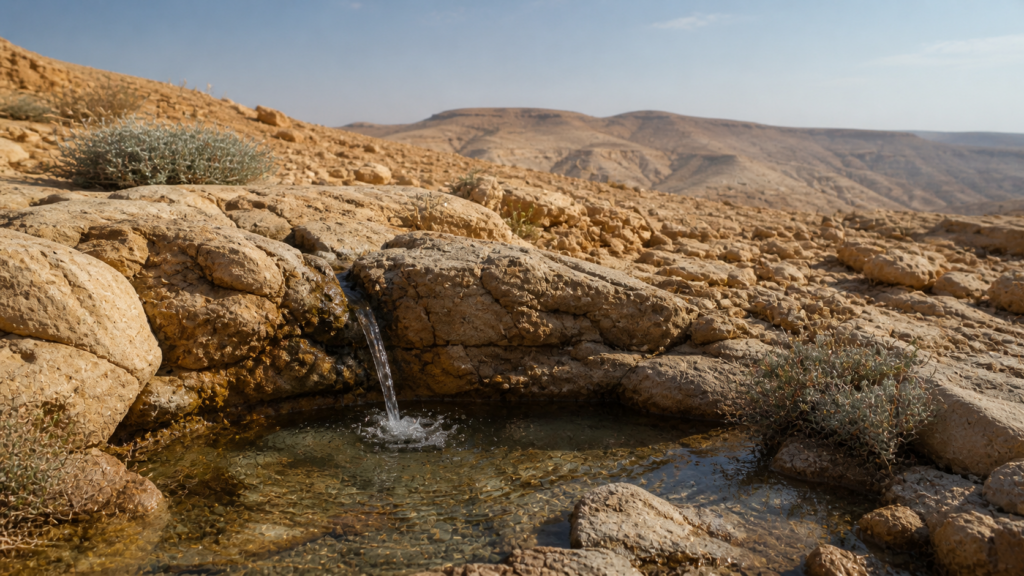
- Then verse 19: God opened her eyes, and she saw a well of water. The well was already there. Hagar could not see it. The chapter is doing one of its most pastoral moves: the provision had already been made; the seeing had to be opened. This is, in its quiet way, a small theology of crisis: the help we cannot find may already be present, awaiting the eyes that can see it.
Influence callout: Walter Brueggemann
Brueggemann’s reading of Hagar’s two wilderness encounters (chapter 16 and chapter 21) frames them as the founding moments of the Hebrew Bible’s tradition of God meeting the marginalized in the wilderness. The covenant family’s exiles, slaves, foreigners, and dispossessed will repeatedly find God showing up in the desert when the resources have run out. Hagar is the first; the Israelite slaves at the Reed Sea will be the second; the prophets in their wilderness exiles will be next. The chapter is not just about Hagar. It is about a recurring divine pattern that the Bible will keep returning to.
- Verses 20 and 21 close the Ishmael arc with care. God was with the boy. The same phrase the narrator will later use for Joseph in Genesis 39:2. The boy grows; he becomes an archer; he lives in the wilderness of Paran; his mother (the Egyptian) gets him an Egyptian wife. The Ishmaelite line is being established as a parallel-but-distinct line, with its own divine attention, its own great-nation promise, its own cultural lineage. The chapter ends Ishmael’s narrative as a covenanted (not Abrahamic) people of God’s care.
C · Genesis 21:22–34 · The treaty at Beer-sheba
²² At that time Abimelech, with Phicol the commander of his army, said to Abraham, “God is with you in all that you do; ²³ now therefore swear to me here by God that you will not deal falsely with me or with my offspring or with my posterity, but as I have dealt loyally with you, you will deal with me and with the land where you have resided as an alien.” ²⁴ And Abraham said, “I swear it.” ²⁵ When Abraham complained to Abimelech about a well of water that Abimelech’s servants had seized, ²⁶ Abimelech said, “I do not know who has done this; you did not tell me, and I have not heard of it until today.” ²⁷ So Abraham took sheep and oxen and gave them to Abimelech, and the two men made a covenant. ²⁸ Abraham set apart seven ewe lambs of the flock. ²⁹ And Abimelech said to Abraham, “What is the meaning of these seven ewe lambs that you have set apart?” ³⁰ He said, “These seven ewe lambs you shall accept from my hand, in order that you may be a witness for me that I dug this well.” ³¹ Therefore that place was called Beer-sheba; because there both of them swore an oath. ³² When they had made a covenant at Beer-sheba, Abimelech, with Phicol the commander of his army, left and returned to the land of the Philistines. ³³ Abraham planted a tamarisk tree in Beer-sheba, and called there on the name of the LORD, the Everlasting God. ³⁴ And Abraham resided as an alien many days in the land of the Philistines. (Genesis 21:22–34, NRSVue)
- The chapter pivots to a treaty scene that, on the surface, has nothing to do with the family drama that just concluded. Abimelech, the Philistine king from chapter 20, comes to Abraham with the commander of his army. The narrative juxtaposition is the narrator’s argument: while the household has been pulling apart, Abraham’s standing in the wider world has been consolidating. The pagan king has been watching. He has seen what Yahweh has done. He wants a treaty.
- Abimelech’s opening line (verse 22) is striking: “God is with you in all that you do.” The Hebrew is Elohim immcha b’kol asher attah oseh, the same construction the narrator will later use for Joseph in Egypt. The pagan king is reading Abraham’s life theologically. Abraham is not just a wealthy nomad; he is a man who is conspicuously favored by his God. The treaty offer rests on that observation.
- The well dispute in verses 25 to 30 is the chapter’s moral interlude. Abimelech’s servants had seized a well that Abraham’s household had dug. Wells in the Negev were the difference between life and death; ownership of wells was the difference between settlement and exile. Abraham confronts Abimelech directly, who pleads ignorance. The two men resolve the dispute formally: seven ewe lambs as witness that Abraham dug the well, paid by Abraham to Abimelech to seal the recognition.
Influence callout: Ray Vander Laan
Vander Laan teaches the Negev’s water culture as the foundation of patriarchal economic life. Wells were dug at enormous labor; their location was remembered for generations; their ownership was protected by treaty and by violence. The “ewe lambs as witness” detail is deeply rooted in ANE legal practice. Abraham is paying Abimelech for the formal acknowledgment that the well is his. The treaty is not just diplomatic; it is the foundation of Abraham’s continued ability to graze in this region. The patriarch has been a sojourner for decades; this treaty grants him, for the first time, a recognized water claim in the land that has been promised to him.
- The naming of Beer-sheba (verse 31) is doubly resonant. The Hebrew Be’er Sheva can be read as “well of seven” (the seven ewe lambs) or “well of oath” (the verb shava, “to swear”). Both readings are present in the wordplay. The patriarch’s first secured well is named both for the count of witness-lambs and for the sworn commitment. Beer-sheba will become one of the recurring landmarks of the patriarchal narratives, the southern boundary of patriarchal life, and the place Abraham, Isaac, and Jacob will all return to.
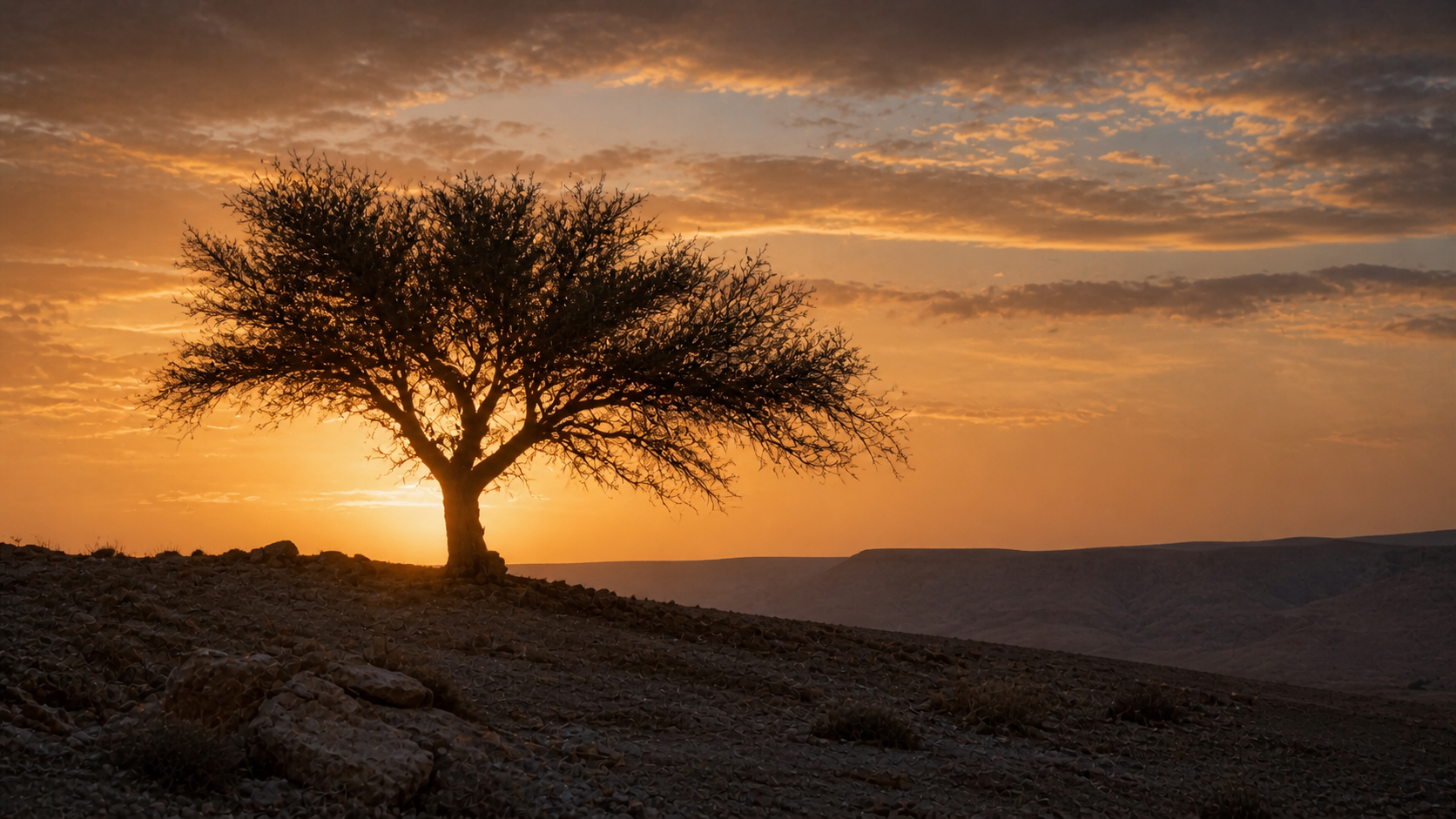
- Verse 33 introduces a new divine name. “Abraham planted a tamarisk tree in Beer-sheba, and called there on the name of the LORD, the Everlasting God.” The Hebrew is El Olam. This is the first appearance of this divine name in Scripture. El is the generic word for God; olam means “everlasting,” “ancient,” “of long duration.” The patriarch, having just secured his first well in the promised land through formal treaty with a pagan king, plants a tree (a marker that long outlasts a tent) and calls on the name of God in his everlasting character. The choice of name is the chapter’s quiet theological climax.
Word study: El Olam (אֵל עוֹלָם), “the Everlasting God”
The first appearance of this divine name in Scripture. Olam in biblical Hebrew can mean “long ago,” “forever,” “always,” “everlasting,” “eternal.” The combination El Olam names God as the deity whose existence is not bound by time, whose presence stretches before and after the sojourner’s brief life. Abraham, who is now nearly a hundred and twenty (Sarah will die in chapter 23 at 127, having borne Isaac at 90), names the God who outlasts him. The tamarisk tree he plants is itself a long-lived tree (tamarisks can live for centuries); the patriarch is, in this small gesture, marking the land with something that will be there long after he is gone, and he is calling the God who placed him there by a name that signals the same kind of permanence.
- The closing line (verse 34) is small but important: “Abraham resided as an alien many days in the land of the Philistines.” The patriarch has a treaty, a well, a tree, a divine name, and a son. He still does not have the land. He is still a sojourner. The chapter’s final word is the reminder that the covenant promise of land has not yet been kept; the patriarch is making peace with sojourner-ness while waiting on what has not yet come.
Reflection prompts
- The chapter opens with Sarah finally claiming her own laughter out loud. The matriarch who once laughed quietly inside her tent now declares the laughter publicly: “everyone who hears will laugh with me.” Where in your life is there a long-deferred joy you have not yet permitted yourself to name? What would it mean to call it out loud?
- Hagar in the wilderness sees the well only after God opens her eyes. The water was already there. Where in your life have you been weeping over scarcity that turned out, on closer look, to be a provision you could not yet see?
- Abraham ends the chapter by planting a tamarisk tree (something that will outlive him) and calling on the name of El Olam, the Everlasting God. What in your life is a tamarisk you have planted (a relationship, a discipline, a piece of work) that you may not see come to its full size? What does it mean to plant slow trees while calling on a God whose time is not your time?