
Chapter 35 makes two provisions for life in the land, and both are quietly profound. First, the Levites, the tribe with no territorial inheritance because the LORD is their portion (chapter 18), are given forty-eight towns scattered among all the other tribes. The priestly tribe is deliberately dispersed, present everywhere, so that the worship and teaching of God are woven through the whole land rather than concentrated in one place. Second, six of those Levitical towns are designated cities of refuge: places where someone who has killed accidentally can flee for safety from the avenger of blood, while the community sorts out whether the death was murder or manslaughter.
The cities of refuge hold mercy and justice together with remarkable care. They protect the accidental killer from blood-vengeance, but they do not excuse real murder; they take human blood with deadly seriousness, because blood pollutes the land where God dwells, and yet they make refuge available to the one whose hand was guiltless. And at the heart of the law sits a strange and beautiful provision: the manslayer must remain in the city of refuge until the death of the high priest, and then he goes free. A death releases the guilty to go home.
A · Numbers 35:1-8 · Levites scattered through the land
² “Command the children of Israel to give to the Levites cities to dwell in out of their inheritance. You shall give the Levites pasture lands for the cities around them.”
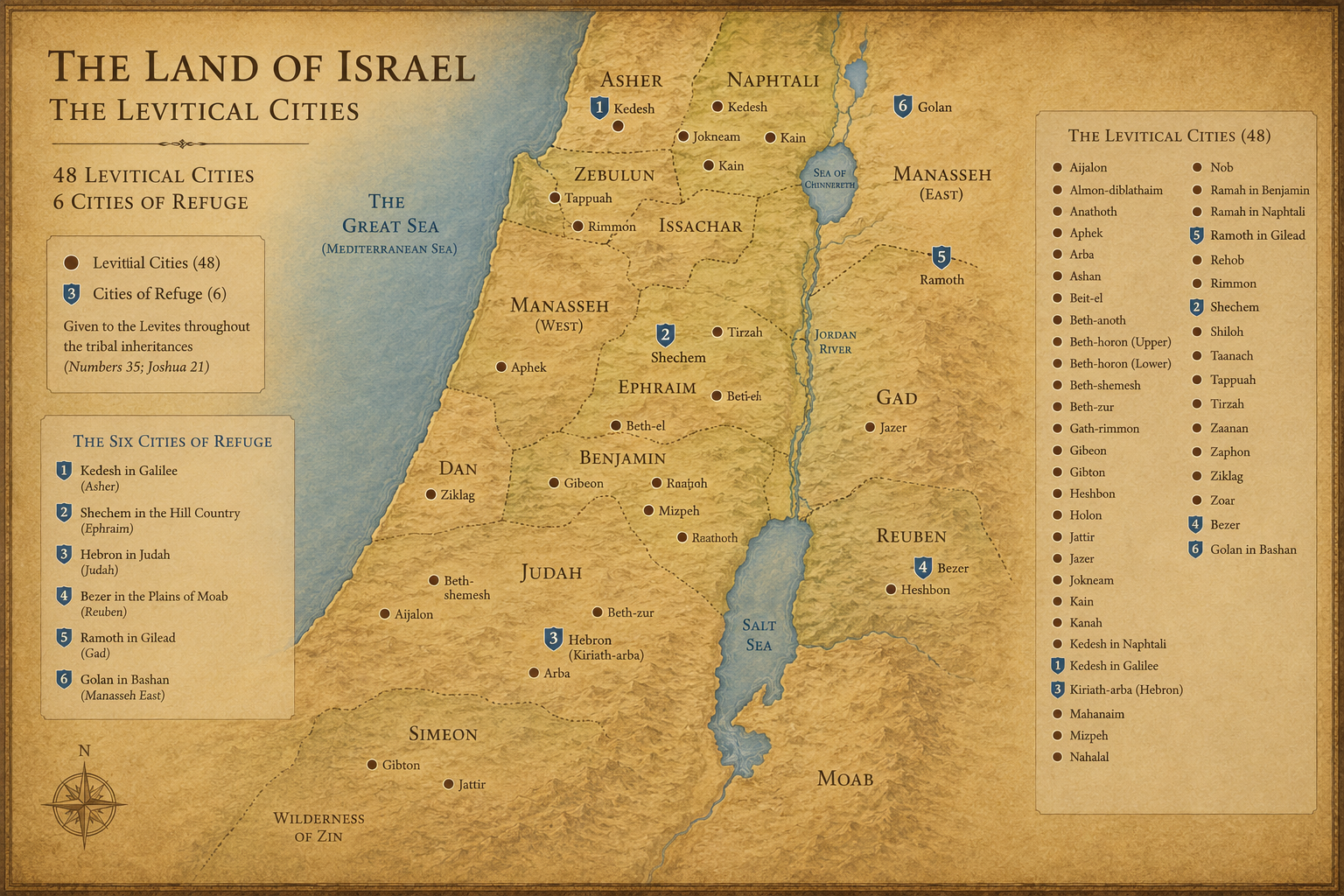
- Cities to dwell in (vv. 1-5). The Levites receive no tribal territory of their own (chapter 18), but they are not left homeless. Each tribe gives some of its towns, forty-eight in all, to the Levites, with surrounding pasture. The tribe whose inheritance is God himself is provided for by the generosity of all the others, woven into every region of the land.
- Scattered among every tribe (vv. 6-8). The dispersal is the point. Rather than clustering the priestly tribe in one place, God scatters them throughout the whole nation, larger tribes giving more towns, smaller ones fewer. The effect is that the presence of those set apart for God, the teachers of Torah, the keepers of worship, is distributed everywhere. No Israelite lives far from a Levite. The holiness concentrated at the tabernacle’s center is meant to radiate outward through people salted across the entire land.
- This dispersal anticipates a pattern the New Testament will make central. Jesus calls his people salt scattered through the earth and light set where it can be seen (Matthew 5:13-16), and the church is sent out into all the world rather than gathered into a single holy place. The Levitical cities are an early picture of it: God’s set-apart people distributed through the ordinary life of the whole community, present in every region, so that no one is beyond the reach of his worship and his word.
B · Numbers 35:9-34 · Cities of refuge, and the high priest’s death
²⁵ “…He shall remain in it until the death of the high priest, who was anointed with the holy oil. … ³³ You shall not pollute the land in which you live; for blood pollutes the land… ³⁴ You shall not defile the land which you inhabit, in the middle of which I dwell; for I, Yahweh, dwell among the children of Israel.”
- Six cities of refuge (vv. 9-15). Six towns are set apart as places of asylum. Someone who kills another unintentionally may flee there and be safe from the avenger of blood until they receive a fair hearing. The provision is open to the foreigner and the resident alike (v. 15), one law for all. It is a stunning piece of ancient jurisprudence: a built-in protection against the cycle of revenge, a place where an accident does not automatically become a death sentence.
- Murder and manslaughter distinguished (vv. 16-25). The law draws careful lines. If the killing was done with a weapon, in hatred, by ambush, it is murder, and the city of refuge offers no protection; the murderer is handed over. But if it was genuinely accidental, without enmity, the manslayer is protected. Intent matters. The same act, a death, is judged differently depending on the heart behind it. Mercy is real, and so is justice; the chapter refuses to collapse one into the other.
- Until the death of the high priest (v. 25). Here is the law’s most striking feature. The manslayer must stay within the city of refuge; if he leaves, the avenger may kill him. But when the high priest dies, the manslayer goes free, fully restored to his home and land. A death ends his exile. The death of the one who represents the people before God releases the guilty to return home. The typology is hard to miss and the church has long seen it: the death of the great High Priest is what finally frees the guilty to come home (see the cruciform hermeneutic and kipper / atonement). Hebrews makes Christ the high priest whose single death opens the way home for all who take refuge in him (Hebrews 6:18, we who have fled for refuge to lay hold of the hope set before us).
- Blood pollutes the land where I dwell (vv. 33-34). The chapter grounds the whole system in the holiness of the land. Innocent blood pollutes the land, and because YHWH dwells in the midst of it (see outside the camp), it cannot be left defiled. This is why murder is taken so seriously and why even accidental killing requires a structured response: the land is holy because God lives in it, and bloodshed contaminates the very ground of his dwelling. Justice here is not vengeance; it is the keeping-clean of the place where God has chosen to live with his people.
Word study: go’el (גֹּאֵל), “kinsman-redeemer, avenger of blood”
The figure who pursues the manslayer is the go’el ha-dam, the “redeemer of blood,” and the word go’el is one of the richest in the Hebrew Bible. The go’el is the near kinsman responsible for protecting and restoring his family: he buys back land that was lost (Leviticus 25:25), redeems a relative sold into slavery, raises up offspring for a dead brother, and, in this role, secures justice for a murdered relative. The same word that here names the avenger of blood is the word for redeemer. Boaz is Ruth’s go’el, redeeming both her and her family’s land (Ruth 4). Job cries, I know that my Redeemer (go’eli) lives (Job 19:25). Isaiah calls YHWH himself Israel’s Redeemer again and again (Isaiah 41:14; 43:14; 44:6). The cities of refuge sit inside this whole world of kinship-redemption: the manslayer is protected from the go’el’s vengeance until a high priest’s death frees him, and the deepest fulfillment is the Redeemer who is also the High Priest, the kinsman who, by his own death, both satisfies justice and brings the guilty home. The avenger and the redeemer are the same word, and in Christ they become the same person.
Reflection prompts
- The Levites were scattered through every tribe so that God’s presence and word were near everyone. Are you, as one of God’s set-apart people, woven into ordinary life where you can be salt and light, or clustered safely among your own?
- The cities of refuge held mercy and justice together: real protection for the one whose hand was guiltless, real reckoning for the one whose heart was hateful. Where do you tend to collapse the two, offering cheap mercy that ignores justice, or hard justice that leaves no room for refuge?
- The manslayer went free at the death of the high priest. The death of the great High Priest is what frees the guilty to come home. Where do you most need to hear that a death has already opened the way back for you, and that you are free to leave your exile and go home?
Frameworks at play in this chapter: kipper / atonement, outside the camp, the cruciform hermeneutic.