
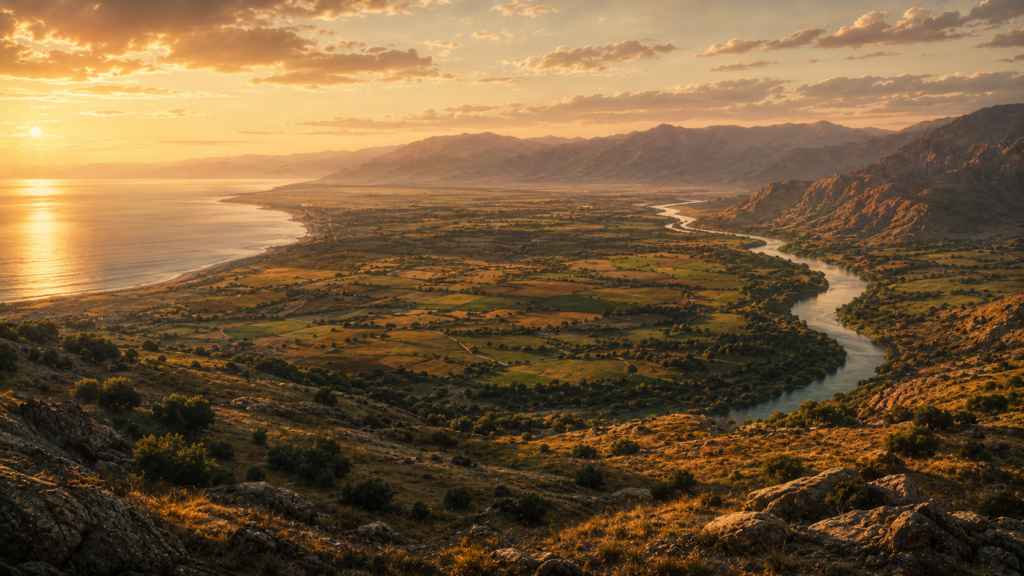
Chapter 34 maps the gift. God traces the borders of the land Israel is about to receive, the southern line through the wilderness of Zin, the western edge along the Great Sea, the eastern boundary down the Jordan to the Salt Sea, and the northern line up toward Lebanon. Then he names the men, a leader from each tribe alongside Eleazar the priest and Joshua, who will oversee dividing it. After forty years of wandering with no fixed home, the land is given a definite, drawable shape.
The chapter’s quiet theology is in that definiteness. The promise is not a vague spiritual abstraction or an escape to somewhere disembodied. It is a real place with real borders, soil and seacoast and river, that God intends his people to inhabit. Biblical hope, from the beginning, is land, a concrete inheritance on a concrete earth, and the specificity of these borders is part of the point. God’s promises have edges. They can be mapped.
A · Numbers 34:1-15 · The four borders
² “Command the children of Israel, and tell them, ‘When you come into the land of Canaan (this is the land that shall fall to you for an inheritance, even the land of Canaan according to its borders)…’”
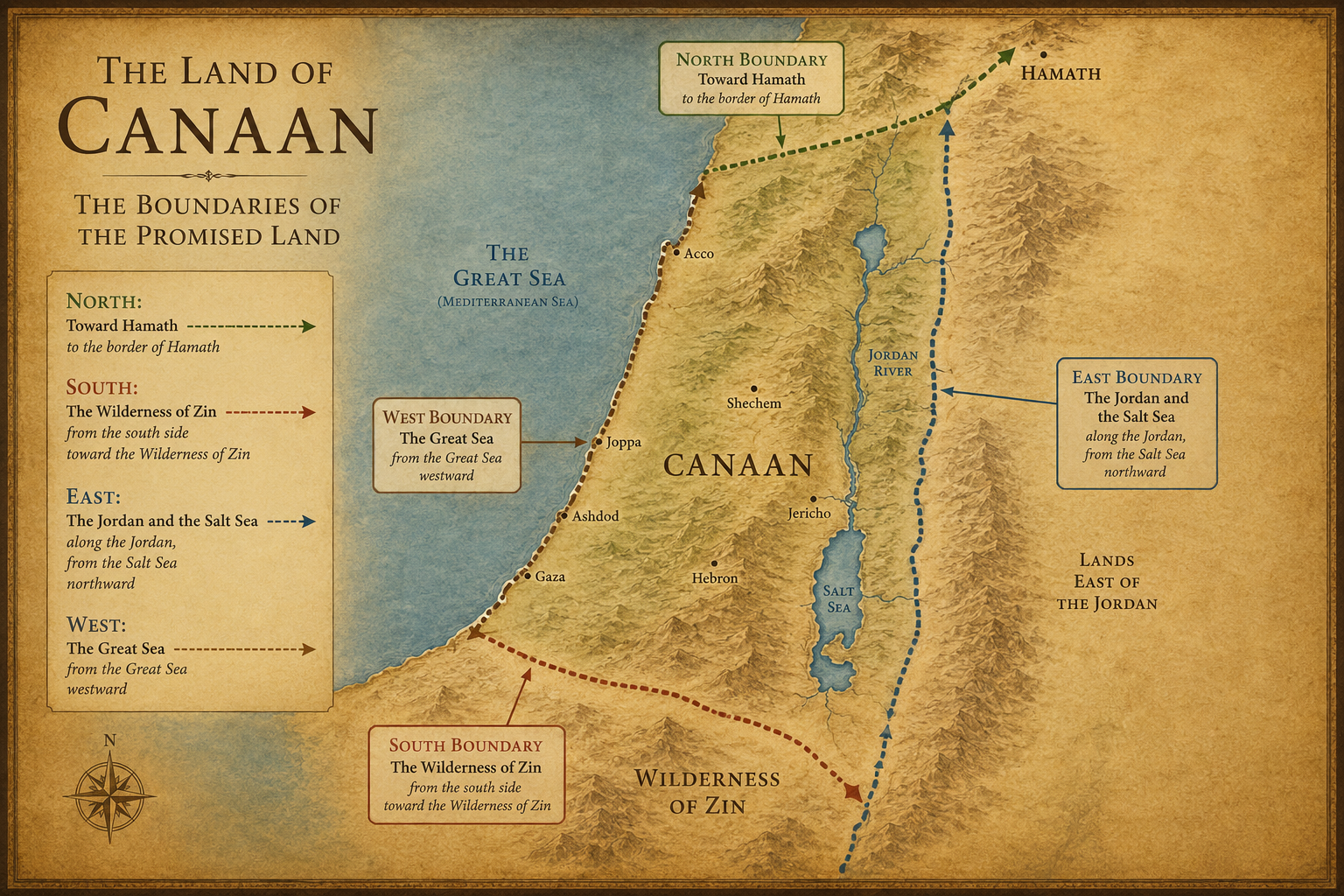
- The land according to its borders (vv. 1-12). God lays out the four boundaries in order, south, west, east, and north, naming specific landmarks: the wilderness of Zin, Kadesh-barnea, the Great Sea (the Mediterranean), the Jordan, the Salt Sea (the Dead Sea), and northern points toward Hamath. The land is not described in vague terms but surveyed like a deed. This is a real territory with real edges, and Israel is to know exactly what God is giving them.
- Nine and a half tribes (vv. 13-15). The land west of the Jordan is for the nine and a half tribes; Reuben, Gad, and half of Manasseh have already received their inheritance east of the Jordan (chapter 32). The arrangement made in the previous chapters is now formalized into the map. The whole nation’s inheritance, east and west, is being settled.
- The boundaries underscore that this is gift, not merely conquest. The land falls to you for an inheritance; it is allotted, bestowed, handed over by God. Israel will fight for it, but they do not earn it or generate it; they receive a portion God has measured out. The map is a picture of grace with a shape: a specific, bordered, knowable gift.
Word study: gevul (גְּבוּל), “border, boundary, territory”
The chapter’s recurring word is gevul, “border” or “boundary,” and by extension the territory the border encloses. The land is defined by its gevulot, its edges. The word matters because it makes the promise concrete: a gevul can be walked, marked, defended, and inherited. The Hebrew Bible takes boundaries seriously, the law forbids moving a neighbor’s boundary marker (Deuteronomy 19:14; Proverbs 22:28), because a gevul protects the inheritance God has assigned. And the psalmist turns the word into worship: the boundary lines (chavalim) have fallen for me in pleasant places; indeed, I have a beautiful inheritance (Psalm 16:6). To have a gevul is to have a place, a portion, a piece of the world that is yours by God’s gift. The bordered land of Numbers 34 is the tangible form of belonging: not everywhere and nowhere, but here, this measured place, given by God.
Influence callout: the materiality of the promise (against escapist hope)
The bordered, physical inheritance of Numbers 34 guards against a persistent distortion of biblical hope. Scripture’s promise was never an escape from the material world to a disembodied “heaven” elsewhere; it was always land, a concrete place on a real earth. Walter Brueggemann argued that land is one of the central, organizing themes of the whole Bible, the tangible sign of covenant relationship, and N.T. Wright has pressed that the New Testament’s hope is not souls fleeing earth but the renewal of creation itself, the meek shall inherit the earth (Matthew 5:5), the creation set free (Romans 8:21), a new heaven and a new earth. Strikingly, the Bible’s final vision is itself a measured place: the New Jerusalem is surveyed with a measuring rod, its dimensions and gates and foundations specified (Revelation 21:15-17), as concrete as the borders of Canaan. The bordered land here is the first installment of a hope that ends not in evaporation but in a renewed, embodied, locatable home. God’s promises have edges because God means to give his people a real place to dwell with him, then and forever.
B · Numbers 34:16-29 · The men who divide it
¹⁷ “These are the names of the men who shall divide the land to you for inheritance: Eleazar the priest, and Joshua the son of Nun.”
- Eleazar, Joshua, and a leader from each tribe (vv. 16-29). God names those who will oversee the division: the high priest, the new leader, and one named representative from each tribe. The distribution will not be done by Moses alone or by raw power; it will be carried out by a representative body, with every tribe having a named voice at the table. The fairness of the inheritance is built into who administers it.
- The naming continues the book’s quiet insistence on individuals over abstraction (the same instinct that recorded twelve identical gifts in chapter 7 and named the daughters of Zelophehad five times). Even the administrative work of dividing land is entrusted to named people, each accountable, each representing their tribe. The new generation enters its inheritance through an orderly, representative, named process, not a scramble.
- The chapter looks entirely forward. Every detail, the borders, the tribes, the appointed leaders, assumes the entry the old generation forfeited and the new generation will accomplish (see the two generations). After a book full of graves, the camera is fixed on the land: its shape drawn, its division planned, its leaders named. The wilderness is nearly behind them, and the promise is taking concrete, mappable form.
Reflection prompts
- God gives the land a definite shape, with borders that can be walked and known. Where do you keep God’s promises vague and abstract when he means them to be concrete? What would it look like to expect something real and locatable from him?
- Biblical hope is land, a renewed earth, not escape from the material world. How does it change the way you live now to know that God’s future is an embodied, physical home rather than a disembodied elsewhere?
- The psalmist turned “border” into worship: the boundary lines have fallen for me in pleasant places. Can you name the “pleasant places,” the portion God has actually given you, with gratitude, rather than only longing for territory you don’t have?
Frameworks at play in this chapter: the two generations, wilderness and liminality, the exodus pattern.