

Near the end of the book, the narrative pauses to do something unexpected: it lists every campsite of the entire journey, forty-two stages from Rameses in Egypt to the plains of Moab across from Jericho. It reads like a travel log, place after place, and a reader in a hurry skims it. But the chapter tells us why it exists: Moses wrote their goings out according to their journeys by the commandment of YHWH. This is the book’s own act of remembering, an inspired record of the whole route from slavery to the threshold, the places of rebellion and the places of provision alike, all of it written down so it would not be forgotten.
The chapter then closes the wilderness era with a command and a warning. As Israel prepares to enter, God tells them to drive out the inhabitants and destroy the idols of the land, and warns that whatever they fail to remove will become thorns in their sides, a warning the book of Judges will show coming true. The list of where they have been gives way to a sober word about where they are going. The journey is nearly over; the next chapter of the story is about to begin.
A · Numbers 33:1-49 · The route remembered
² Moses wrote their starting points according to their journeys by the commandment of Yahweh. These are their journeys according to their starting points.
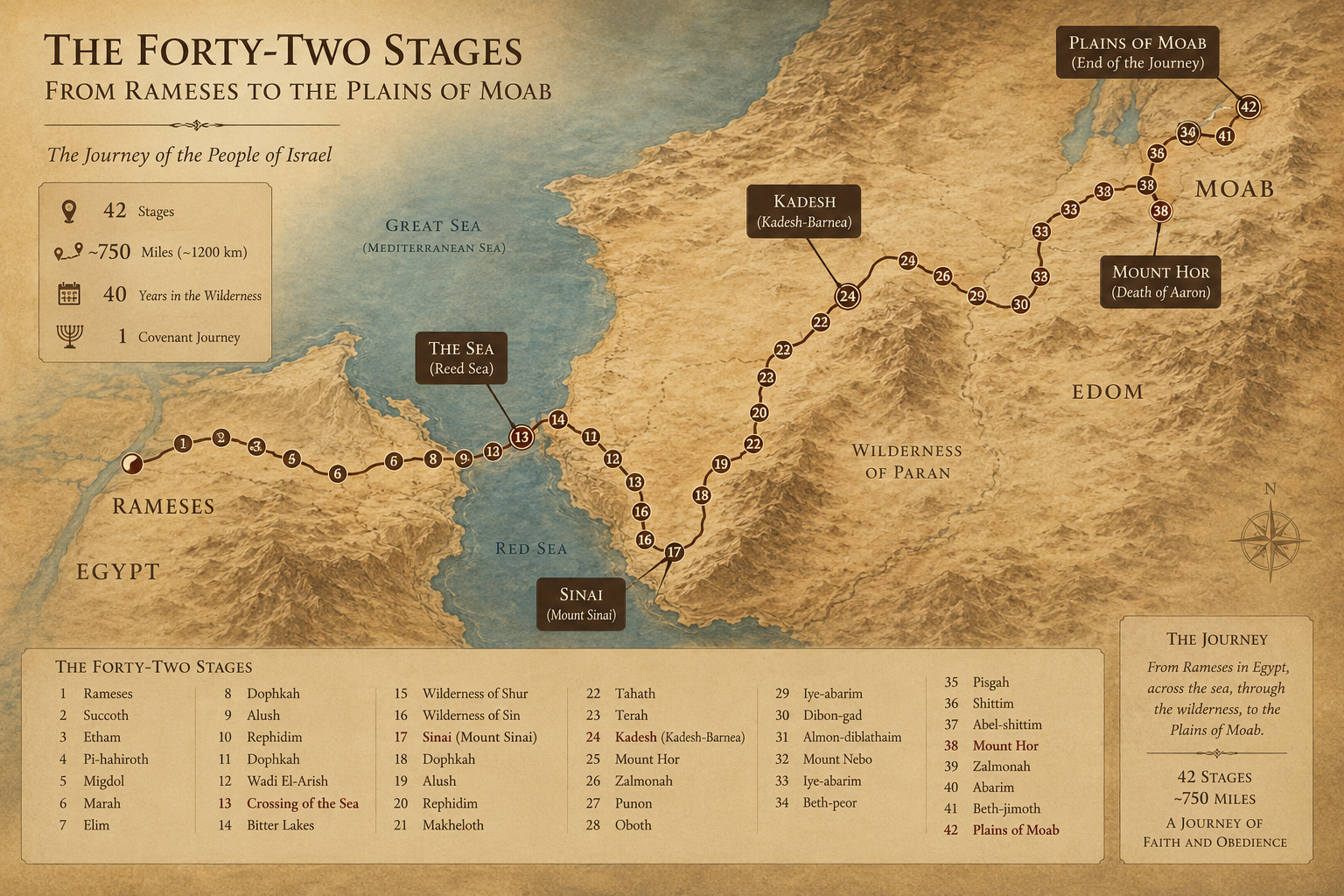
- Moses wrote it down (v. 2). The chapter is, explicitly, a written record made by the command of YHWH. The journey was worth remembering in detail, every stage named and preserved. There is a theology of memory here: the people of God are to keep an account of where God has brought them. The route mattered enough to be written, so that future generations could trace the whole path from Egypt to the edge of the land and see God’s hand at every stage.
- Forty-two stages (vv. 3-49). The list moves from Rameses, through the sea, through the wilderness years, to the plains of Moab. It includes the famous places, the sea crossing, the bitter water, the manna, Sinai, Kadesh, the bronze serpent, and many obscure ones whose stories the Bible never tells. The route holds together the high points and the rebellions, the provisions and the failures. None of it is edited out. The full journey, with all its wandering, is what God brought them through, and the chapter records all of it as a single, traceable path.
Word study: mas’ei (מַסְעֵי), “journeys, stages, settings-out”
The chapter’s key word, which gives the Hebrew parashah its name (Mas’ei), is mas’ei, “journeys” or “stages,” from the verb nasa’, “to pull up, to set out”, literally the act of pulling up the tent pegs to move on. Each “stage” is a pulling-up: a place where the people struck camp and followed the cloud onward. The word captures the rhythm of the whole wilderness life (see wilderness and liminality): settle, then pull up and move; rest, then follow. The journey is named not by its destinations but by its departures, the repeated willingness to pull up stakes and go when God moved. There is something quietly formative in that. A people learning to follow God is a people always ready to pull up the pegs, to hold every campsite loosely because the cloud may lift tomorrow. The forty-two settings-out are forty-two acts of trust, strung together into a single road home.
Influence callout: Origen and the stages of the soul’s ascent
Origen devoted an entire homily to this chapter (Homilies on Numbers 27), and his reading became one of the most influential in the premodern tradition. He took the forty-two stages as a map of the soul’s spiritual ascent: each campsite a stage of growth, each setting-out a movement of the soul further up and further in toward God. The wilderness route, on Origen’s reading, is the pattern of the Christian life, a long progress through testings and provisions, never quite arriving in this life, always pulling up the pegs to follow further. Gregory of Nyssa’s Life of Moses develops the same instinct: the spiritual life is perpetual advance, never static. The site offers this figural reading as the church has long treasured it, alongside the plain sense of a real journey through real places. There may even be a numerical echo forward: Matthew opens his Gospel by counting forty-two generations from Abraham to Christ (Matthew 1:17), the long road of Israel’s story arriving at last at the Messiah. Whether or not the echo is intended, the instinct is the same one the chapter teaches: redemption comes by a long road of many stages, and the God who recorded every campsite is the God who brings the journey, finally, home.
B · Numbers 33:50-56 · A command and a warning
⁵⁵ “But if you do not drive out the inhabitants of the land from before you, then those whom you let remain of them will be like pricks in your eyes and thorns in your sides. They will harass you in the land in which you dwell.”
- Drive out the inhabitants, destroy their idols (vv. 50-53). As Israel prepares to cross, God commands them to dispossess the land’s inhabitants and to destroy their carved images, cast idols, and high places. The concern is not ethnic but theological: the idolatry that nearly destroyed Israel at Baal-Peor (chapter 25) must not be allowed to take root in the land where YHWH will dwell. The site reads these dispossession texts through holy war and herem, set in their ancient world, held honestly, and finally measured against the cross, where the warfare is reassigned to the spiritual realm (Ephesians 6:12).
- Thorns in your sides (v. 55). The warning is realistic and, as it turns out, prophetic. Whatever Israel fails to remove will become a snare, thorns in your sides, drawing them back into idolatry. The book of Judges is essentially the story of this warning coming true: Israel does not fully clear the land, the surrounding idolatry becomes a constant temptation, and the people are repeatedly drawn away. The chapter sees it coming. Compromise with what nearly destroyed you has a way of becoming the thing that does.
- Divide the land by lot (vv. 54). Even amid the warning, the forward note sounds again: the land will be divided, by lot, as an inheritance (see the two generations). The journey of forty-two stages is about to reach its destination. The same chapter that records where Israel has been turns, at its end, to where they are going, the land itself, now within reach.
Reflection prompts
- God commanded that the whole journey be written down, the rebellions and the provisions alike, so it would be remembered. Have you kept any account of where God has brought you? What would it do for your faith to trace the whole route, including the hard stages?
- The journey is named by its settings-out, the repeated willingness to pull up the pegs and follow. Where is God asking you to hold a current “campsite” loosely and be ready to move when the cloud lifts?
- The chapter warns that whatever Israel failed to remove would become thorns in their sides, and Judges proves it true. What is the “good enough” compromise in your life that you suspect will come back to harass you if it is not dealt with now?
Frameworks at play in this chapter: wilderness and liminality, the exodus pattern, the two generations.