
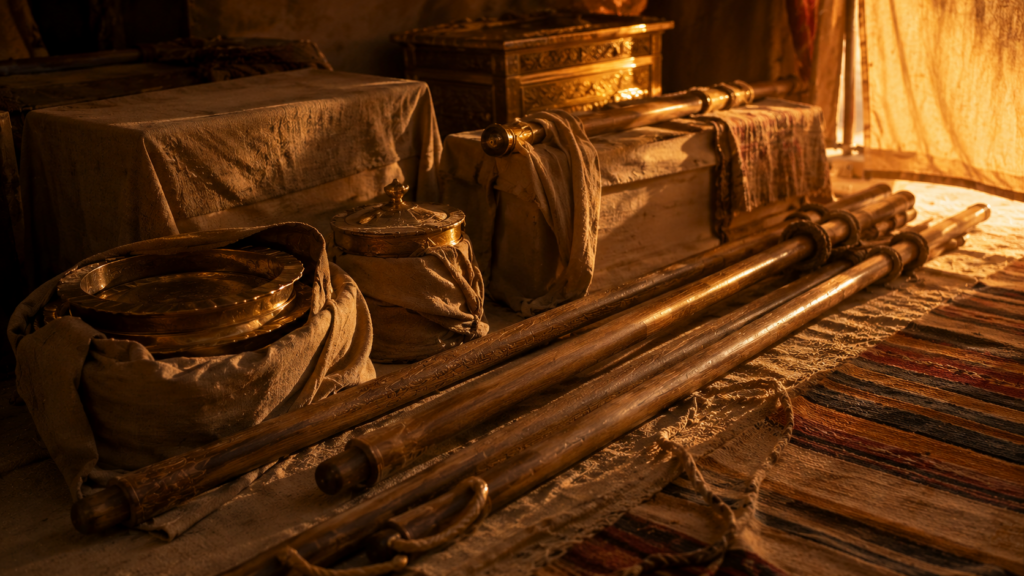
Chapter 3 set the Levites apart; chapter 4 puts them to work. A second Levite census counts only the men of working age, thirty to fifty, and assigns each of the three clans its load for the march. The Kohathites carry the most holy things, the ark, the table, the lampstand, the altars. The Gershonites carry the curtains and coverings. The Merarites carry the frames and structural hardware. It reads like a moving company’s manifest.
But the chapter’s emotional center is danger. Before the Kohathites may carry the most holy things, Aaron and his sons must go in and cover each object, wrapping it in cloth and hides, so that the Kohathites never touch or even see it directly. The reason is repeated like a drumbeat: lest they die. The holiness at the center of the camp is not a gentle glow. It is a real power, and proximity to it without the proper covering is lethal. The chapter is teaching that the privilege of carrying the holy is also a peril, and that the elaborate procedures are an act of mercy toward the carriers. To serve at the center is to handle live current.
A · Numbers 4:4-15 · The covered holy things
⁵ “When the camp moves forward, Aaron shall go in with his sons; and they shall take down the veil of the screen, cover the ark of the Testimony with it, ⁶ put a covering of sealskin on it, spread a blue cloth over it, and put in its poles. … ¹⁵ “When Aaron and his sons have finished covering the sanctuary and all the furniture of the sanctuary, as the camp moves forward; after that, the sons of Kohath shall come to carry it. But they shall not touch the sanctuary, lest they die. These things are the burden of the sons of Kohath in the Tent of Meeting.
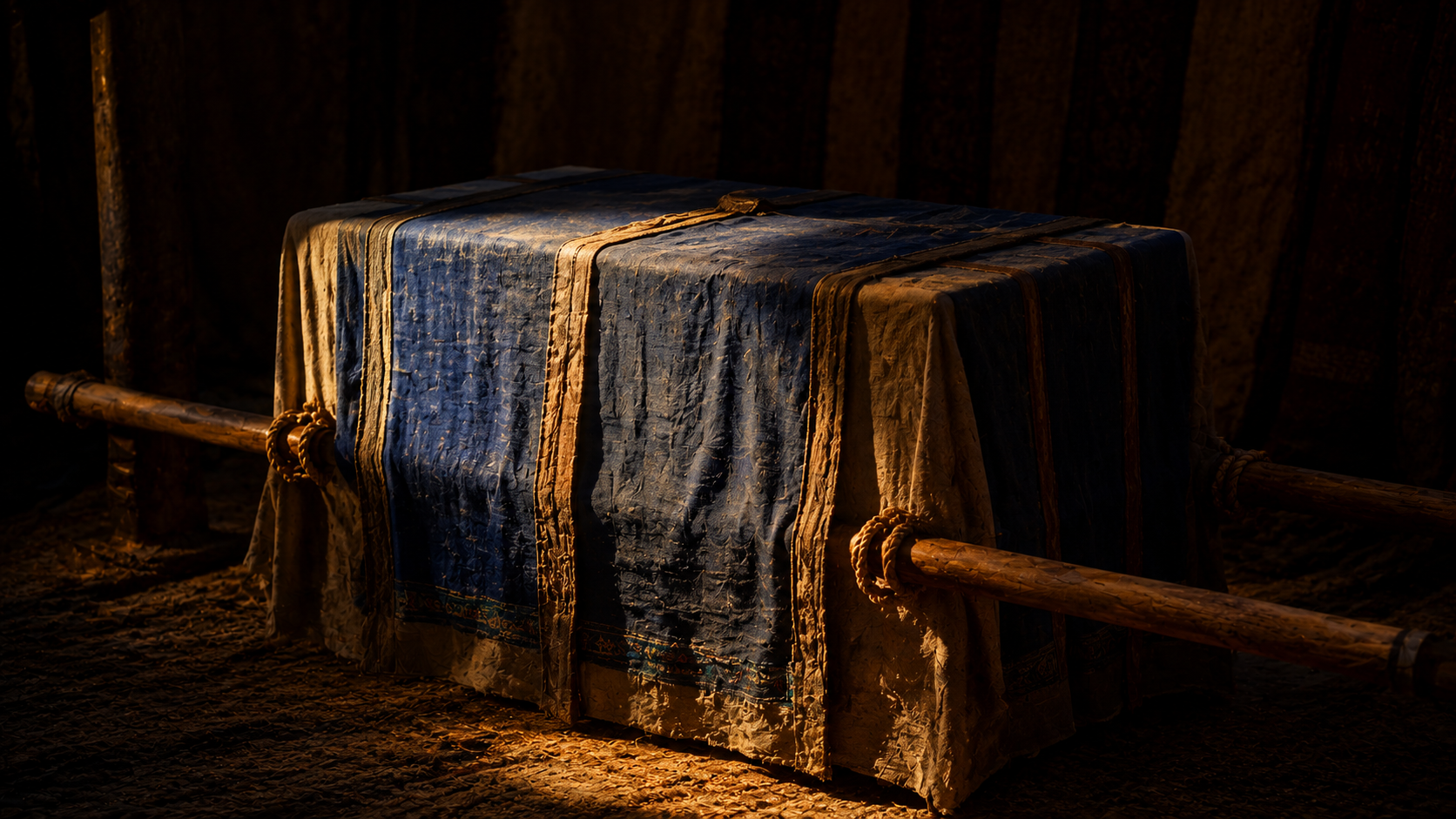
- Aaron shall go in with his sons (v. 5). Only the priests may handle the holy things directly. Before the camp moves, Aaron and his sons enter and wrap each object: the ark first, then the table of the bread, the lampstand, the golden altar, and the bronze altar, each in its prescribed cloths and skins. The Kohathites, who will actually shoulder the load, are kept one layer removed from the holiness. The chapter establishes a careful chain: the priests prepare, the Levites carry.
- Put in its poles (v. 6). The ark is carried by poles run through rings on its sides, never handled directly (Exodus 25:14-15). The design exists precisely so the holy object can be moved without being touched. The poles are mercy in wood: a way to carry the unbearable without dying.
- They shall not touch the sanctuary, lest they die (v. 15). The warning lands at the end of the section like a verdict. The Hebrew is blunt: contact with the uncovered holy things kills. This is not magic and not arbitrary cruelty; it is the chapter’s consistent theology that the presence of YHWH is real power, and that power must be approached on its own terms. The cautionary echo comes generations later: Uzzah, reaching out to steady the ark on a cart, touches it and dies (2 Samuel 6:6-7), and David’s mistake is exactly the one this chapter forbids, moving the ark by cart rather than on the shoulders of Kohath (compare Numbers 7:9).
Word study: massa (מַשָּׂא), “burden, load,” and nasa’, “to carry, bear”
The chapter’s recurring noun for each clan’s assignment is massa, “burden” or “load,” from the verb nasa’, “to lift, carry, bear.” The Levites are not merely workers; they are burden-bearers. The same verb runs through the priestly vocation in a striking way: the high priest bears (nasa’) the names of the tribes on his shoulders and over his heart (Exodus 28:12, 29), bears the iniquity of the holy things (Exodus 28:38), and the third commandment forbids bearing (nasa’) the Name in vain (see bearing God’s name). The vocabulary knits the chapter into the larger biblical theology of carrying: to serve God is to carry something on behalf of others, the holy things, the names of the people, the Name itself. The burden is heavy by design. To be entrusted with the holy is to be entrusted with a weight, and the chapter treats that weight as an honor and a danger in the same breath.
B · Numbers 4:17-20 · The danger and the mercy
¹⁷ Yahweh spoke to Moses and to Aaron, saying, ¹⁸ “Don’t cut off the tribe of the families of the Kohathites from among the Levites; ¹⁹ but do this to them, that they may live, and not die, when they approach the most holy things: Aaron and his sons shall go in and appoint everyone to his service and to his burden; ²⁰ but they shall not go in to see the sanctuary even for a moment, lest they die.”
- That they may live, and not die (v. 19). The whole elaborate covering procedure has a single, stated purpose: so the Kohathites will not die. The instructions are not bureaucratic fussiness; they are protective. God is arranging the move so that the people who carry the most dangerous objects in the camp can do so and live. The severity and the kindness are the same gesture. The boundary that could kill is also the boundary that keeps them alive.
- They shall not go in to see the sanctuary even for a moment (v. 20). Even seeing the uncovered holy things, before the priests have wrapped them, is fatal. The Kohathites arrive only after the covering is finished. The chapter draws the line not at malice or carelessness but at exposure: unmediated contact with the holy, even visual, even brief, is more than a creature can bear. The later prophetic awe (“Woe is me, for I am undone… my eyes have seen the King,” Isaiah 6:5) and the New Testament’s no one has ever seen God (John 1:18) sit on the far side of this same conviction.
Influence callout: Tim Mackie (BibleProject; holiness as power, not magic)
Mackie presses the point that modern readers most need here: biblical holiness is not a moral abstraction or a ritual technicality but a real, intense power, like a high-voltage current or unshielded radiation. The covering of the holy things is not superstition; it is the equivalent of insulation. The danger is genuine because the presence is genuine. Mackie’s pastoral note is that this chapter recovers something domesticated Christianity has lost: the sense that nearness to God is not safe in the trivial sense, that the holy is not tame. The covering procedure is the chapter’s way of saying that a holy God has made it possible for ordinary people to carry his presence through the wilderness, but only because he has provided the means to do so without being consumed. The kindness is in the provision; the seriousness is in the warning. Both are true at once, and the chapter refuses to let go of either.
C · Numbers 4:21-49 · Gershon, Merari, and the count
⁴⁹ According to the commandment of Yahweh they were counted by Moses, everyone according to his service and according to his burden. Thus they were counted by him, as Yahweh commanded Moses.
- Gershon and Merari. The other two clans receive their assignments in turn. The Gershonites carry the soft architecture, the tabernacle curtains, the screens, the coverings, the hangings of the courtyard (4:24-28). The Merarites carry the hard architecture, the frames, bars, pillars, sockets, pegs, and cords (4:31-32). The Gershonites and Merarites work under Ithamar son of Aaron; the Kohathites under Eleazar (4:28, 33, 16). Every load has an owner, and every owner has a supervisor. Nothing about the dwelling moves without someone assigned to carry it and someone assigned to oversee the carrying.
- Everyone according to his service and according to his burden (v. 49). The summary verse repeats the chapter’s two key words, service (avodah) and burden (massa). The Levites are counted not as a population but as a workforce, each man matched to a task and a load. The dignity of the chapter is in its specificity: this clan, this object, this man, this weight. The working total comes to 8,580 Levites between thirty and fifty (4:48), the actual labor force that will carry the presence of God across forty years of wilderness.
- The chapter quietly models a theology of vocation as assigned weight. To belong to the service of God is to be given something specific to carry. The New Testament’s image of the body with its differing members, each with a function (1 Corinthians 12), and Paul’s instruction to bear one another’s burdens (Galatians 6:2), grow from this soil. The Levites show what it looks like when a community knows exactly who carries what, and the holiest things are never left for no one to lift.
Reflection prompts
- The holy things are wrapped so the carriers will not die. The same boundary that warns also protects. Where in your life have you experienced a limit or a guardrail that felt restrictive but was actually keeping you safe?
- Each Levite is matched to a specific burden. Vocation here is not a feeling but an assignment: this object, this weight, this man. What have you been given to carry, and have you actually picked it up?
- The chapter treats nearness to God as genuine power, not a comfortable abstraction. Has your sense of God become too tame? What would it mean to recover a healthy awe without slipping into mere fear?
Frameworks at play in this chapter: outside the camp, bearing God’s name, the two generations.