
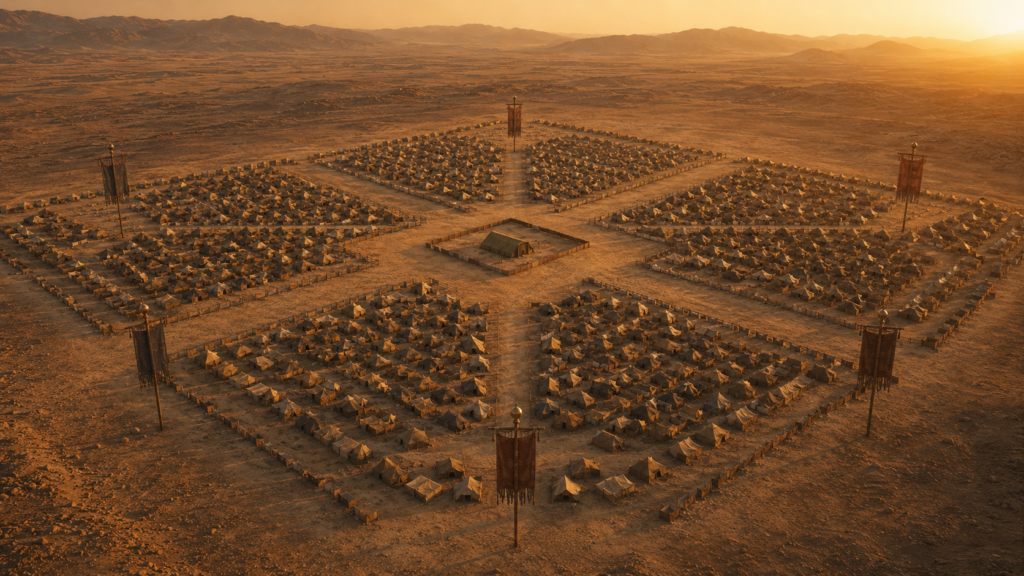
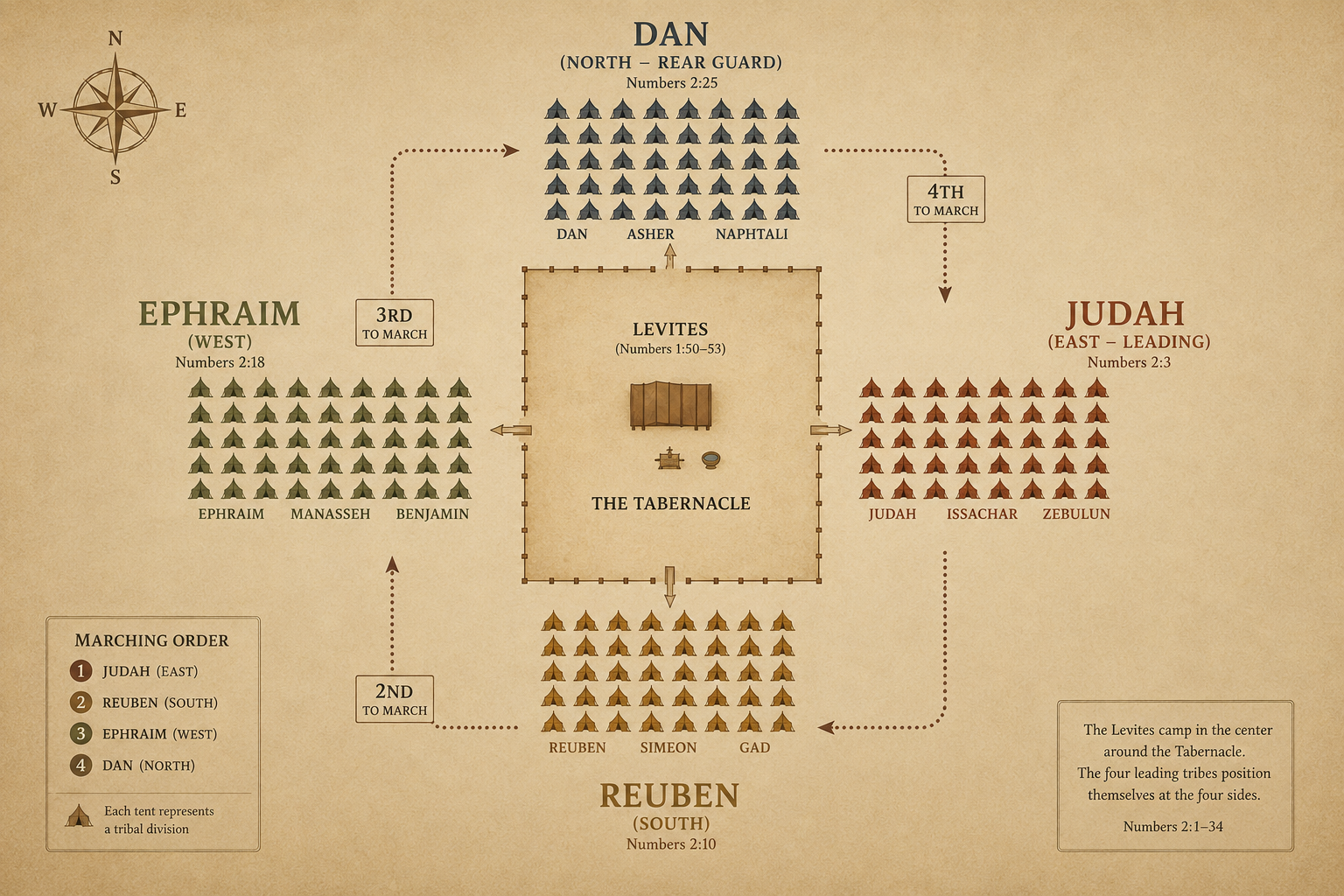
Chapter 2 draws the map. The tribes counted in chapter 1 are now arranged in space: three tribes on each of the four sides of the Tent of Meeting, each side under a leading tribe and its standard, with the Levites and the Tent itself in the middle. The chapter then sets the marching order, which preserves the same shape in motion. It reads like a seating chart, and like the census it can feel skippable.
It is not. The arrangement is a theology rendered as a diagram. The tabernacle sits at the dead center; the people are organized entirely by their distance and direction from it; and the whole camp, at rest or on the march, is built around the one fact that gives the book its shape, that YHWH dwells in the middle of his people. This is the camp as concentric sacred space, the pattern named in outside the camp: holiness at the center, graded outward. To read chapter 2 is to see what it looks like when a people organizes its entire common life around the presence of God.
A · Numbers 2:1-2 · Each under his own standard
¹ Yahweh spoke to Moses and to Aaron, saying, ² “The children of Israel shall encamp every man by his own standard, with the banners of their fathers’ households. They shall encamp around the Tent of Meeting at a distance from it.”
- Every man by his own standard (v. 2). The Hebrew is degel, a tribal standard or military banner around which a division gathers. Each of the four sides of the camp rallies under a degel. The image is martial: this is an army arranged by its colors. But the army is organized around a sanctuary, not a fortress, which quietly redefines what kind of army it is.
- With the banners of their fathers’ households (v. 2). Beneath the four large divisional standards, each household has its own ensign. The arrangement honors the family unit within the larger order. A person in this camp knows exactly where they belong: which household, which standard, which side of the Tent. Belonging here is concrete and located.
- Around the Tent of Meeting (v. 2). The organizing principle is stated plainly: the people encamp around the Tent. The dwelling is the fixed point; everything else is positioned relative to it. The later rabbinic tradition pictured Israel’s camp as a series of rings, like a target with the Holy of Holies at the bullseye. The chapter is drawing exactly that.
- At a distance from it (v. 2). The nearness is real but bounded. The tribes camp around the Tent but at a distance, a reverent gap between the people and the holy center. The same phrase and the same instinct return at the Jordan crossing, where Israel is told to keep a distance from the ark (Joshua 3:4). Proximity to the presence is a privilege held with care, never casual. The whole logic of the buffer in chapter 1 (the Levites encamped so that no wrath falls on the people) is built into the spacing here.
Word study: degel (דֶּגֶל), “standard, banner”
The Hebrew degel names a military standard, the rallying banner of a division. The word appears most densely in this chapter and structures the whole arrangement of the camp. Its martial sense matters: Israel is mustered like an army under its colors. But the most beloved later use turns the war-banner into a love-banner. In the Song of Songs the beloved says of her lover, his banner (degel) over me is love (Song 2:4), and he brought me to the banqueting house, and his banner over me was love. The same word that organizes the war-camp around the dwelling becomes, in the love poetry, the sign of belonging-under-protection. Read together, the two uses catch something true about the camp of Numbers: it is an army, and it is a marriage (see the wedding lens in the Sinai covenant). The standards mark both a battle order and a betrothed people gathered under the banner of the God who lives in their midst.
B · Numbers 2:3-31 · The four divisions
³ “Those who encamp on the east side toward the sunrise shall be of the standard of the camp of Judah, according to their divisions. The prince of the children of Judah shall be Nahshon the son of Amminadab.” … ⁹ “All who were counted of the camp of Judah were one hundred eighty-six thousand four hundred, according to their divisions. They shall set out first.”
- On the east side toward the sunrise… the camp of Judah (v. 3). The east, the direction of the sunrise and the side the Tent’s entrance faces, is the place of honor, and Judah holds it. Judah, Issachar, and Zebulun camp to the east. The order is not random. Judah leads, and Judah’s leadership has a long arc: the scepter will not depart from Judah (Genesis 49:10), the tribe of David and, through David, of the Messiah. The marching camp is already arranged around a royal-Messianic expectation, with the kingly tribe at the front.
- They shall set out first (v. 9). The marching order follows the camp order. Judah’s division leads (east), then Reuben’s division (south, vv. 10-16), then the Tent of Meeting carried by the Levites in the middle (v. 17), then Ephraim’s division (west, vv. 18-24), then Dan’s division as the rear guard (north, vv. 25-31). The four divisions and their totals: Judah 186,400; Reuben 151,450; Ephraim 108,100; Dan 157,600. On the march, the holy things travel protected, in the middle of the column, exactly as they sit in the middle of the camp.
- The whole arrangement is centripetal. Whether at rest or in motion, the camp is built inward toward the Tent. There is no front-facing fortress and no rear sanctuary; the sanctuary is always the center, and the people are always its perimeter. The geography preaches a single sermon: this people exists around its God, not the other way around.
Influence callout: Zondervan Illustrated Bible Backgrounds (the war-camp around the king)
The ANE background sharpens the picture. Egyptian and other ancient armies on campaign arranged their camps as rectangles with the royal or divine tent at the center; the famous depictions of Rameses II’s war camp at Kadesh show the pharaoh’s tent in the middle of a fortified rectangular enclosure, with the army arranged around its king. Israel’s camp follows the same recognizable pattern, with one decisive difference: the tent at the center is not the king’s residence but YHWH’s. The arrangement makes a claim that any ancient observer would have understood instantly. The God of Israel is the King-Warrior in the midst of his army, the divine sovereign whose presence the whole host is organized to protect and serve. Numbers is using the visual grammar of imperial military power and quietly reassigning it: the throne at the center belongs to YHWH alone (compare counter-imperial reading).
C · Numbers 2:17 · The presence at the center
¹⁷ “Then the Tent of Meeting shall set out, with the camp of the Levites in the middle of the camps. As they encamp, so shall they set out, every man in his place, by their standards.”
- The Tent of Meeting… in the middle of the camps (v. 17). The verse states the whole chapter’s logic in a sentence. The Tent is in the middle, both when the camp is pitched and when it moves. The presence does not lead from the front like a general, nor follow from the rear like baggage. It travels in the protected heart of the column, surrounded on every side. The center is the point.
- As they encamp, so shall they set out (v. 17). The marching formation is the camp formation in motion. The concentric order is not just for the rest stops; it is the people’s permanent shape. Israel is to be, always and everywhere, a people arranged around the dwelling presence. This is the same conviction that will let the New Testament call the church a temple in which God dwells (1 Corinthians 3:16; Ephesians 2:21-22): the people of God are defined by the presence at their center.
- Every man in his place (v. 17). The order is not impersonal uniformity; it is each person in his place. The arrangement gives every household a known, dignified position relative to God. There are no anonymous spots in this camp and no spot that is not defined by its relation to the center.
Influence callout: the rabbinic tradition on the four standards (Numbers Rabbah)
The text names the four leading tribes (Judah, Reuben, Ephraim, Dan) but does not describe the emblems on their standards. The later rabbinic tradition filled in the picture: Numbers Rabbah and the Targums assign each of the four divisions an emblem, a lion for Judah, a human face for Reuben, an ox for Ephraim, and an eagle for Dan. Read alongside Ezekiel’s vision of the four living creatures with the faces of a lion, a man, an ox, and an eagle (Ezekiel 1:10), and John’s vision of the same four around the throne (Revelation 4:7), the tradition saw a striking resonance: the four faces that surround the throne of God in the prophetic and apocalyptic visions are the four standards that surround the dwelling in the wilderness camp. This is a reading the tradition found, not a claim the text makes outright, and it should be held as such. But it catches something the chapter genuinely teaches: the camp of Israel is a model of the cosmos ordered around God’s throne, a wilderness diagram of the worship that fills heaven (see the tabernacle as cosmic temple).
Reflection prompts
- The entire camp is organized by distance and direction from the Tent. If someone mapped your life by what sits at its center, what would they find at the middle, and what would be arranged around it?
- Judah, the kingly and eventually Messianic tribe, leads the march from the place of honor. The people are arranged around a hope they cannot yet see fulfilled. Where are you being asked to order your life around a promise that has not yet arrived?
- The presence travels in the middle, surrounded and protected, never out front and never left behind. What would it change in your community to treat the presence of God as the center the whole common life is built around, rather than as one priority among many?
Frameworks at play in this chapter: outside the camp, the tabernacle as cosmic temple, the two generations.