
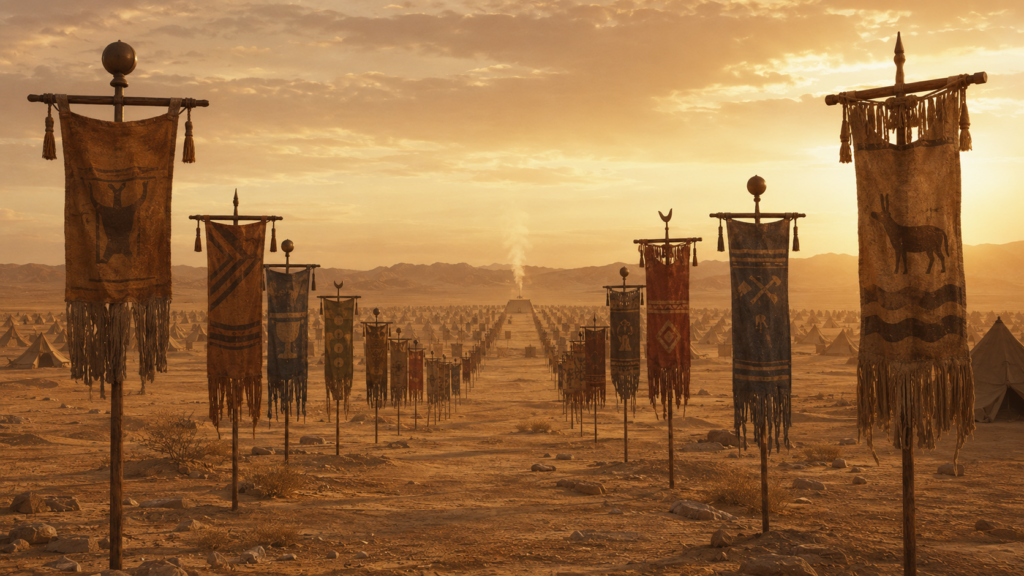
Numbers opens with a head-count. On the first day of the second month of the second year out of Egypt, one year and one month after the exodus, YHWH tells Moses to take a census of every Israelite man twenty years old and upward, all who are able to go out to war. The result, tribe by tribe, is 603,550 fighting men. The Levites are deliberately left out of the count and assigned instead to the tabernacle. The chapter reads, on the surface, like the registry the book’s English name promises.
It is more than that. This is the first of the two censuses that frame the entire book (see the two generations), and it counts a very particular group: the generation of the exodus, the people who walked through the Red Sea. Within two chapters they will be marching toward the land in good order. Within fourteen chapters they will refuse to enter it, and this whole mustered army, every man counted here, will die in the wilderness without fighting the war they were numbered for. The census is a roll call of the generation that will not make it. Reading Numbers well means hearing chapter 1 in the shadow of chapter 14.
The chapter’s Hebrew name for the book, Bemidbar, “in the wilderness,” is set in its first verse. Whatever else this is, it is a census taken in the wilderness: a people being organized in the in-between, on the way, not yet home.
A · Numbers 1:1-3 · The summons and the muster
¹ Yahweh spoke to Moses in the wilderness of Sinai, in the Tent of Meeting, on the first day of the second month, in the second year after they had come out of the land of Egypt, saying, ² “Take a census of all the congregation of the children of Israel, by their families, by their fathers’ houses, according to the number of the names, every male, one by one, ³ from twenty years old and upward, all who are able to go out to war in Israel. You and Aaron shall count them by their divisions.”
- In the wilderness of Sinai, in the Tent of Meeting (v. 1). The book locates itself twice over: in the wilderness (the place) and in the Tent of Meeting (the source of the word). The God who moved into the camp at the end of Exodus now speaks from inside it, organizing the people around his presence. The setting is the whole book in miniature: a people in the wilderness, ordered around a dwelling.
- Take a census (v. 2). The Hebrew idiom is se’u et-rosh, literally lift the head of the congregation. To be counted is to have your head lifted, to be individually registered and named. The phrase resists the impersonal feel of a head-count. Each person is not a tally mark but a raised face. The recurring verb for the counting itself, throughout this chapter and chapter 26, is paqad.
- According to the number of the names, every male, one by one (v. 2). The census is granular. Not an estimate, not a crowd, but names, one by one. The lists that follow can read as tedious, but the tedium carries a theological weight: this God knows the people by household and by name. The same care that names them here will track them, individually, to their graves in chapter 26.
- All who are able to go out to war (v. 3). This is a military census. The unit of counting is the fighting man, twenty and older. Israel is being mustered as an army, organized for the conquest of the land that is now only an eleven-day march away (Deuteronomy 1:2). The tragedy the book will unfold is already loaded into this verse: this army, mustered and ready, will refuse the war it was counted for, and not one of these men, except two, will live to see the land.
Word study: paqad (פָּקַד)
The verb running underneath this chapter and its twin in chapter 26 is paqad, one of the richest verbs in the Hebrew Bible. Its range includes to muster, to number, to enroll, but also to attend to, to appoint, to visit, and even to call to account. The same verb describes God visiting Sarah with the promised son (Genesis 21:1) and God visiting iniquity (Exodus 34:7). To be counted by this verb is to be attended to: noticed, assigned, held responsible. The census is not bookkeeping; it is the act of a God who takes account of his people, who knows the number and the names. When the same verb returns in chapter 26 to count a different generation, the reader is meant to feel both edges of the word: God has numbered them, and God has called them to account.
B · Numbers 1:17-46 · The twelve named leaders and the total
⁴⁴ These are those who were counted, whom Moses and Aaron counted, with the twelve men who were princes of Israel, each one for his fathers’ house. ⁴⁵ So all those who were counted of the children of Israel by their fathers’ houses, from twenty years old and upward, all who were able to go out to war in Israel; ⁴⁶ all those who were counted were six hundred three thousand five hundred fifty.
- The twelve men who were princes of Israel (v. 44). Before the count, twelve named leaders are appointed, one per tribe (1:5-15), and the chapter records every name: Elizur son of Shedeur for Reuben, Shelumiel son of Zurishaddai for Simeon, Nahshon son of Amminadab for Judah, and so on. The list refuses anonymity. A people being formed has a leadership with names and households, and the text honors them by recording each one. Nahshon of Judah (v. 7) will reappear in the genealogy of David and, through it, of Jesus (Matthew 1:4).
- Six hundred three thousand five hundred fifty (v. 46). The total of fighting men, which implies a whole population of roughly two million. This number is one of the book’s standing difficulties. Read flatly, it strains the logistics of the wilderness (water, food, movement) and sits oddly against other biblical data. The main faithful proposals are worth knowing: the Hebrew word eleph, normally “thousand,” can also mean a clan or a military unit, so the totals may count units rather than literal thousands; and ANE record-keeping often used large numbers schematically or hyperbolically, for rhetorical and ceremonial effect, rather than as modern census data. (David Fouts has argued the hyperbolic case in detail.) The commentary does not force a single solution. What matters theologically is not in dispute: a great host, mustered and ready, stands at the edge of the land.
Influence callout: Dennis Olson (The Death of the Old and the Birth of the New; the census as frame)
Olson’s structural reading is the key to the whole book, and it begins here. The first census is not an isolated administrative note; it is the opening half of a frame. Olson observes that Numbers is built around its two censuses (chapters 1 and 26), and that the difference between them tells the story: the first counts the exodus generation, the generation that saw the sea and stood at Sinai; the second, taken forty years later, counts a generation in which not one of the first remains, except Caleb and Joshua (26:64-65). Read this way, chapter 1 is a roll call of the condemned, though they do not yet know it. Every name lifted here will fall in the wilderness. Olson’s point is not morbid but clarifying: the book is the story of one generation’s death and another’s birth, and the censuses are the literary frame that makes the story legible. To read chapter 1 without chapter 26 in view is to miss what the list is for.
C · Numbers 1:47-53 · The Levites set apart
⁴⁷ But the Levites after the tribe of their fathers were not counted among them. ⁴⁸ For Yahweh spoke to Moses, saying, ⁴⁹ “Only the tribe of Levi you shall not count, and you shall not take a census of them among the children of Israel; ⁵⁰ but appoint the Levites over the Tabernacle of the Testimony, and over all its furnishings, and over all that belongs to it. They shall carry the tabernacle and all its furnishings; and they shall take care of it, and shall encamp around it. ⁵¹ When the tabernacle is to move, the Levites shall take it down; and when the tabernacle is to be set up, the Levites shall set it up. The stranger who comes near shall be put to death. ⁵² The children of Israel shall pitch their tents, every man by his own camp, and every man by his own standard, according to their divisions. ⁵³ But the Levites shall encamp around the Tabernacle of the Testimony, that there may be no wrath on the congregation of the children of Israel. So the Levites shall be responsible for the Tabernacle of the Testimony.”
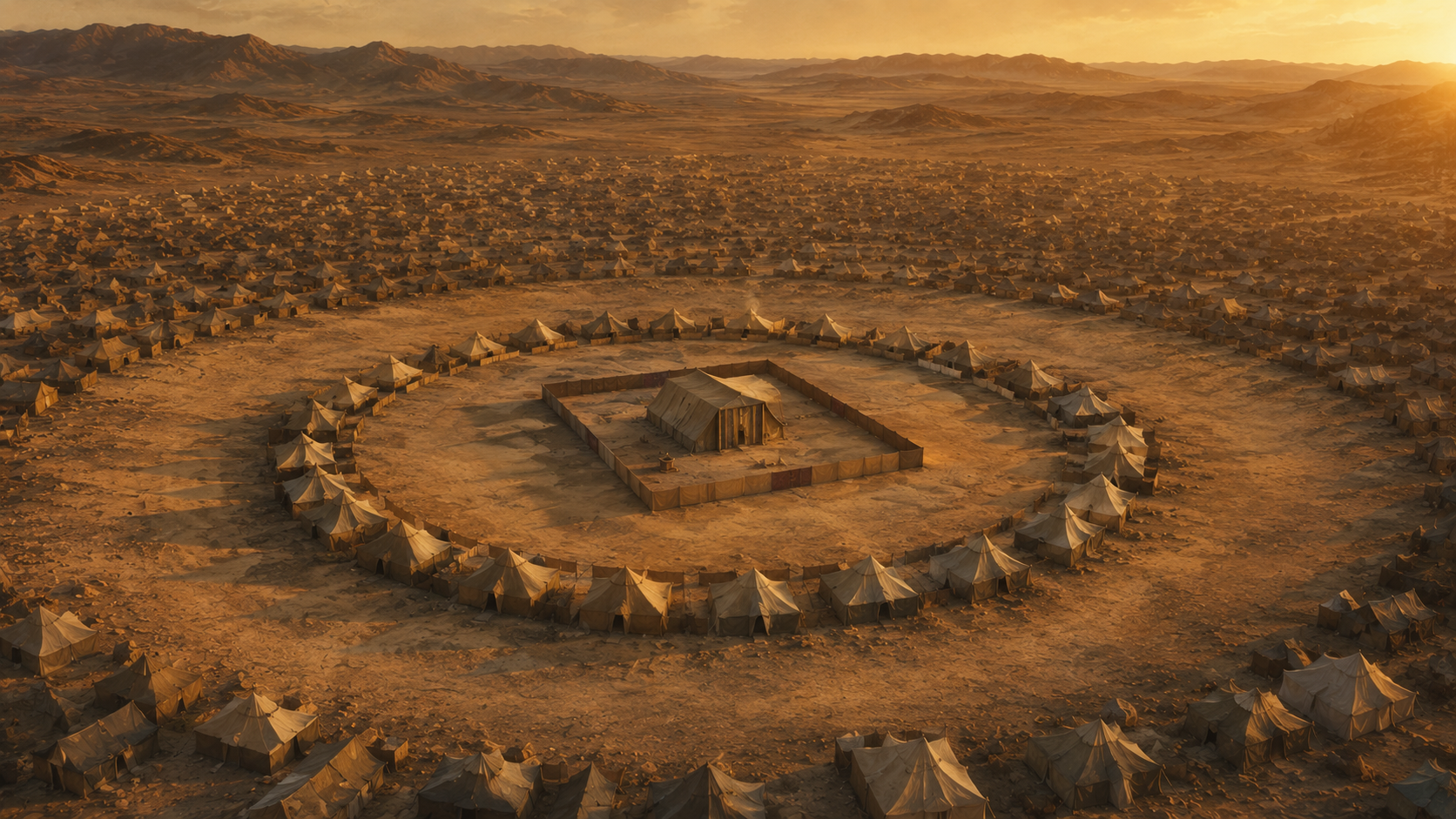
- The Levites… were not counted among them (v. 47). The military census stops at the tribe of Levi. The Levites are not mustered for war because they are assigned to a different service: the tabernacle. The chapter draws a line between the army of Israel and the servants of the dwelling. Levi’s exemption is not exclusion; it is a different vocation, spelled out in detail in chapter 3.
- They shall… encamp around it (v. 50). The Levites form a ring around the tabernacle. This is the first hint of the concentric arrangement that chapter 2 will lay out fully (see outside the camp). Holiness in the camp is graded by proximity, and the Levites are positioned as the innermost human ring, closest to the dwelling, between the holy things and the rest of the people.
- The stranger who comes near shall be put to death (v. 51). The Hebrew zar, “outsider” or “unauthorized person,” names anyone not assigned to the holy service who approaches the tabernacle. The warning is severe because the danger is real: the dwelling of a holy God in the middle of a camp is, in this book’s theology, the most dangerous arrangement imaginable (the lesson Nadab and Abihu paid for in Leviticus 10). The Levites’ encircling service is, in part, a protective cordon.
- That there may be no wrath on the congregation (v. 53). This is the verse that interprets the whole arrangement. The Levites encamp around the tabernacle so that wrath does not break out on the people. They are a buffer, a firebreak between the searing holiness at the center and the ordinary Israelites in the surrounding tribes. The geography is a theology: a holy presence at the center, a consecrated ring guarding the boundary, and a people kept safely near but not too near. The same logic will send the unclean outside the camp in chapter 5. Nearness to God is a gift that has to be carefully ordered, or it becomes lethal.
Influence callout: Tim Mackie (BibleProject; the dignity of the ordered camp)
Mackie reads the census-and-arrangement material not as filler but as a portrait of a people being formed into ordered, dignified life around God’s presence. The point of counting and naming and arranging is that Israel is becoming a structured community, no longer a fleeing mob of former slaves but a people with households, leaders, assignments, and a center. Mackie emphasizes that the center is the tabernacle: everything is organized by distance from the dwelling. The lists, in his reading, are the opposite of dehumanizing. They are the record of a God who knows each household and assigns each one a place in relation to himself. The later New Testament image of the church as a body with differing members and gifts, each with a place and a function around the one Lord (1 Corinthians 12; Ephesians 4), takes its deep logic from exactly this: a people ordered around a presence, each one named, each one placed.
Reflection prompts
- The census lifts the head of every person and records the name. Where in your own life or community do people get reduced to numbers or functions, and what would it look like to “lift the head,” to see and name each one?
- This mustered army never fights the war it was counted for; it refuses out of fear (chapter 14). Readiness and willingness turn out to be different things. Where are you organized and equipped for something you are, in fact, unwilling to actually do?
- The Levites encamp around the tabernacle so that wrath does not break out on the people. The arrangement treats nearness to God as both a gift and a danger to be handled with care. What has your own tradition done with the holiness of God, made it too safe, or made it too distant? What would a healthier sense of ordered nearness look like?
Frameworks at play in this chapter: the two generations, outside the camp, wilderness and liminality.