

If Genesis 1 was the cosmic temple inauguration (wide-angle, ordered, formal), Genesis 2 zooms in. Same God, same creation, but now we see it from the ground up. There’s a particular garden, a particular man, particular animals, a particular woman. The narrative voice changes too. Genesis 1 was liturgical, repeating, almost hymn-like. Genesis 2 is intimate, almost folkloric, the kind of story you’d tell sitting around a fire.
This isn’t a contradiction with chapter 1. It’s a complement. Two angles on the same thing. Where Genesis 1 told us what the cosmos is (a temple) and who humanity is (image-bearers commissioned to rule), Genesis 2 tells us how humans are formed and what we’re for at the level of daily life: vocation, relationship, and limits.
A · Genesis 2:4–7 · From cosmos to garden, dust and breath
⁴ These are the generations of the heavens and the earth when they were created. In the day that the Lord God made the earth and the heavens, ⁵ when no plant of the field was yet in the earth and no herb of the field had yet sprung up (for the Lord God had not caused it to rain upon the earth, and there was no one to till the ground, ⁶ but a stream would rise from the earth and water the whole face of the ground), ⁷ then the Lord God formed the man from the dust of the ground and breathed into his nostrils the breath of life, and the man became a living being.
(Genesis 2:4–7, NRSVue)
- Verse 4 introduces the divine name we’ll use through the rest of the Pentateuch: Yahweh Elohim (often rendered “the LORD God”). Where Genesis 1 used the more universal Elohim, the more intimate Yahweh now appears alongside it. The text is signaling that the cosmic God of chapter 1 has a personal name and a personal history with this people.
- The word for “man” here is adam, and the ground he’s formed from is adamah. There’s a pun built into the Hebrew: the earthling formed from the earth. We could translate it “the human from the humus.” Or, in Mackie’s elegant phrasing, ground-creature from the ground. The pun isn’t decoration; it’s theology. Humanity and earth are bound together at the level of substance.
Word study: adam / adamah (אָדָם / אֲדָמָה)
Adam is the Hebrew word for human. Adamah is the word for ground or soil. The two are linked etymologically: the human comes from and belongs to the earth. Genesis isn’t reporting on a single individual’s biology; it’s telling us what kind of creatures we are. We’re earth that breathes.
- Then the breath. Yahweh leans down and breathes into the earthling’s nostrils, and the earth-stuff becomes a living being, the Hebrew nephesh chayyah. NRSVue captures this well; older translations like WEB rendered it “living soul,” which imports later Greek philosophical categories the Hebrew doesn’t carry. Nephesh doesn’t mean a disembodied soul. It means a whole living creature. The animals will get the same designation a few verses later. Body and breath together, animated by God.
- Notice the contrast with Mesopotamia. In Atrahasis, humans are made from clay mixed with the blood of a slaughtered god, fashioned to be slaves doing the gods’ agricultural work because the gods are tired. Genesis says: humans are made from the same dirt the gods would have used, but God’s own breath gives them life, and they’re made not as servants of divine fatigue but as image-bearing partners. Same materials, completely different theology.
B · Genesis 2:8–14 · The garden in Eden, the four rivers
⁸ Yahweh God planted a garden eastward, in Eden, and there he put the man whom he had formed. ⁹ Out of the ground Yahweh God made every tree to grow that is pleasant to the sight, and good for food, including the tree of life in the middle of the garden and the tree of the knowledge of good and evil. ¹⁰ A river went out of Eden to water the garden; and from there it was parted, and became the source of four rivers. ¹¹ The name of the first is Pishon: it flows through the whole land of Havilah, where there is gold; ¹² and the gold of that land is good. There is aromatic resin and the onyx stone. ¹³ The name of the second river is Gihon. It is the same river that flows through the whole land of Cush. ¹⁴ The name of the third river is Hiddekel. This is the one which flows in front of Assyria. The fourth river is the Euphrates.
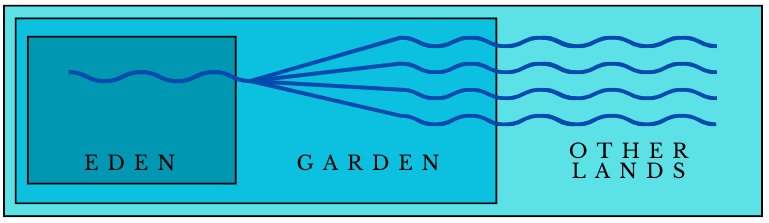
- Eden means “delight” or “pleasure.” It’s a place of abundance, life, and divine presence. The garden is in Eden, “eastward.” East, in Hebrew narrative, is the direction of beginnings, but it’s also the direction people go when they’re moving away from God’s presence. We’ll see that pattern repeat throughout Genesis.
- The garden is, on a careful reading, a temple. Several details point this direction. The single river that flows out of Eden and divides into four mirrors the hydrological imagery Ezekiel 47 and Revelation 22 use to describe the temple and the new creation. Adam is “put” in the garden (the verb nuach), the same verb used for placing the ark in the Holy of Holies. The cherubim that will guard Eden in chapter 3 also flank the ark in Exodus and stand sentry over the temple. And Adam’s vocational verbs in the next section, avad and shamar, are technical terms for priestly service. Eden is the original sanctuary.
- The four rivers anchor the garden in real geography. Two of them, the Tigris (Hiddekel) and Euphrates, locate the story in Mesopotamia, exactly the world the original audience knew. The other two are harder to place, but the larger point is that Eden isn’t a cartoon paradise floating somewhere outside reality. It’s positioned in the world the readers actually inhabited.
- Two trees stand out: the tree of life and the tree of the knowledge of good and evil. In ANE thought, eating from a sacred tree was a way of accessing divine power or wisdom. Genesis is using imagery the audience would have recognized, while doing something distinct with it. Both trees are given, not denied, but one comes with a limit.
C · Genesis 2:15–17 · Vocation and limits
¹⁵ The Lord God took the man and placed him in the garden of Eden to work it and watch over it. ¹⁶ And the Lord God commanded the man, “You are free to eat from any tree of the garden, ¹⁷ but you must not eat from the tree of the knowledge of good and evil, for on the day you eat from it, you will certainly die.”
(Genesis 2:15–17, CSB)
- “To work it and watch over it” (CSB) translates avad and shamar, and these are not generic gardening verbs. Avad is the same word used throughout the Pentateuch for priestly service in the Tabernacle. Shamar is the verb used for the Levites’ role of guarding the sanctuary. Adam isn’t just gardening. He’s serving and keeping a sanctuary.
Word study: avad and shamar (עָבַד / שָׁמַר)
Avad: to serve, to work, to worship. The same word is used for both slave labor (Egypt) and priestly service (Tabernacle). Shamar: to guard, to keep, to watch over. Used for the Levites’ duty to guard the sanctuary. When Adam is given these two verbs in Eden, the text is naming his role: priestly servant and keeper of God’s garden-temple.
Influence callout: John Walton (the garden as sanctuary)
Walton’s reading of Genesis 2 extends his cosmic-temple frame from chapter 1 down to the particular sanctuary at the chapter’s center. The garden of Eden, on Walton’s reading, is not a separate idyllic landscape; it is the inner sanctuary of the cosmic temple. Three features establish the reading. First, the verbs avad (to work, to serve) and shamar (to keep, to guard) are the same verb-pair used elsewhere in the Hebrew Bible for Levitical priestly service in the tabernacle (Num 3:7-8; 8:26; 18:5-7). Adam’s vocation in the garden is priestly. Second, the garden’s geography (a single source-river dividing into four named rivers covering the known world) follows the standard ANE temple-garden pattern: sacred space at the center, rivers flowing out to bless the wider land. Third, the cherubim that guard the eastern entrance after the expulsion (3:24) are the same cherubim that will later guard the ark and the inner sanctum of the tabernacle (Ex 25:18-22; 26:31). Walton’s pastoral note: the chapter is teaching that human vocation begins as priestly service in a sanctuary. The work Adam does in the garden is not modern wage labor; it is the priestly tending of God’s dwelling-place. The whole later biblical theology of worship as vocation and vocation as worship takes its first form here.
- The first thing humanity is given is vocation. Not commandment, not law, not penalty. Work. The garden was “good,” but the earthling was placed there to participate in it. We were made to do something with what God has made.
- Then the limit. “You may freely eat of every tree of the garden.” The default is yes. The default is generosity. There’s only one tree off-limits, and the prohibition is given alongside the explicit affirmation that everything else is open. This matters. The God of Genesis 2 is not stingy. He’s generous, and he’s drawn one specific line.
- What is “the tree of the knowledge of good and evil,” exactly? Several careful readings have been proposed. Knowing in Hebrew (yada) often means experiential or even intimate knowing, so this could be experiencing good and evil rather than acquiring intellectual awareness of them. “Good and evil” in Hebrew can also function as a merism for “everything,” like “north and south,” so it could mean knowing everything, or claiming the kind of moral autonomy that belongs to God alone. It may be both. The point isn’t ignorance for its own sake. It’s the insistence that defining good and evil is God’s prerogative, and humans are invited to trust his definition rather than seize it for themselves.
- “In the day that you eat of it, you will surely die.” A real warning, but notice that when Adam and Eve do eat, they don’t physically drop dead. Something else dies: their relationship with God in the garden, their innocence, their access to the tree of life. The death is real. It’s just bigger than physical mortality.
D · Genesis 2:18–20 · Ezer kenegdo and naming the animals
¹⁸ Then the Lord God said, “It is not good that the man should be alone; I will make him a helper as his partner.” ¹⁹ So out of the ground the Lord God formed every animal of the field and every bird of the air and brought them to the man to see what he would call them, and whatever the man called every living creature, that was its name. ²⁰ The man gave names to all cattle and to the birds of the air and to every animal of the field, but for the man there was not found a helper as his partner.
(Genesis 2:18–20, NRSVue)
- The first time anything in the creation account is called not good is right here: “It is not good for the man to be alone.” Genesis 1’s repeated tov, “functioning as intended,” gets one explicit exception. Solitude is dysfunctional. The creature made in God’s image is made for relationship.
- “Helper as his partner” is NRSVue’s rendering, and it captures something many older translations missed. The Hebrew is ezer kenegdo. Ezer is a word used elsewhere in scripture overwhelmingly of God himself. God is Israel’s ezer, their help, their strength. “I lift up my eyes to the hills; from where does my help (ezer) come?”, Psalm 121. Ezer is not a subordinate term. Kenegdo means “corresponding to” or “facing him,” like a counterpart, a match, an equal-and-opposite. Translating this as “helpmeet” or “helper” in a subordinate sense reads patriarchal hierarchy back into a text that doesn’t carry it. This matters. Generations of complementarian theology have built on the foundation of Eve-as-subordinate-helper, often grounded in this very verse. The Hebrew runs the other direction. The grammar of Genesis 2 is mutuality. Hierarchy enters the story in chapter 3 as a consequence of the rupture, and the text frames it as broken rather than ideal.
Word study: ezer kenegdo (עֵזֶר כְּנֶגְדּוֹ)
Often translated “a helper suitable for him.” Ezer means strong help, the kind God gives, not a junior assistant but a powerful corresponding partner. Kenegdo means corresponding to, opposite, matching. The phrase names a partner of equal weight, made for relationship, not subordination.
- Then a strange interlude: God brings the animals to be named. The text says God did this to see what the man would call them. Naming, in the ANE, was an act of authority and discernment, and the text is letting us watch the image-bearer exercise his vocational role. Genesis 1’s “dominion” gets concrete here. Adam isn’t dominating; he’s recognizing. He looks at each creature and gives it a name that fits.
- The climax of the naming process is what isn’t found: “for the man there was not found a helper suitable for him.” The animals are named, the cosmos is functioning, the garden is good, and yet there’s still a gap. Adam still isn’t whole. Genesis is being honest about a deep truth: human beings can have meaningful work, abundant resources, and a relationship with God, and still be incomplete without their counterparts. We are made for one another.
E · Genesis 2:21–25 · The woman, the man, naked and unashamed
²¹ Yahweh God caused a deep sleep to fall on the man, and he slept; and he took one of his ribs, and closed up the flesh in its place. ²² He made the rib, which Yahweh God had taken from the man, into a woman, and brought her to the man. ²³ The man said, “This is now bone of my bones, and flesh of my flesh. She will be called ‘woman,’ because she was taken out of Man.” ²⁴ Therefore a man will leave his father and his mother, and will join with his wife, and they will be one flesh. ²⁵ They were both naked, the man and his wife, and were not ashamed.
- The “rib” is a contested translation. The Hebrew word tsela most often means “side,” and it’s used for the side of the Tabernacle, the Holy of Holies, and the like. So this might be less “God removed a small bone” and more “God split the original earth-creature down its side and made two.” The point would be that man and woman are made of the same stuff. They are two halves of one whole. The text is staging a profound symmetry. There is also a New Testament resonance worth noticing. The Adam who falls into deep sleep and from whose opened side a bride is formed prefigures, in Christian typological reading, the second Adam who falls into the sleep of death and from whose pierced side (John 19:34) blood and water flow as the church is formed. The patristic tradition (Augustine, Chrysostom) developed this Adam-and-bride / Christ-and-church parallel at length. The chapter is laying down, in one sentence about a tsela, the bridal-from-the-side pattern that the gospel will eventually carry to the cross.
- Adam’s response is the first poetic line in the Bible:
“This is now bone of my bones, and flesh of my flesh. She shall be called woman (ishah) because she was taken out of man (ish).”
Note that until this moment, the earthling has been adam, the human, the ground-creature. Only when ishah (woman) appears does adam become ish (man). Sexual difference enters language at the same moment partnership becomes possible. They define each other.
→ Read the vocabulary of humanity framework for a fuller treatment of how ha-adam, ish, and ishah function across Genesis 1 to 3. The framework traces the Hebrew vocabulary the chapter has been quietly using all along: the earth creature first, the gendered pair together, neither one prior to the other in the language the text actually uses.
- “Therefore a man will leave his father and his mother, and will join with his wife, and they will be one flesh.” This is the etiology of marriage. The text is reading backward from human practice: the reason marriage exists, the reason a person leaves their family of origin and forms a new family, is because in some sense husband and wife are recovering the original unity of adam. They’re not two separate persons becoming a contract. They’re two halves remembering they belong together.
- “Naked and not ashamed.” Two words in Hebrew here will matter in chapter 3: arumim (naked) and, in the next verse, arum (cunning), used of the serpent. The sound is deliberate. The same root that means “naked” in 2:25 has a homophone that means “cunning” in 3:1. The text is preparing us. Vulnerability is about to meet exploitation.
Reflection prompts
- Adam’s first work is avad and shamar, to serve and to keep. What in your life are you tending as a sanctuary, even if no one calls it that? Where might you be doing priestly work without realizing it?
- The first thing called “not good” in scripture is the human being alone. Where in your life is solitude functioning as it should, as rest, focus, communion, and where has it slipped into the dysfunctional kind that needs a counterpart?
- Ezer kenegdo names a partner of equal weight, not a subordinate. Whom in your life do you know in this strong, mutual way? Where might you have flattened a partnership into a hierarchy?